

By Ben Emos | Monday January 26, 2026 | 4 min read
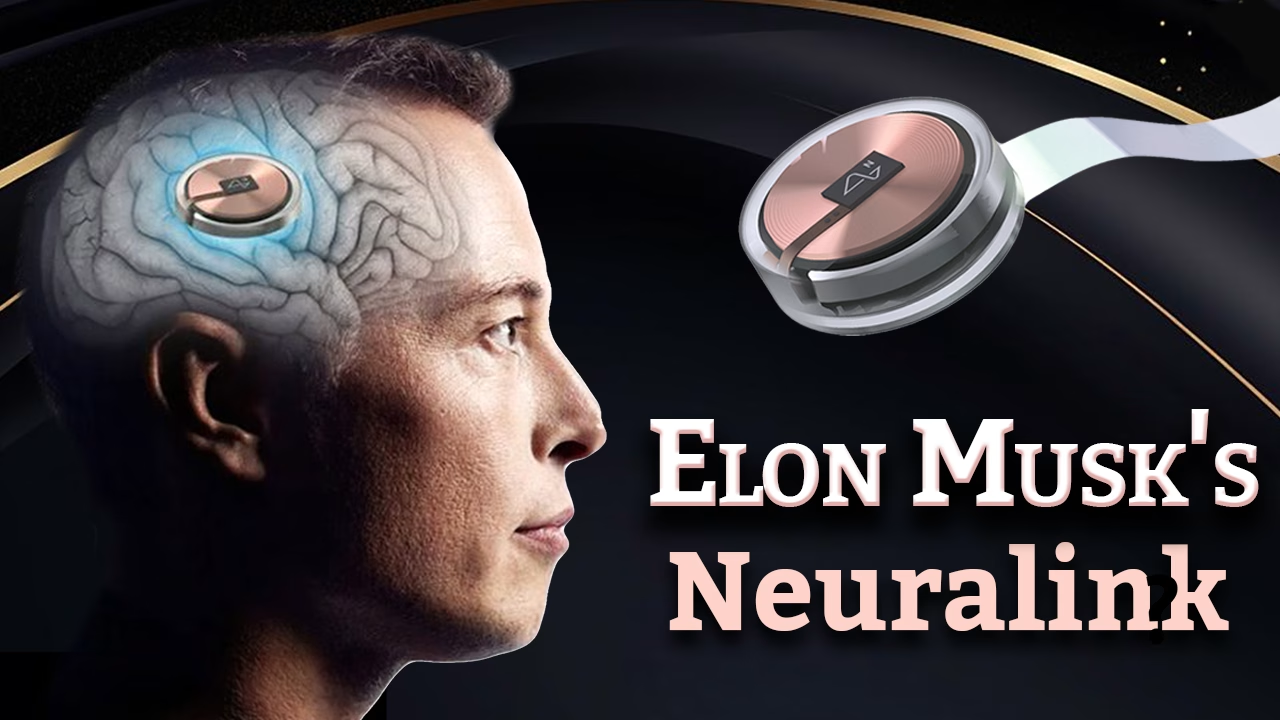
Neuralink has long existed in a space where bold scientific ambition meets Silicon Valley mythology. From the moment Elon Musk introduced the idea of a brain‑computer interface that could restore lost abilities or even merge human cognition with artificial intelligence, the company became a magnet for fascination. The presentations were sleek, the promises sweeping, and the public imagination easily captured. Yet behind the futuristic imagery, Neuralink’s journey has been far more complicated than its polished demos suggested.
The challenge the company set out to solve is one of the most difficult in modern science. Building a safe, reliable link between the human brain and a computer requires extraordinary precision and a deep respect for biological limits. It’s not the kind of problem that rewards speed or aggressive timelines. It demands patience, caution, and a willingness to accept that biology rarely cooperates with engineering schedules. Neuralink, however, approached the task with the ethos of a tech startup: move fast, iterate quickly, and treat obstacles as temporary bugs to be patched. That mindset created friction almost immediately.
When Neuralink announced its first human implant in early 2024, the moment was framed as a historic breakthrough. A patient paralyzed from the shoulders down demonstrated the ability to move a cursor using only neural activity. It was a remarkable achievement, and for a brief moment, it seemed to validate the company’s bold vision. But within weeks, engineers discovered that many of the implant’s ultra‑thin electrode threads were pulling away from the brain tissue they were meant to read. As those threads retracted, the quality of the neural signals deteriorated. Software adjustments helped recover some functionality, but the incident exposed a gap between the company’s confident public messaging and the fragile reality of its hardware.
Regulators had raised concerns about these risks long before the first human surgery. The U.S. Food and Drug Administration initially rejected Neuralink’s request to begin human trials, citing issues such as implant migration, overheating, battery safety, and the difficulty of removing the device without damaging brain tissue. These were not minor bureaucratic hurdles—they were fundamental safety questions. In medicine, a device that cannot be reliably controlled or safely removed is not simply flawed; it is dangerous.
Animal testing added another layer of scrutiny. Reports emerged alleging that monkeys and other test animals experienced severe complications or died during experiments. While animal research is standard in neuroscience, critics argued that Neuralink pushed too quickly, treating losses as an acceptable cost of speed. Federal investigations followed, along with complaints from medical ethics groups. Neuralink disputed the harshest allegations, but the perception stuck: the company was applying startup urgency to living brains.

Mein Kampf & Trump Now On AMAZON
What unsettled many scientists was not only the setbacks themselves but the way Neuralink communicated. Instead of publishing detailed, peer‑reviewed research, the company relied on staged demonstrations and Musk’s social‑media announcements. Sweeping claims about curing paralysis or restoring vision arrived long before robust data. In medical science, trust is built through transparency and independent verification. Neuralink tried to skip that step, and the scientific community noticed.
None of this means Neuralink’s work is without promise. Brain‑computer interfaces are real, and the field is advancing. Neuralink could still make meaningful contributions. But the company’s story highlights a deeper tension: the collision between Silicon Valley’s appetite for rapid innovation and the slow, methodical nature of medicine. Whether Neuralink ultimately succeeds may depend less on engineering breakthroughs and more on something the tech world rarely celebrates—patience.