
By Jane Lewis | Monday April 27 2026 | 5 min read
Following a security incident linked to the White House Correspondents’ Dinner, Donald Trump forcefully rejected accusations circulating in its aftermath, saying, “I’m not a rapist or pedophile,” as he responded to the growing controversy. His remarks came as attention intensified around an armed breach and writings authorities have attributed to the suspect.
The episode has unfolded against a broader shift in public discourse, where the lines between allegation, verified fact, and personal belief are increasingly hard to separate. In that environment, unresolved legal questions about the Epstein files, and acts of violence can end up folded into the same narrative stream—driven less by careful verification than by speed, emotional reaction, and relentless amplification.
That pattern is not new. But it has become more visible, and more consequential.
In 2016, an armed individual entered a Washington, D.C. pizzeria acting on the conspiracy theory. The claims were false, but the consequences were real.
Pizzagate became an early example of how information does not require truth to produce impact—it only requires circulation.
Since then, the information ecosystem has only accelerated. Social platforms reward engagement, not accuracy. Emotional narratives travel faster than corrections, and once a story enters the political bloodstream, it rarely exits cleanly.
In that environment, public figures, commentators, and influencers often become nodes in a larger amplification network. Even without coordinated intent, repetition and engagement can elevate incomplete or misleading claims into widely accepted “truths.”
Epstein, Allegations, and the Politics of Uncertainty
The Epstein case sits in a complicated corner of public debate. It spans years of investigations, court proceedings, and confirmed criminal activity tied to Jeffrey Epstein, along with a broader web of allegations and associations involving various public figures. Discussions around it often pull in names like Donald Trump, but the details and implications of those connections remain widely debated and not uniformly established.
At the same time, it is also surrounded by ongoing public debate over transparency, document disclosure, and institutional accountability. Claims that certain materials have been delayed, withheld, or insufficiently released are widely discussed, though interpretations vary significantly depending on legal and political framing.
What makes the topic particularly volatile is the way it blends confirmed legal history with unresolved allegations and political interpretation. In public discussion, those categories are often flattened into a single narrative—one where distinction between proven fact and accusation becomes increasingly difficult to maintain.
Recent incidents involving individuals leaving written statements or manifestos further illustrate this pattern.
In the case of Cole Allen, law enforcement sources have described writings attributed to him in connection with a security incident at the White House Correspondents’ Dinner. Those writings reportedly referenced grievances and alleged motivations, but remain part of an ongoing investigation and have not been independently validated as factual accounts.
Authorities say Allen allegedly attempted to breach a security checkpoint while armed before being stopped by law enforcement, prompting evacuation and cancellation of the event. The investigation remains active, and officials continue to treat the writings as evidentiary material rather than verified truth.
Trump’s CBS Interview and the Narrative Loop
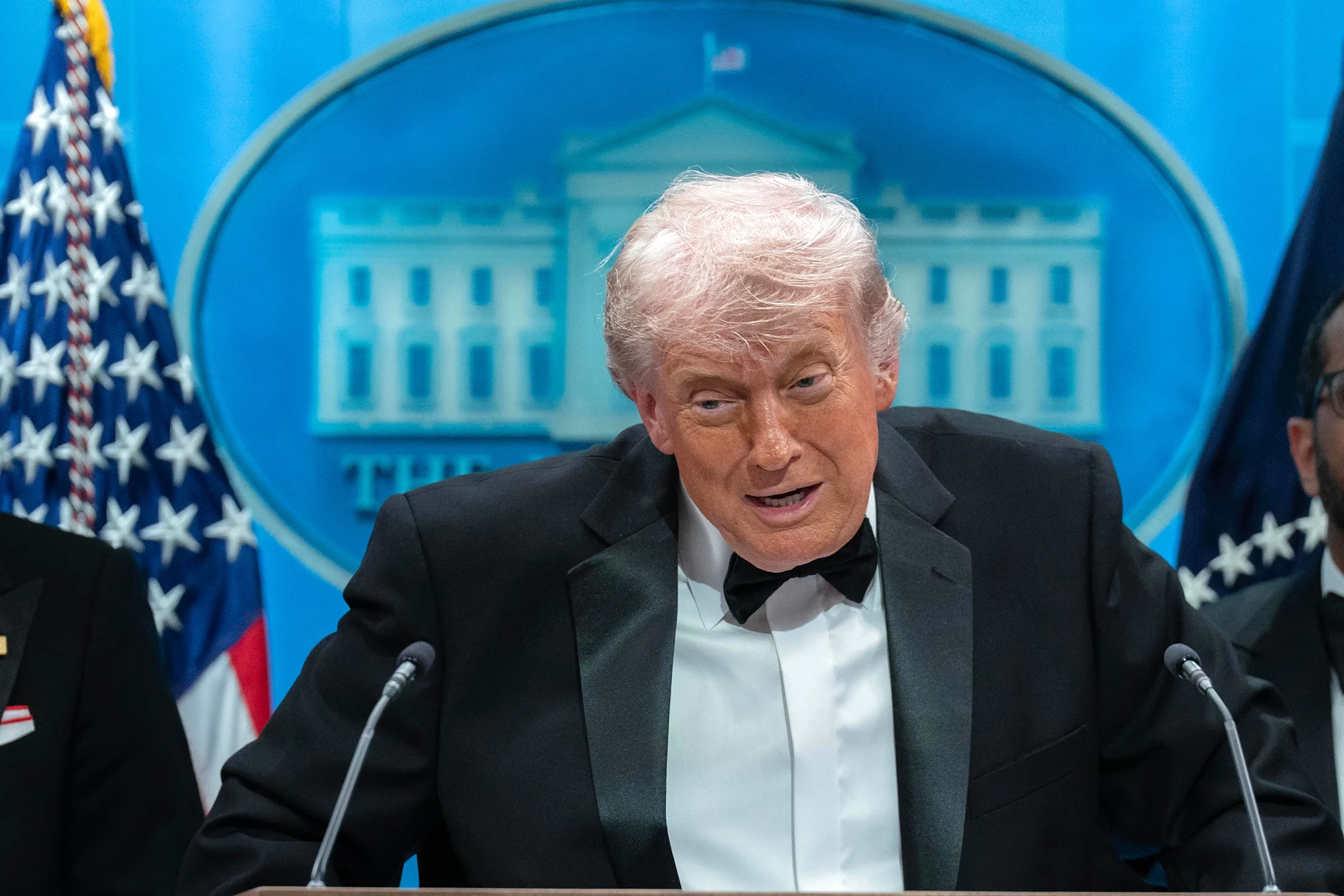
As public attention intensified, Donald Trump responded in a CBS interview, pushing back hard against how he was being portrayed in coverage of the controversy. During the exchange—recorded at the White House—CBS News anchor Norah O’Donnell read a line attributed to the suspect, Cole Allen, from what investigators describe as a manifesto: “I am no longer willing to permit a pedophile, rapist, and traitor to coat my hands with his crimes.”
Trump, who had been relatively measured up to that point, reacted sharply. “I’m not a rapist or pedophile,” he said, his tone shifting as he rejected the characterization outright.
His remarks were part of a broader pattern in which public response becomes entangled with ongoing interpretation. In fast-moving media cycles, statements made in defense or rebuttal are often absorbed immediately into the same ecosystem that generated the initial controversy.
During that interview, Trump lashed out at Norah O’Donnell after she read excerpts from the manifesto, a move that cut through his framing of the incident. By introducing the suspect’s own words, the exchange shifted away from Trump’s narrative, undercutting his attempt to either spin or shape the story around a shooting that occurred far from his direct involvement.
Some legal analysts say disputes over access to records tied to the Jeffrey Epstein case could eventually end up in court, where judges—not the Justice Department alone—decide what gets released. There’s no confirmed link between those issues and Trump’s reaction in the CBS interview, though the broader controversy has clearly heightened tensions around the coverage.

Mein Kampf & Trump — Available on Amazon
As a result, response and narrative become indistinguishable before facts are fully established.
Across these cases—Pizzagate, Epstein-related discourse, manifesto-driven incidents, and political response cycles—the same structural problem repeats.
False stories like Pizzagate show that something doesn’t have to be true to shape how people act. At the same time, allegations tied to the Jeffrey Epstein case continue to influence public perception even as many questions remain unresolved. In today’s fast-moving media cycle, interpretation tends to come first, while verification struggles to catch up.
What happens next may depend less on speculation and more on legal process—particularly whether courts ultimately compel broader access to Epstein-related records, bringing more clarity to a debate that has long been defined by uncertainty.
Critics Call Kash Patel a “Useful Idiot” as Donald Trump Refuses to Fire Him
Jesus vs. Donald Trump: Comparing Legacy and Impact After Jesus-Like Image Controversy
Hungary’s Turning Point: Voters Reject Viktor Orbán—and the Trump–Putin Axis of Evil
Melania Trump’s Surprise Speech Ignites Epstein Firestorm and Raises New Questions