
By Don Terry | Friday, April 17, 2026 | 5 min read
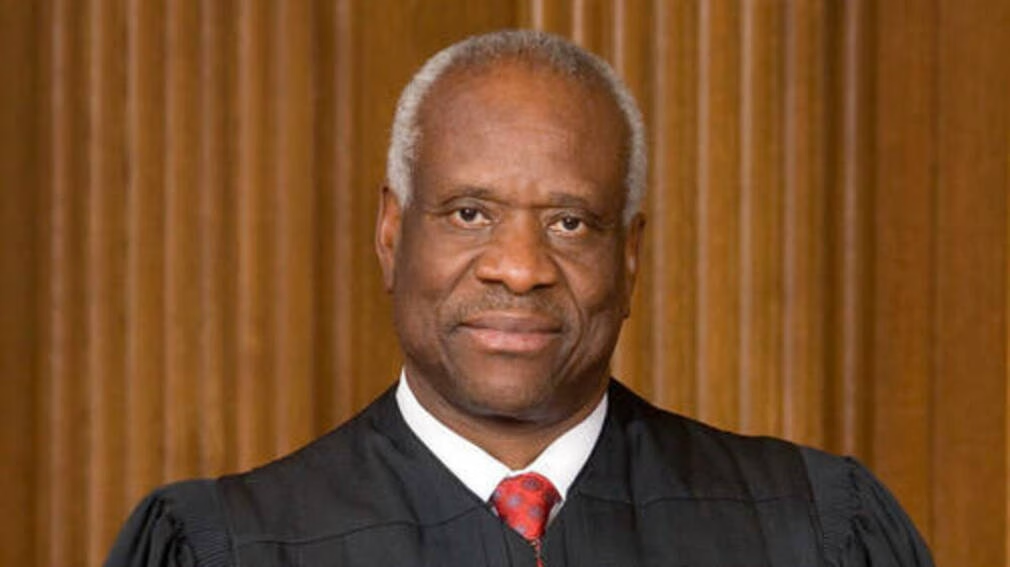
In a recent televised address, Supreme Court Justice Clarence Thomas delivered a sharp critique of progressivism, describing it as a direct challenge to the foundations of the United States. Speaking at the University of Texas at Austin Law School ahead of the country’s 250th anniversary, Thomas argued that modern progressive thought seeks to move the nation away from the principles outlined in the Declaration of Independence.
“Progressivism seeks to replace the basic premises of the Declaration of Independence and hence our form of government,” Thomas said. He also warned that a growing sense of “cynicism, rejection, hostility and animus” toward the country has taken hold among Americans themselves, framing it as a cultural and political shift that could reshape the nation’s future.
His remarks, broadcast on C-SPAN, quickly sparked debate—not just about ideology, but about Thomas himself and the broader issue of credibility on the Supreme Court.
For critics, Thomas’s warning about moral and political decay rings hollow. They argue that before condemning others, public figures—especially those in positions of lifelong authority—should be held to the highest ethical standards. Some have drawn on a familiar biblical idea: it’s difficult to call out flaws in others while ignoring larger issues closer to home.
That criticism has intensified in recent years, largely due to revelations about Thomas’s relationship with billionaire donor Harlan Crow. Investigative reporting by ProPublica found that over the course of two decades, Thomas accepted luxury trips, private jet travel, yacht vacations, and real estate transactions linked to Crow—many of which were not disclosed in financial filings.
These disclosures raised serious questions about transparency and accountability. Federal ethics laws, strengthened after Watergate scandal, require public officials to report significant gifts. Initially, Thomas responded by saying he had been advised that certain forms of “personal hospitality” from friends did not need to be disclosed. However, as more details emerged, some of those trips were later added through amended filings.
The controversy doesn’t end there. Reports have also noted Thomas’s attendance at exclusive gatherings like Bohemian Grove, where influential political and business figures meet behind closed doors. He has also spoken at events tied to wealthy donor networks, raising further concerns about the appearance of political alignment or influence.
Legal experts often point out a key issue: unlike lower federal judges, Supreme Court justices are not bound by a strict, enforceable ethics code. That gap has fueled calls for reform, with watchdog groups arguing that the highest court in the country should be held to at least the same—if not higher—standards as other judges.
The situation has drawn comparisons to past scandals, including the 1969 resignation of Abe Fortas over financial ties to a donor. For some observers, the scale and duration of the current controversy could make it one of the most significant ethical debates surrounding the Court in decades.
Additional scrutiny has also fallen on Thomas’s wife, Ginni Thomas, particularly for her political activities surrounding the 2020 election. Critics argue that her involvement in efforts tied to that period raises further questions about impartiality, especially when cases connected to those events reached the Court.

Mein Kampf & Trump — Available on Amazon
Taken together, these issues have contributed to a broader erosion of public trust. Polls in recent years have shown declining confidence in the Supreme Court, a trend many analysts link to concerns about partisanship, transparency, and the influence of money in politics.
At the heart of the debate is a deeper question: who holds power, and how is it exercised? Thomas’s speech framed progressivism as a threat to America’s founding ideals. His critics, however, see a different danger—one rooted in the growing influence of wealth and personal connections at the highest levels of government.
Whether one agrees with Thomas’s warnings or not, the controversy surrounding him underscores a larger issue facing the country. As institutions shape the direction of American life, the demand for accountability, fairness, and integrity continues to grow. For many, the credibility of those institutions depends on it.
Jesus vs. Donald Trump: Comparing Legacy and Impact After Jesus-Like Image Controversy
Hungary’s Turning Point: Voters Reject Viktor Orbán—and the Trump–Putin Axis of Evil
War, Distraction, and Fallout: Inside the Crisis Shadowing Trump’s Presidency
Melania Trump’s Surprise Speech Ignites Epstein Firestorm and Raises New Questions