
By Don Terry | Monday May 25 2026 | 6 min read
There’s something unsettling about watching history fade in real time—especially when it’s the DOJ at the center of it. Not argued over. Not reexamined. Not even openly challenged. Just… quietly removed.
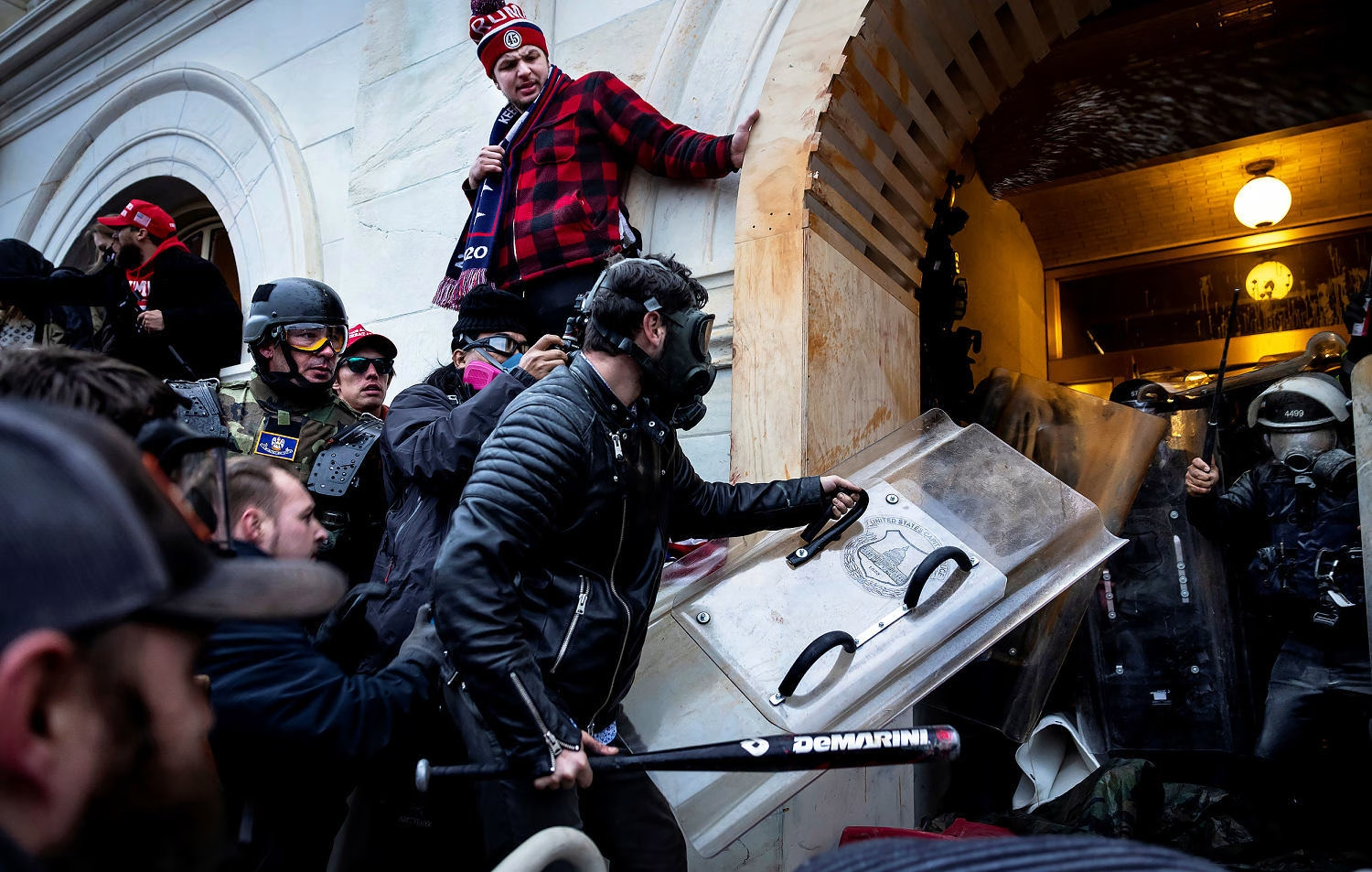
The Department of Justice has admitted it took down webpages detailing charges, convictions, and case records tied to the January 6 attack on the U.S. Capitol. For years, those pages served as a public record—a living timeline of what happened, who was involved, and how the justice system responded.
And the explanation? That it’s all part of undoing “political weaponization.”
That word—weaponization—has become a convenient shield. It reframes accountability as persecution, documentation as propaganda. But when official records begin to vanish under that banner, it raises a far more serious question: who gets to decide what counts as truth?
The move didn’t go unnoticed. When journalist Meryl Kornfield pointed out that information was being deleted, the DOJ’s own Rapid Response account didn’t deny it. Instead, it leaned in—saying there was “nothing quiet about it” and framing the purge as something to be proud of.
Proud of what, exactly?
Because what’s being removed isn’t opinion pieces or political commentary. These were records—real cases, real charges, real people. Among them, according to Kornfield, was a release about a man who allegedly brought bear spray to the Capitol and is also facing a separate child solicitation case. That information mattered. Not because it fit a narrative, but because it painted a fuller picture of who showed up that day and why.
Some of those pages survive only because they were captured by the Internet Archive. Think about that for a second. The historical record of a major event in American history is now being preserved not by the government itself, but by digital archivists racing to save fragments before they disappear.
What does that say about institutional memory?
A search of DOJ archives still turns up a handful of January 6–related releases—guilty pleas from members of extremist groups, early federal charges, statements from officials in the immediate aftermath. But the pattern is hard to ignore. Searches for terms like “Capitol breach” return only a scattering of results. And more tellingly, nothing appears in press releases after January 20, 2025.
It’s as if the clock just stopped.
This isn’t just about politics. It’s about continuity—about whether the story of what happened on January 6 remains intact or becomes fragmented, selective, easier to reinterpret depending on who’s in power.
Because that’s the real danger here. Not that people disagree about January 6. Disagreement is part of democracy. The danger is when the underlying record itself starts to shift. When facts become harder to find. When the baseline disappears.
We’ve seen something like this before, in smaller ways—documents relocated, reports delayed, language softened. But this feels different. More direct. More deliberate.
And it comes against a backdrop that makes the situation even more uncomfortable. A political environment already shaped by battles over classified documents, transparency, and accountability is now facing something new: the quiet subtraction of information from public view.
You don’t have to be a legal expert to understand why that matters. You just have to ask a simple question:
If the record is clean, why erase it?
Institutions like the DOJ aren’t supposed to have short memories. They exist, in part, to preserve the continuity of law and fact across administrations, across political swings, across time itself. When that continuity breaks—even a little—it chips away at trust.

Mein Kampf & Trump — Available on Amazon
And once trust is gone, it’s very hard to rebuild.
So what’s left of January 6 history?
Some archived pages. Some court records. News reports. Personal accounts. Fragments.
But the official narrative—the one maintained by the very agency tasked with enforcing the law—now has gaps.
And gaps, in history, don’t stay empty for long. They get filled. Reinterpreted. Rewritten.
Maybe that’s the point.
Or maybe it’s just another decision made in the moment, without fully reckoning with its consequences.
Either way, the question lingers: Who do they think they’re fooling?
#doj #DOJ #Trump #doj #trump #politics #doj
Trump’s $1.8 Billion DOJ Fund Looks Less Like Justice—and More Like Appeasement
Trading the Presidency: Did Trump’s Stock Buys Suspiciously Track His Presidential Actions?
Tesla Spins FSD Setback: Drops Autopilot in Netherlands, Cancels Denmark Purchase
How Democrats Could Win Despite GOP Gerrymandering and Trump’s Unpopularity