

By Don Terry | Tuesday June 23 2026 | 4 min read
It won’t sound like an exaggeration to anyone paying attention: there are days when it feels as if a quiet, unofficial Department of Truth Social exists somewhere inside the Justice Department — a reflexive machinery that springs into action whenever Donald Trump names, mocks, or vilifies someone online. Public records show a pattern: individuals, institutions, even companies singled out on his feed often find themselves under sudden scrutiny. The list is long, too long to recite, and it grows every time Trump opens his app.
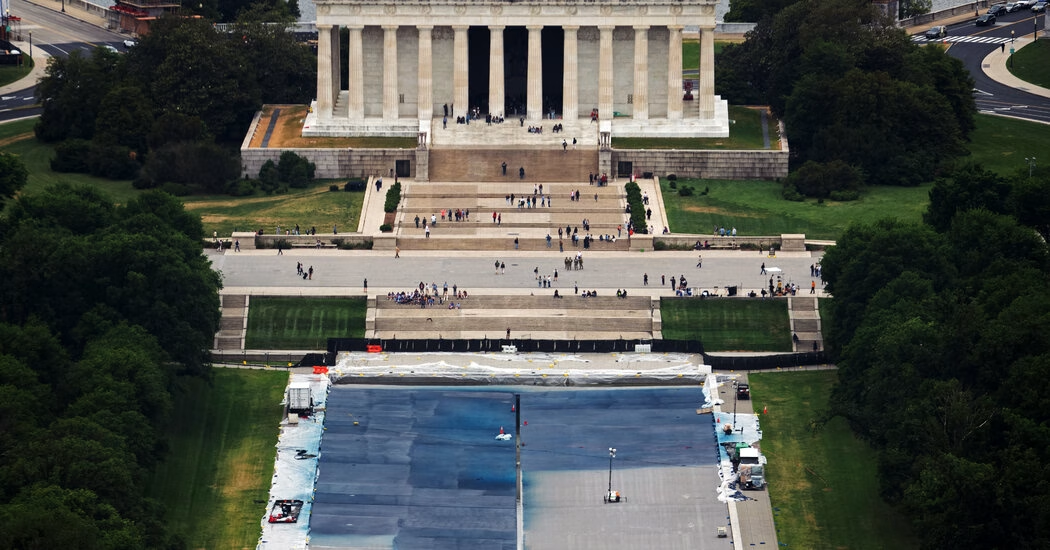
The latest chapter in this pattern arrived wrapped in blue rubber and algae. Trump’s troubled reflecting pool project — once pitched as a gleaming, indestructible showpiece — has become a case study in how a narrative can be bent, weaponized, and enforced. What began as a construction fiasco has now morphed into something darker: accusations without evidence, arrests without clarity, and a government apparatus seemingly eager to validate a story that keeps shifting.
It started, as these things often do, with a boast. Trump promised a pool lining that would last half a century. “You couldn’t cut it with a knife,” he said. “So strong. So powerful. Sealed.” But the coating didn’t last fifty years. It didn’t last a week. Within days, the surface began peeling, bubbling, and floating to the top like discarded tarp. The water turned cloudy. Algae bloomed. The “powerful rubber” looked more like truck‑bed liner sprayed on in a hurry.
Then came the pivot. Instead of admitting the project had been mishandled — or that the no‑bid contract he’d pushed through, awarded to a company tied to one of his donors, might have played a role — Trump reached for a different explanation: sabotage. “We had vandalism,” he declared. “A 300‑foot slit right through it.”
When reporters asked how anyone could have slipped past the National Guard units stationed around the Mall, he brushed it off with a shrug. “Who would think somebody would go into a pool and start cutting it?”
It was a familiar move: shift the blame, float a dramatic theory, and let the accusation hang in the air long enough for it to become part of the story.
From there, the story accelerated. Trump accused ABC reporter Jonathan Karl of ripping up the lining — a claim Karl’s footage directly contradicted. Yet the accusation spread, repeated by allies and amplified by officials who should have known better. Trump‑appointed U.S. Attorney Jeanine Pirro warned that anyone accused of tampering could face prosecution “to the full extent.” The implication was unmistakable: the problem wasn’t the project. The problem was the people noticing it.

Mein Kampf & Trump — Available on Amazon
By Saturday, the reflecting pool looked less like a public space and more like a crime scene. National Guard troops, federal officers, and park police swarmed the area. Five people were arrested. Five more received federal citations. Among them: David Carter Hearn, a 67‑year‑old former Olympic canoe racer who said he touched a loose piece of lining out of curiosity. He was detained for five hours.
“I’m a curious citizen,” Hearn said. “It was very rubbery.”
The administration had only recently insisted the water was “crystal clear” and the coating “shining brightly.” Now, with the failure impossible to hide, the narrative hardened: blame outsiders, blame saboteurs, blame anyone except the people who ordered, approved, and rushed the project.
For critics, the episode feels familiar. A project falters. Evidence piles up. Instead of accountability, there’s a search for culprits. Whether it’s elections, investigations, or — now — a collapsing reflecting pool, the pattern repeats: deny, deflect, and deploy the machinery of government to reinforce the preferred story.
The reflecting pool was sold as a tribute to strength and longevity. Instead, it’s become a mirror — not for the Mall, but for the style of governance behind it: chaotic, accusatory, and always ready to weaponize a narrative. And it all started before the first coat was even applied, when Trump handed out a no‑bid contract to paint the pool blue.
Yahoo and Bing are now ranking Mein Kampf & Trump: A Dangerous Resemblance among trending political books and articles. What’s fueling the attention? Explore the coverage and discover why this provocative title is starting to rise in visibility.
Trump Wanted to Walk Off With a $400 Million U.S. Aircraft — And Claims Qatar Said He Could
Haberman and Swan’s Regime Change Revives Debate Over Trump’s View of Power
SpaceX Crosses $200 Milestone, Then Stumbles: What’s Behind the Investor Jitters?
Trump’s Iran Deal Faces Criticism as Questions Mount Over the Outcome of the Conflict