
By Andrew James | Tuesday July 21 2026 | 5 min read
The ethics fight surrounding FIFA President Gianni Infantino has entered a new and volatile phase, and this time the blast radius extends far beyond Zurich. A prominent human‑rights group, FairSquare, says it will file a formal complaint with the International Olympic Committee, alleging Infantino repeatedly violated political‑neutrality rules through his public support for U.S. President Donald Trump. If the IOC accepts the complaint, Infantino — an IOC member since 2020 — could face an investigation that drags global sport deeper into a political storm it has tried for years to avoid.
FairSquare’s move marks an escalation in a dispute that has simmered for months. The group already filed a complaint with FIFA’s Ethics Committee in December 2025, accusing Infantino of openly aligning himself with Trump’s actions and policies. But FIFA’s response, according to FairSquare, has been silence — or something close to it. The organization says FIFA acknowledged receiving the complaint but has given “no indication” that any investigation has begun. In a letter reviewed by Fedlannews, FIFA said its secretariat may initiate preliminary inquiries, but only if instructed by the chair of the Investigatory Chamber. Filing a complaint, FIFA reminded FairSquare, does not guarantee proceedings will be opened, nor does it entitle complainants to updates.
That opacity is part of what pushed FairSquare toward the IOC. Their new complaint argues Infantino breached Article 15 of the FIFA Code of Ethics, which requires officials to remain politically neutral in their official roles. Violations can carry fines of at least 10,000 Swiss francs and bans of up to two years from football‑related activity. But FairSquare’s argument goes further: they say Infantino’s conduct wasn’t just a lapse — it may have been an abuse of power.
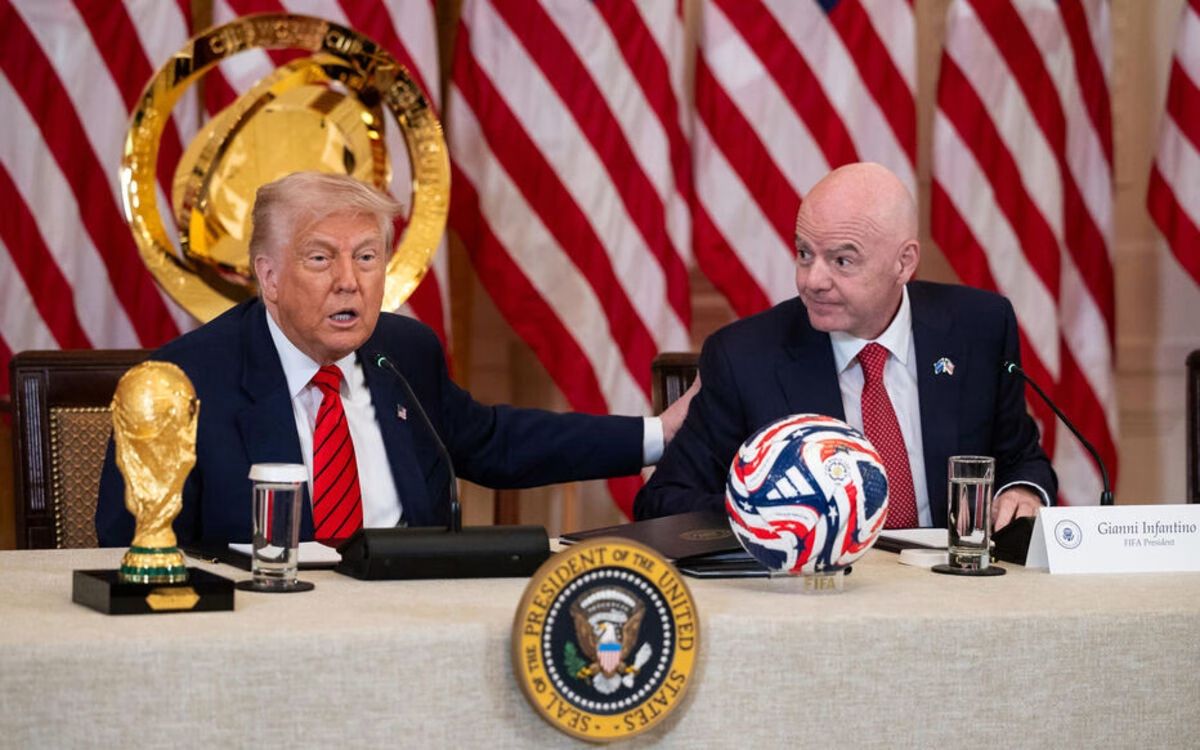
Central to their claim is the creation of the FIFA Peace Prize, a new award introduced shortly before the World Cup draw. FairSquare wants investigators to determine whether the decision to create the prize — and then award it to Trump — was approved by the FIFA Council or pushed through unilaterally by Infantino. If Infantino acted alone, the group says, it should be considered “an egregious abuse of power.”
The stakes are high because the Peace Prize wasn’t a symbolic gesture tucked into a quiet ceremony. It was unveiled on one of FIFA’s biggest stages, with Trump receiving the inaugural award in front of global media. FairSquare argues that the optics were unmistakable: a supposedly neutral sports body elevating a political leader in a way that blurred — or erased — the line between governance and political endorsement.
IOC President Kirsty Coventry said Tuesday that no complaint had yet been received, but added that if one arrives, the ethics commission “would look into it.” Her comment was measured, but it signaled something important: the IOC is not dismissing the possibility of investigating one of its own.
FairSquare’s campaign is gaining political traction. Last week, the group announced that 50 Members of the European Parliament had written to FIFA’s Ethics Committee supporting the complaint. The Norwegian Football Federation also formally backed the effort, asking FIFA to assess whether Infantino violated statutes on political neutrality through the Peace Prize and related actions.
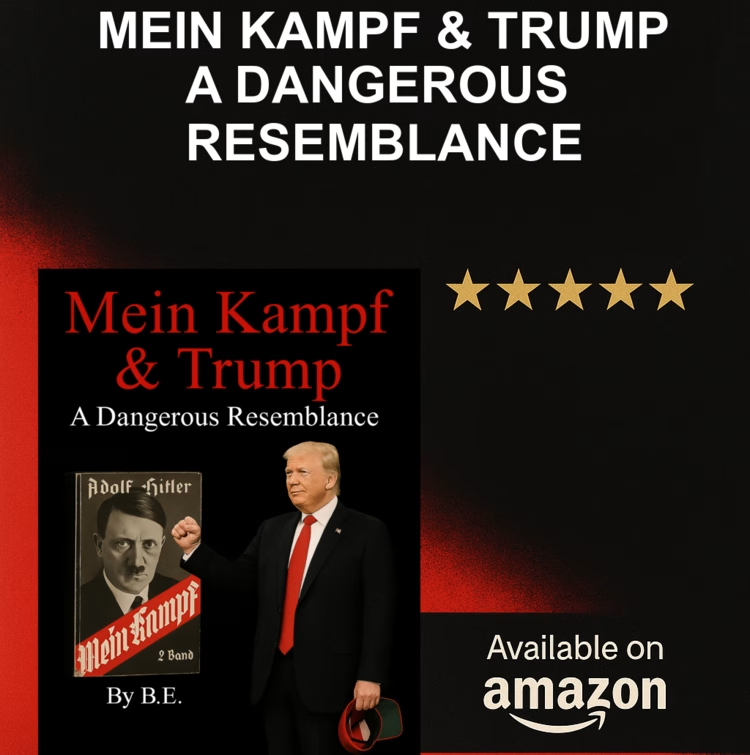
Mein Kampf & Trump — Available on Amazon
And then there is the Balogun incident — a moment that, for critics, crystallized the problem. During the World Cup, American striker Folarin Balogun had been suspended after a red card. Trump personally urged Infantino to review the case. Shortly afterward, FIFA cleared Balogun to play in the last‑16 match against Belgium. The U.S. lost 4–1, but the decision raised eyebrows across Europe. Infantino denied involvement in the final ruling, yet the timing fed the perception that political influence had seeped into disciplinary decisions.
FairSquare’s broader campaign, titled “Reboot,” launched just a week before the World Cup. Its message is blunt: FIFA’s governance system is broken, and neutrality rules mean nothing if the president can publicly champion a political leader without consequence.
The complaint to the IOC is not guaranteed to trigger an investigation. But it signals a shift — a willingness to take the fight beyond FIFA’s walls, into an arena where Infantino has less control and where political neutrality is treated as a foundational principle, not a flexible guideline.
If the IOC accepts the complaint, Infantino could face scrutiny from an institution that has historically been more willing than FIFA to discipline its own members. If it doesn’t, the pressure campaign will likely intensify, fueled by lawmakers, federations, and watchdogs who say global sport cannot afford to look the other way.
Supreme Court Justice Jackson Obliterates Clarence Thomas Over His Stunning Dissent
When Satire Becomes Reality: Supreme Court Justice Clarence Thomas and the Clayton Bigsby Paradox
R.A.G.E. in 2028: Why Democrats May Turn to Jack Smith or Jon Ossoff to Reset American Politics
Jon Ossoff Declares ‘Day of R.A.G.E.,’ Warns Corruption Is Becoming America’s Defining Crisis