
By Ben Emos | Wednesday July 15 2026 | 5 min read
SpaceX has spent the last decade building a reputation as the most disruptive force in American aerospace. It launches more rockets than any nation on Earth, controls the world’s largest satellite constellation, and has become a critical backbone for U.S. military communications. But beneath the triumphs and the mythology surrounding Elon Musk, there’s a structural truth investors often ignore: SpaceX’s financial future is inseparable from U.S. government policy. One shift in Washington—one budget change, one regulatory freeze, one political realignment—could send its valuation into a tailspin and complicate any future IPO.
SpaceX’s relationship with the federal government isn’t casual. It’s foundational. NASA relies on SpaceX for crewed missions to the ISS. The Pentagon depends on Starlink for battlefield connectivity. The Space Force uses Falcon 9 and Falcon Heavy for national‑security launches. These contracts aren’t just revenue streams; they shape the company’s entire technological roadmap. When NASA funds a lunar lander, SpaceX builds Starship around that mission profile. When the Pentagon needs rapid‑launch capability, SpaceX adjusts its cadence and infrastructure to meet those demands.
In other words, SpaceX’s innovation is not happening in a vacuum—it’s happening inside the gravitational pull of U.S. policy.
That’s why any political shift in Washington matters. A new administration could tighten FAA oversight, slow Starship testing, or redirect NASA’s priorities. A change in defense strategy could reduce reliance on commercial launch providers or shift procurement toward legacy contractors. Even subtle regulatory changes—environmental reviews, licensing delays, spectrum rules—can ripple through SpaceX’s operations and valuation.
Investors understand this. Analysts understand this. And anyone paying attention to SpaceX’s valuation knows that government stability is baked into every dollar of the company’s worth. The political environment isn’t background noise — it’s a structural risk. Even the possibility of a future investigation into Donald Trump that uncovers money‑laundering or fraudulent financial ties involving Musk could send shockwaves through Washington and trigger consequences that hit SpaceX directly.
Risks Related to Space Exploration Technologies Corp. Business
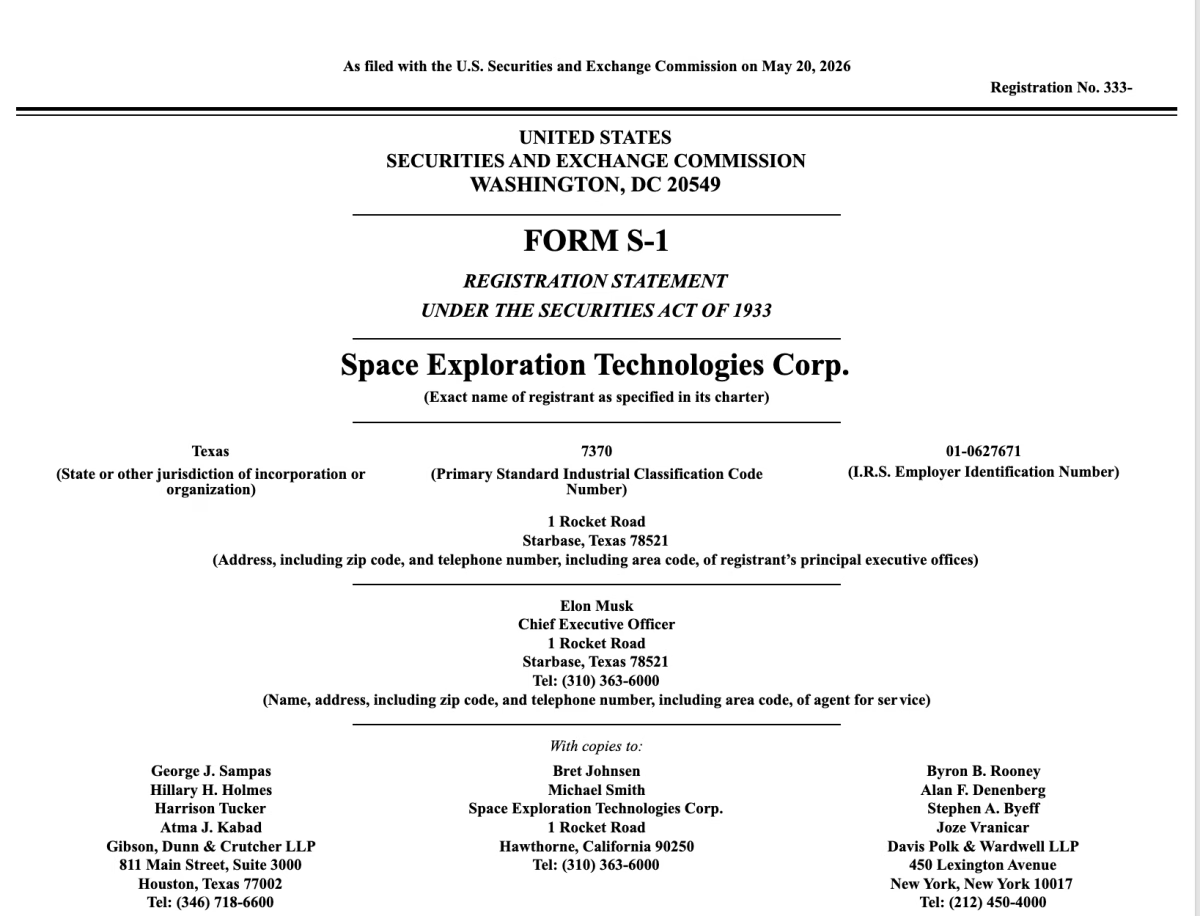
SpaceX doesn’t hide the fact that it sits on a fault line. The company openly acknowledges that a large share of its revenue depends on U.S. government contracts — the kind that live and die by competitive bidding, political approval, and the chaos of federal budget cycles. These aren’t guaranteed streams of income; they’re moving targets. A contract can be delayed, rewritten, downsized, or canceled outright with little warning. Federal agencies have sweeping authority to terminate programs “for convenience,” add new regulatory hurdles, or shift mission priorities overnight.
Any one of those changes can hit SpaceX where it hurts: revenue, launch cadence, long‑term planning, and investor confidence. The company also notes that navigating federal procurement rules is a heavy lift, and losing even a single major contract could materially weaken its financial position and future prospects. In short, SpaceX’s success is tied not just to engineering breakthroughs, but to the stability and decisions of the U.S. government — a dependency the company itself recognizes.
But as the mid‑term elections approach, there’s a new layer of volatility: Elon Musk’s political footprint. Musk has become one of the most polarizing figures in American public life, not just because of his companies, but because of his political spending, public endorsements, and the way he uses his platforms to shape narratives. Democrats argue that Musk’s growing influence—financial, technological, and cultural—has become a force Republicans are eager to harness. Some critics warn that his spending and political activism could tilt the playing field in ways that undermine democratic norms or distort the electoral landscape.

Mein Kampf & Trump — Available on Amazon
Whether one agrees with that assessment or not, the political reality is unavoidable: SpaceX’s fortunes rise and fall in a political environment Musk himself is actively reshaping. That creates a feedback loop investors cannot ignore. If Musk’s political activity triggers backlash from regulators or lawmakers, SpaceX could find itself facing tighter oversight, slower approvals, or reduced contract opportunities. If his alliances shift the balance of power in Washington, SpaceX could benefit—or it could become a lightning rod.
This is the uncomfortable truth: SpaceX is not just a tech company. It is a national‑security contractor whose value depends on political stability, regulatory predictability, and government trust. When the CEO becomes a political actor, the company inherits his political risks.
As the election season intensifies, Democrats will argue that Musk’s political spending deserves scrutiny. Republicans will argue he’s simply exercising influence like any major industrial leader. But investors should be clear‑eyed: SpaceX’s valuation is not insulated from politics. It is defined by it. And any future will be priced not just on rockets and satellites, but on Washington’s mood.
Justice Jackson Obliterates Clarence Thomas Over His Stunning Dissent
When Satire Becomes Reality: Justice Thomas and the Clayton Bigsby Paradox
R.A.G.E. in 2028: Why Democrats May Turn to Jack Smith or Jon Ossoff to Reset American Politics
Jon Ossoff Declares ‘Day of R.A.G.E.,’ Warns Corruption Is Becoming America’s Defining Crisis