
By Don Terry | Friday July 03 2026 | 8 min read
For generations, Americans have been taught that no one—not even the president—is above the Constitution. Every president takes the same oath: to preserve, protect, and defend the Constitution of the United States. That promise is more than ceremonial. It is the foundation of a system designed to prevent any single branch of government from accumulating unchecked power.
Yet one of the defining constitutional debates of Donald Trump’s second presidency centers on a simple but unsettling question: What does it mean to defend the Constitution if the executive branch acts as though it can rewrite or ignore it?
That question has become increasingly urgent as President Trump has relied heavily on executive authority, issuing more than 150 executive orders during the opening months of his second term. Many of those orders invoke Article II of the Constitution as justification for broad presidential action. Critics argue that this interpretation transforms Article II from a limitation on executive authority into a claim of near-unlimited presidential power.
But constitutional scholars have long maintained that Article II was never intended to grant unlimited authority. The Constitution establishes a government of separated powers, with Congress writing laws, the president enforcing them, and the courts interpreting them. Each branch exists to restrain the others.
The Constitution does not authorize a president to rewrite federal statutes passed by Congress. It does not permit executive orders to override Supreme Court precedent. Nor does it allow constitutional protections to disappear with the stroke of a presidential pen.
Those principles have become the focus of an extraordinary wave of litigation.
With Congress deeply divided and Republicans largely united behind Trump’s agenda, much of the responsibility for reviewing executive actions has shifted to the federal judiciary.
During the early months of Trump’s second term, dozens of federal judges appointed by presidents from both political parties—including some appointed by Trump himself—have issued rulings blocking or temporarily halting various administration initiatives.
Those cases have involved issues ranging from birthright citizenship and immigration enforcement to federal funding, politically targeted investigations, and executive authority over programs established by Congress.
The growing number of injunctions illustrates an increasingly common pattern: executive action is announced, lawsuits are filed almost immediately, and federal judges intervene to determine whether those actions exceed constitutional or statutory authority.
The disputes are no longer merely political disagreements. They have become constitutional tests.
The Supreme Court’s Cautious Approach
Many critics argue that while lower courts have acted aggressively to enforce constitutional limits, the Supreme Court has often taken a more restrained procedural approach.
Instead of immediately resolving the underlying constitutional questions, the Court has, in several high-profile disputes, issued narrow rulings focused on jurisdiction, procedure, or temporary relief rather than directly addressing whether the administration’s actions are constitutional.
Supporters of this approach argue that the Court is exercising judicial restraint, allowing cases to develop before issuing sweeping constitutional decisions.
Critics see something very different.
They argue that procedural caution creates valuable time for controversial executive actions to take effect, potentially reshaping government long before final constitutional rulings arrive.
Whether one agrees with that criticism or not, the practical reality is difficult to ignore: constitutional litigation often moves far more slowly than executive action.
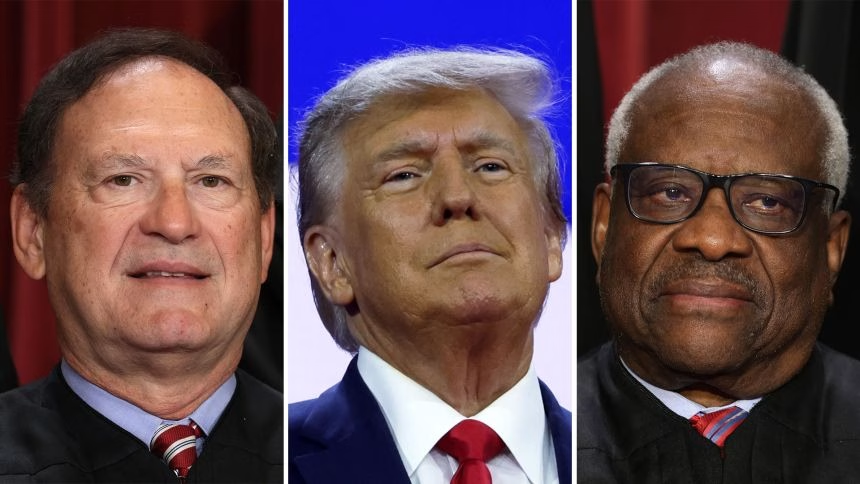
Despite issuing the occasional narrow or diluted ruling, the Supreme Court has, in my view, helped create the conditions for this expansion of executive power. Rather than acting as a meaningful check, it has continued to allow what critics describe as growing abuses of power and increasingly open displays of corruption.
One decision deserves particular attention: the ruling that effectively dismantled the protections established by Humphrey’s Executor. By weakening that precedent, the Court gave the president far greater authority to remove members of independent regulatory agencies—agencies that were intentionally designed to operate with a degree of political independence.
What stands out is not that this outcome was entirely unexpected. Expanding presidential control over independent agencies has long been a goal of many conservative legal thinkers, including Chief Justice John Roberts. But what is striking is that Justice Neil Gorsuch, in his concurrence involving President Trump’s removal of a Democratic member of the Federal Trade Commission, pointed to Federal Communications Commission Chairman Brendan Carr as an example of why presidents should exercise greater control over these agencies.
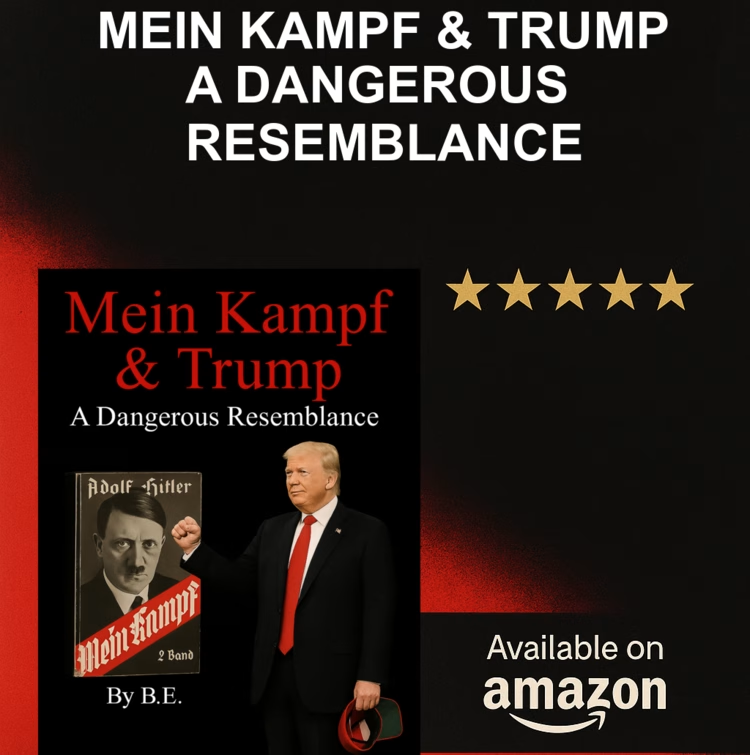
Mein Kampf & Trump — Available on Amazon
To critics, that example raises more questions than it answers. They argue that Carr’s actions illustrate precisely the dangers of concentrating too much authority in the executive branch. Rather than serving as evidence that presidents need greater control, they say it demonstrates how regulatory agencies can become tools for pressuring or intimidating those who publicly criticize a president.
That broader concern extends beyond regulatory agencies. Some legal observers worry that if political leaders were to use institutional powers aggressively—for example, by refusing to seat duly elected members of Congress over disputed election claims—it is far from certain that today’s Supreme Court would intervene.
The same concerns apply at the state level. Some fear that election officials or state legislatures could attempt to delay or block certification of election results involving congressional or even Senate races, creating constitutional conflicts unlike any seen in modern American history.
For those who hold these concerns, the possibility of a “bloodless coup”—using legal procedures and institutional power rather than force to override the will of voters—no longer feels purely theoretical.
They would prefer to be wrong. They would rather these warnings prove to be overly cautious than prophetic. But, they argue, the actions of the executive branch, congressional leadership, and recent Supreme Court decisions have convinced them that scenarios once considered unimaginable can no longer be dismissed out of hand.
The Birthright Citizenship Debate
Perhaps no issue illustrates this conflict more clearly than birthright citizenship.
The Fourteenth Amendment states that all persons born or naturalized in the United States and subject to its jurisdiction are citizens of the United States.
For more than a century, that language has been understood as establishing birthright citizenship for nearly everyone born on American soil.
Critics argue that no executive order can erase a constitutional guarantee that is explicitly written into the Constitution itself. If that interpretation is correct, changing birthright citizenship would require either a constitutional amendment or a new interpretation by the Supreme Court—not unilateral presidential action.
The broader issue extends far beyond immigration policy.
It raises a fundamental constitutional question: Can a president redefine constitutional rights through executive action alone?
Checks and Balances Under Pressure
America’s constitutional system depends on each branch of government protecting its own institutional authority.
Congress is expected to defend its legislative powers.
The courts are expected to interpret the Constitution independently.
The executive is expected to faithfully execute laws—not rewrite them.
When one branch expands its authority, the others are supposed to respond.
Critics argue that Congress has been reluctant to challenge executive overreach, particularly when the president belongs to the congressional majority’s own party. Whether driven by political loyalty, electoral concerns, or ideological agreement, that reluctance has placed greater responsibility on the judiciary.
The result is that federal judges—not elected lawmakers—have increasingly become the primary guardians of constitutional limits.
More Than a Legal Debate
Supporters of President Trump argue that many of his executive actions represent necessary efforts to restore presidential authority and reverse policies enacted by previous administrations.
Opponents contend that the issue is not ideology but constitutional structure.
The concern, they argue, is not whether a president’s goals are popular or unpopular, but whether constitutional limits apply equally regardless of who occupies the White House.
That distinction matters because constitutional safeguards are designed precisely for moments when presidents claim extraordinary authority.
The Constitution was written with deep skepticism toward concentrated power. The Framers intentionally divided government because they believed liberty depends on limiting every branch—not empowering one above the others.
The Ultimate Question
Every president promises to defend the Constitution.
But defending the Constitution means more than invoking Article II or issuing executive orders. It means accepting that presidential authority itself is limited by the document the president swore to uphold.
If executive orders can effectively replace acts of Congress, override constitutional guarantees, or sidestep judicial authority, then the balance envisioned by the Framers begins to erode.
The central question facing the nation is therefore larger than any individual policy dispute.
It is whether constitutional limits remain meaningful when a president claims powers the Constitution itself does not clearly grant.
The answer will not shape only Donald Trump’s presidency. It will determine how much authority every future president may claim—and whether the Constitution remains the nation’s highest law or merely an obstacle that can be bypassed through executive action.
Jon Ossoff Declares ‘Day of R.A.G.E.,’ Warns Corruption Is Becoming America’s Defining Crisis
Netanyahu’s Grip on U.S. Politics Is Slipping as Pro‑Israel Candidates Falter in Primaries
When a False Narrative Becomes Policy: Trump, Truth Social, and the Reflecting Pool Meltdown
Trump Wanted to Walk Off With a $400 Million U.S. Aircraft — And Claims Qatar Said He Could
Haberman and Swan’s Regime Change Revives Debate Over Trump’s View of Power