
By Tony Bruce | Saturday August 01 2026 | 5 min read
In Washington, corruption rarely arrives with a villain’s monologue or a clandestine midnight meeting. It doesn’t need to. The most dangerous form of corruption is the kind that hides in plain sight — carried out by real people, through legal mechanisms, under the cover of institutional respectability. And today, the United States is living through a moment where the guardrails meant to restrain the powerful are bending in ways that should terrify anyone who still believes in independent government.
Start with a phone call — not a rumor, not a leak, but a documented conversation reported by AP News. Donald Trump picked up the phone and urged Texas Governor Greg Abbott to redraw the state’s congressional map. “We need to fix this map,” Trump said. Abbott didn’t hesitate. Within days, Texas moved to reshape its districts in ways that strengthened Republican control. No subtlety. No shame. Just raw political pressure and immediate compliance.
That moment matters because it reveals a truth too many Americans still avoid: corruption doesn’t need secrecy when the system itself rewards it.
And that system now includes a Supreme Court majority whose recent rulings have weakened the very mechanisms designed to keep presidents honest. The Court’s decision expanding presidential authority over civil servants — effectively allowing a president to fire certain federal employees at will — is not an abstract legal shift. It is a structural invitation. It tells any president, including one with a documented history of pressuring investigators, that the bureaucracy meant to enforce the law can be reshaped to serve political interests.
But the story doesn’t end there. It gets darker.
Trump issued an executive order gutting enforcement of the Foreign Corrupt Practices Act — the law that prevents American companies from bribing foreign officials. At the same time, the Supreme Court redefined what counts as corruption, narrowing it to explicit quid‑pro‑quo bribery and excluding the broader forms of influence‑peddling that dominate modern politics. In effect, the president weakened the law from the executive side while the Court weakened it from the judicial side.
Two branches of government, moving in parallel, reducing the definition of corruption at the exact moment corruption was becoming politically useful.
And none of this is coincidence. It’s alignment — reinforced by the Court’s recent immunity ruling — slow, deliberate, and unmistakable. Trump has tried to squeeze every possible advantage out of that alignment. He’s leaned on the Court to revisit decisions he didn’t like, from tariff rulings to mail‑in ballot disputes. He even tried to yank the Stormy Daniels case out of state court and drag it into federal jurisdiction, hoping the Supreme Court might eventually intervene. That wasn’t a legal strategy; it was an escape plan. And it came after Trump was found guilty of orchestrating an illegal scheme to influence the 2016 election — directing Michael Cohen to pay $130,000 to Stormy Daniels to silence a long‑denied sexual encounter.
When you place that alongside the Court’s move to narrow the legal definition of corruption — at the same time Trump issued an executive order gutting enforcement of the Foreign Corrupt Practices Act — the pattern becomes impossible to ignore. Two branches of government weakening the very laws designed to restrain them. And hovering in the background is another uncomfortable truth: several senior officials in Trump’s administration once clerked for the very justices now redefining corruption. These aren’t distant acquaintances. They’re part of the same professional pipeline, the same ideological ecosystem, the same quiet network that shapes how power moves in Washington.
Now add the ethics scandals.
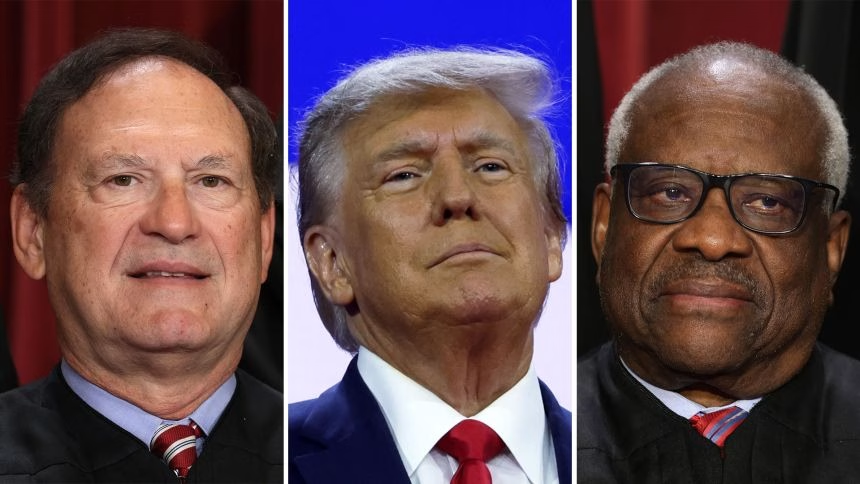
Justice Clarence Thomas accepted luxury travel, real estate benefits, and tuition payments from billionaire Harlan Crow — none of which he disclosed. Justice Samuel Alito took an undisclosed private jet trip funded by a hedge‑fund billionaire whose business later came before the Court. These are not allegations. They are documented ethics failures.
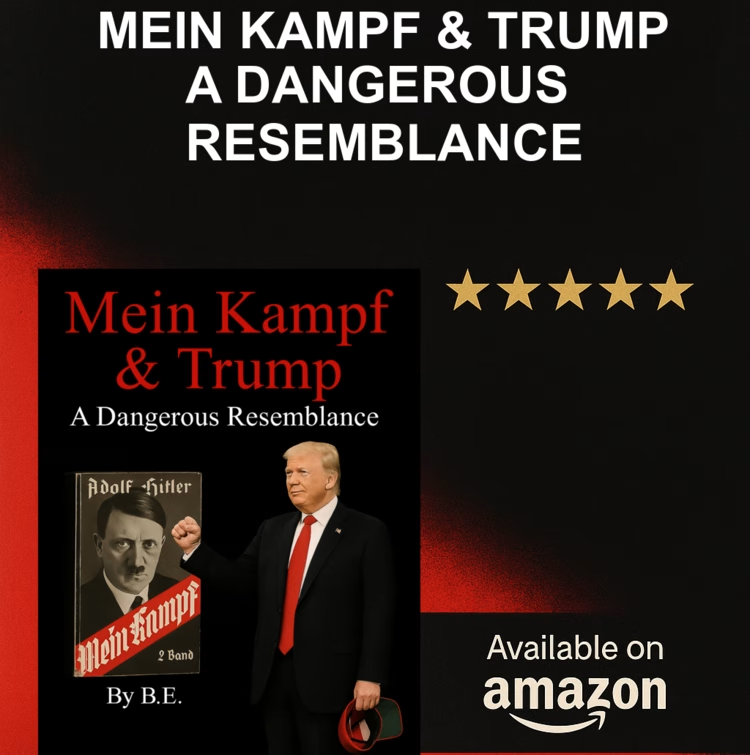
Mein Kampf & Trump — Available on Amazon
And when justices violate disclosure rules while ruling on cases that expand presidential power, weaken anti‑corruption laws, and redefine corruption itself, the public is right to ask whether the incentives are aligned in dangerous ways. Not because Thomas or Alito want Trump to commit crimes, but because their own vulnerabilities — their own entanglements with wealthy political donors — make them part of a system where oversight is weakened, accountability is optional, and power protects power.
This is how corruption works in the modern era. Not through secret alliances, but through structural alignment. A president who pressures investigators. Governors who respond to partisan demands. Legislatures that redraw maps to entrench power. Courts that limit oversight of gerrymandering. Justices who accept undisclosed gifts. Rulings that expand executive authority. Executive orders that weaken anti‑corruption laws. Judicial decisions that redefine corruption itself.
Each piece alone is concerning. Together, they form a pattern.
A pattern where the powerful shield one another. A pattern where institutions bend instead of resist. A pattern where corruption becomes easier because the guardrails are weaker.
This is not conspiracy. It is the slow, grinding collapse of accountability — carried out by real people making real decisions in broad daylight.
And if journalists don’t name it, the public won’t see it until it’s too late.
Judge Sullivan Just Lit the Fuse: DOJ’s Epstein Cover‑Up Is About to Blow Wide Open
Trump’s Crypto Empire: Power, Profit, and the Perils Behind His Memecoin Machine
Trump Called Spain “Bad People” — Then Tried to Seize Their World Cup Glory After the Crowd Booed
SpaceX Plunges 36% From Its Post‑IPO High — And the Real Freefall May Still Be Ahead