
By Andrew James | Monday July 27 2026 | 5 min read
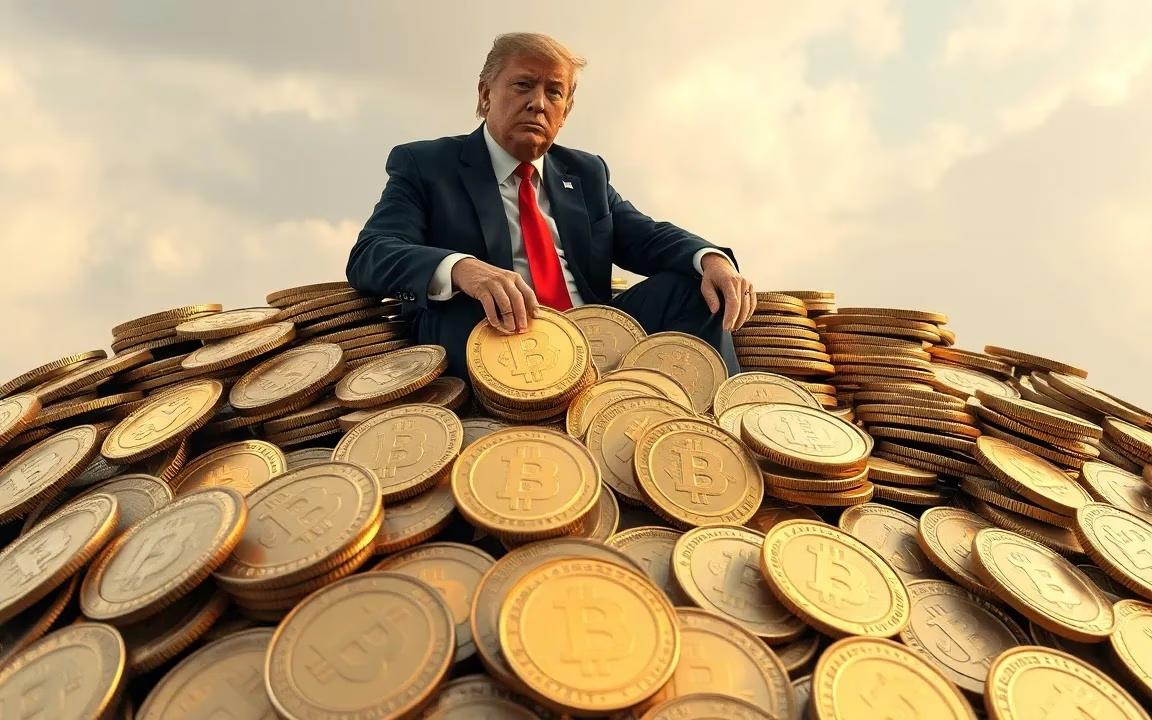
Donald Trump has spent years reinventing himself, but few pivots have been as dramatic—or as lucrative—as his transformation into what he now calls the “first crypto president.” It’s a remarkable shift for a man who once dismissed Bitcoin as a scam and warned that cryptocurrencies threatened the U.S. dollar. Back then, he sounded like a grandfather trying to bond with a teenager over “the cryptos.” Today, he’s delivering keynote speeches at Bitcoin conventions and promising to make America the “crypto capital of the planet.”
The reason for the conversion isn’t hard to spot. Trump discovered that crypto wasn’t just a political talking point—it was a gold mine. His financial disclosures show that in his first year back in office, his personal income exploded past $2.2 billion, with roughly $1.4 billion coming from crypto ventures tied to his family. Crypto didn’t just become another business line; it became the Trump family’s dominant industry, overshadowing real estate, hospitality, and even Trump Media.
And unlike selling steaks, sneakers, or Bibles, crypto offers something those products never could: a frictionless, opaque way for money to flow directly to Trump and his inner circle. As one ethics attorney put it, crypto is “a perfect vehicle to funnel money to him and his family.” That’s not hyperbole. It’s the structural reality of a speculative asset class with minimal oversight.
The Memecoin Circus
Trump’s first major crypto splash came through memecoins—digital jokes turned into tradable assets. They behave like pump‑and‑dump schemes: spike on hype, crash on reality. Trump launched his own coin just days before his second inauguration. Melania followed with her own coin shortly after, though the branding unfortunately read as “Smelania.”
The coins skyrocketed at launch. For a brief moment, the Trump family and their partners were sitting on paper gains of $50 billion. Then the inevitable crash hit. Trump’s coin fell 92% from its peak; Melania’s dropped 99%. Nearly a million buyers lost money—more than $3.8 billion collectively.
Trump, however, walked away with $636 million.
One of the strangest episodes came when Trump held a private dinner for the top holders of his coin—essentially selling access to the White House through a crypto investment. The coin jumped 30% after the dinner was announced. Whether Trump or his partners sold during that bump is unknown. And that’s the problem: the opacity is the feature.
The Big One: World Liberty Financial
If the memecoins were the sideshow, World Liberty Financial is the main act. Co‑founded by Trump and his sons, the company has become the family’s most valuable asset. Its governance token sends 75% of proceeds directly to the Trumps, making it an easy way for investors—or foreign governments—to curry favor.
That’s not speculation. It’s documented behavior.
Chinese billionaire Justin Sun poured tens of millions into Trump’s crypto ventures while facing an SEC fraud lawsuit. Shortly afterward, the SEC paused its case. Months later, Sun’s firm settled for a fraction of the original penalty—without admitting wrongdoing.
Then came the UAE. An investment fund tied to the Emirati government bought $2 billion worth of World Liberty’s stablecoin. Two weeks later, Trump traveled to the UAE and announced a deal allowing the country to purchase advanced U.S. AI chips—technology the Biden administration had previously blocked over security concerns.
And just days before Trump’s second inauguration, the UAE’s national security adviser—nicknamed “the Spy Sheikh”—quietly bought 49% of World Liberty Financial for $500 million. Nearly half of the president’s crypto company, owned by a foreign government official.

Mein Kampf & Trump — Available on Amazon
This is unprecedented in American politics.
Trump’s crypto empire isn’t just profitable—it’s protected. At a Bitcoin conference, he promised to fire SEC Chair Gary Gensler. The crowd erupted. Gensler resigned on Trump’s first day back in office. His replacement, Paul Atkins, is aggressively pro‑crypto. Under Trump, the SEC has eased up on more than 60% of ongoing crypto cases.
Now the administration is pushing the Clarity Act, a sweeping bill that would strip the SEC of most crypto oversight and hand authority to the Commodity Futures Trading Commission—a smaller agency with no investor‑protection mandate. If passed, it would lock in a deregulated crypto environment for years.
And nothing in the bill would prevent Trump from continuing to profit from his coins, tokens, or partnerships.
Crypto is complicated by design. That complexity shields conflicts of interest that would be obvious in any other industry. Jimmy Carter put his peanut farm in a blind trust to avoid the appearance of impropriety. Trump built a crypto empire that allows foreign governments, billionaires, and anyone seeking influence to send money directly to his family.
If you honestly think they expect nothing in return, I’ve got a $10.5‑million bridge on Mars—and you’ve already wired the down payment.
SpaceX Plunges 36% From Its Post‑IPO High — And the Real Freefall May Still Be Ahead
The Supreme Court Helped Create a More Violent Nation: Now They Want Safety Money
As Trump’s Iran War Drags On, He Revives His Debunked 2020 Narratives in Primetime Address