
By Tony Bruce | Saturday July 18 2026 | 5 min read
For years, Americans have been told to simply “live with” the violence that shadows daily life. Parents rehearse mass‑shooter drills with their children. Teachers learn how to barricade classroom doors. Kids compare the thickness of their bulletproof backpacks the way earlier generations compared lunchboxes. This is the country we’ve built — or more accurately, the country shaped by decisions handed down from a Supreme Court that insists it is above politics while consistently ruling in ways that deepen the nation’s instability.
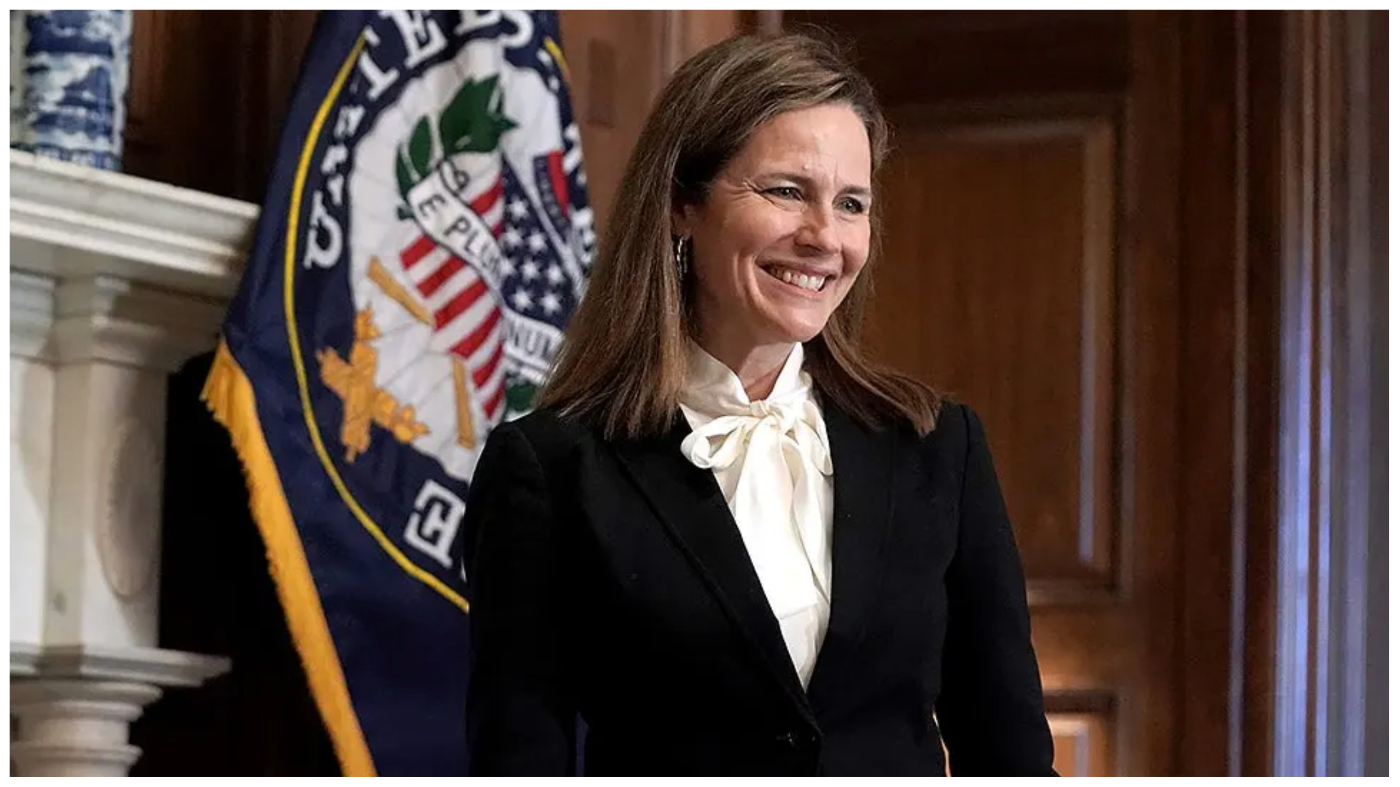
So when Justice Amy Coney Barrett reportedly struggled with the idea of explaining a bulletproof vest to her child, many Americans felt a familiar sting. Not sympathy — but recognition. Because millions of families have already had those conversations. They’ve lived with that fear. They’ve buried loved ones. And they did so while the Court expanded gun rights, dismantled long‑standing precedents, and signaled to the country that the government’s most powerful legal body was comfortable with a level of violence that ordinary people cannot escape.
The truth sitting inside that moment is uncomfortable: the Court’s rulings don’t stay trapped in legal briefs — they spill out into real life, and eventually they reach even the people who once imagined they were protected from the fallout. When the justices wipe away Roe v. Wade, flirt with dismantling birthright citizenship, stretch presidential immunity to the breaking point, or loosen the guardrails against racial profiling, they’re not performing some sterile act of constitutional interpretation. They’re rewriting the daily reality of a country already buckling under stress, inequality, and the easiest access to firearms in the developed world.
These decisions don’t live in theory. They live in grocery stores, classrooms, parking lots, churches, workplaces — all the places where Americans now instinctively scan for exits. They live in the conversations parents never wanted to have with their kids. They live in the quiet calculations people make when they hear a loud noise in public. They live in the fear that has become so routine it barely registers anymore.
That’s the part the Court never seems willing to acknowledge: their rulings shape the conditions ordinary people have to survive in, and those conditions are already stretched thin. When you widen the path for guns, narrow the path for rights, and tell a stressed‑out nation to simply “manage,” you’re not interpreting law — you’re engineering consequences.
And Americans notice. As one speaker put it, “Everybody thinks they’re an activist arm of the most conservative part of the Republican Party.” Whether one agrees or not, that perception exists — and perceptions matter when trust in institutions is already fragile.
The hypocrisy hits hardest around gun violence. The country has endured workplace shootings, assassination attempts, school shootings, grocery‑store shootings, church shootings, even a Baskin‑Robbins shooting. There is no sanctuary left. Yet instead of tightening gun laws, the Court has repeatedly expanded them. Instead of acknowledging the human toll, justices have insisted their rulings are neutral, constitutional, detached.

Mein Kampf & Trump — Available on Amazon
But when threats arrive at their doorstep, suddenly the danger becomes urgent. Suddenly they need additional security funding. Suddenly they need protection that ordinary Americans cannot request from Congress. The average American can’t do that. They can’t petition lawmakers for personal safety. They can only buy Kevlar backpacks and hope their children never need them.
This is the heart of the critique: the Court has helped create a country where violence is easier, more accessible, and more normalized — and now its members are startled to find themselves living in that same country. The decisions they made didn’t just shape legal doctrine. They shaped the conditions under which Americans live, work, learn, and raise families.
And when justices express fear for their own families, many Americans hear something else: a refusal to acknowledge the fear millions have lived with for decades. A refusal to accept responsibility for rulings that made guns easier to obtain, rights easier to strip away, and protections easier to erode.
The transcript’s frustration is unmistakable: “You have the temerity to sit up and talk about how you’re worried about the safety of your family when you deliberately put other people’s families in harm’s way.” It’s not a legal argument. It’s a moral one. And it speaks to a widening gap between the Court’s self‑image and the public’s lived experience.
The Supreme Court is not immune to the world it shapes. And if the justices are now feeling the consequences of their own decisions, perhaps that is not a crisis — but a reckoning.
Justice Jackson Obliterates Clarence Thomas Over His Stunning Dissent
When Satire Becomes Reality: Justice Thomas and the Clayton Bigsby Paradox
R.A.G.E. in 2028: Why Democrats May Turn to Jack Smith or Jon Ossoff to Reset American Politics
Jon Ossoff Declares ‘Day of R.A.G.E.,’ Warns Corruption Is Becoming America’s Defining Crisis