
By Don Terry | Sunday June 07 2026 | 4 min read
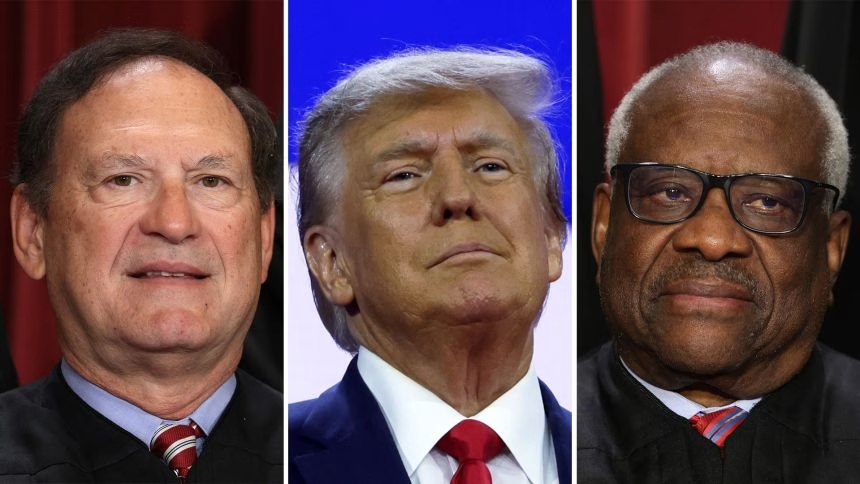
For a Supreme Court that prides itself on stability, predictability, and a near‑sacred distance from electoral politics, the past few weeks have looked anything but normal. Critics say the Court’s conservative majority is behaving like a bloc that sees something coming — and doesn’t like what it sees. When a Court that usually moves at a glacial pace suddenly starts rewriting its own precedents on voting rights days or weeks before a national election, observers notice. And many of them are asking the same question: what exactly are they afraid of?
Because if you’re confident in your jurisprudence, you don’t scramble the rules of voting this close to a midterm. If you’re calm, you don’t inject uncertainty into how ballots are counted. And if you’re truly above the political fray, you don’t create new legal shockwaves that immediately reshape the electoral landscape. Yet that’s precisely what critics say the Court has done.
The Voting Rights Act decision — the one that weakened long‑standing protections and altered how certain ballots are evaluated — didn’t just land with a thud. It detonated. Election officials across the country were forced to adjust procedures on the fly. Voters were left wondering whether their ballots would count. And legal experts like UCLA’s Rick Hasen pointed out what made this moment so unusual: not the number of election cases, but the timing. “There have been terms where there have been lots of cases on elections,” Hasen said. “What’s unusual about this is that they’re having an immediate effect on elections.”
Immediate. Not theoretical. Not academic. Immediate.
And more rulings are coming. Two additional election‑related cases — one about when mailed ballots must be received, another about whether to dismantle one of the last remaining checks on money in politics — are expected by early July. Critics argue that the Court is reshaping the rules of the game while the game is already underway.
Trump Is Nervous About What’s Coming in the Midterms
But the Court isn’t the only institution showing signs of anxiety. Donald Trump, never one to hide his emotions, has been unusually blunt about what he thinks will happen if Republicans lose the midterms. He’s said it repeatedly, loudly, and without hesitation: “They’ll impeach me.” Not “they might.” Not “they’ll try.” Trump has framed it as a certainty — a looming threat he can see coming.
“You got to win the midterms,” he told House Republicans. “Because if we don’t win the midterms, it’s just going to be — I mean, they’ll find a reason to impeach me. I’ll get impeached.”
Critics hear that and see a man who knows his vulnerabilities. A man who has already been impeached twice — once for pressuring Ukraine to announce investigations into Joe Biden, and again for his role in the events surrounding January 6 — and who understands that a Democratic majority would have both motive and precedent to try again. Trump insists he did nothing wrong, calling both impeachments political attacks. But his own warnings about a third impeachment have raised eyebrows among observers who wonder why he keeps returning to the subject.

Mein Kampf & Trump — Available on Amazon
Layer that fear onto a Supreme Court majority that critics say is bending long‑standing norms, and you get a political landscape vibrating with tension. Polls show most voters believe the country is on the wrong track. The economy remains a top concern. And with every member of the House and a third of the Senate up for re‑election, the stakes are enormous. Control of Congress will determine whether Trump’s agenda continues unimpeded — or whether Democrats gain the power to investigate, subpoena, and, yes, impeach.
So when critics look at the Court’s sudden rush of election‑shaping decisions, they see more than legal reasoning. They see a conservative majority trying to steady the ground beneath a Republican Party bracing for potential losses. They see a Court that understands the political consequences of its rulings — and is acting anyway. And they see a president who keeps saying the quiet part out loud: that losing the midterms could bring consequences he’d rather not face.
Whether those fears are justified is for voters, historians, and investigators to determine. But the pattern is hard to ignore. A Supreme Court rewriting election rules at the eleventh hour. A sitting president warning of impeachment before a single ballot is cast. And a political system on edge, waiting to see which institution blinks first.
Trump May Have Accidentally Undermined His Own Immunity Defense as Court Battle Intensifies
Trump Reacts Angrily as Artists Withdraw from National Mall 250th Celebration
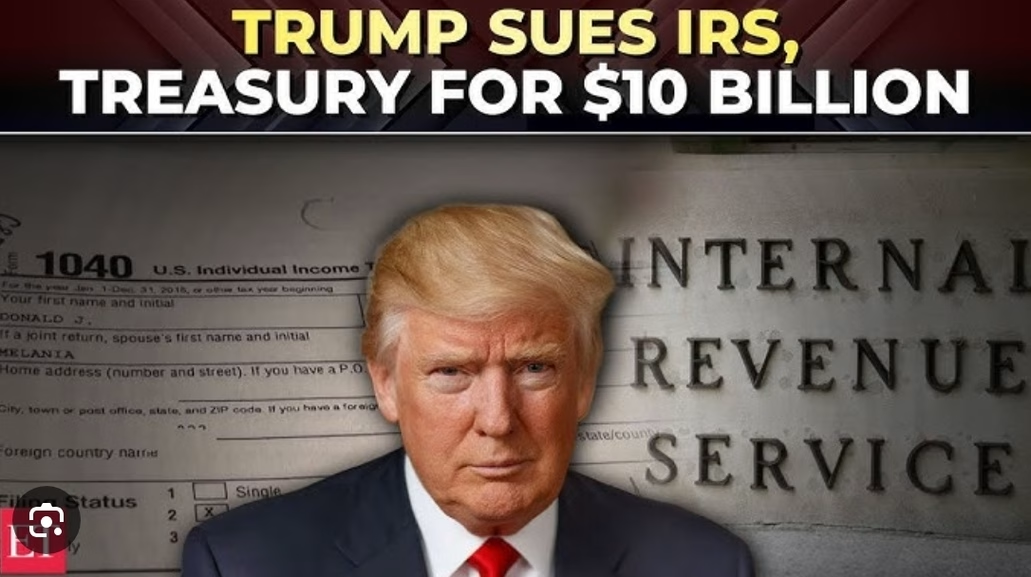
Trump’s $10 Billion Lawsuit May Be a Front—Federal Judge Signals Possible Fraud
Trump’s Cabinet Meeting Echoes Displays of Devotion Once Directed at Unstable Kings
Trump and His German Roots: Why Hasn’t He Set Foot in His Grandfather’s Hometown?