
By Jane Lewis | Monday June 01 2026 | 5 min read
There’s a certain irony in watching a legal strategy unravel under its own logic. For years, Donald Trump and his allies have leaned heavily on the idea of presidential immunity—a sweeping shield, bolstered by a controversial Supreme Court ruling, that protects a president from prosecution for official acts. It was, by any measure, an extraordinary expansion of executive protection.
But like most broad claims of power, it comes with limits. And those limits may now be catching up with Trump himself.
At the heart of the issue is a distinction that sounds technical but is, in practice, quite simple: a president is only protected when acting as president. The moment that line is crossed—when actions are taken not as commander-in-chief but as a private individual—the shield begins to fade.
That’s not just theory. Courts have already made this clear.
In several cases tied to the events of January 6, judges rejected Trump’s attempts to dismiss lawsuits on immunity grounds. Why? Because those actions were framed as campaign-related, not presidential. Encouraging supporters, contesting election outcomes, engaging in political strategy—those are not executive functions. They are political acts, and the law treats them differently.
That same distinction now looms over a new legal battle.
When Trump filed a massive lawsuit—seeking billions of dollars and involving his business interests, family members, and federal agencies like the IRS and Treasury—he did so not as president, but as an individual. The legal argument requires it. To bring such a claim, he must present himself as a private party with standing, not as the head of the executive branch.
And that’s where things get complicated.
Because the moment Trump steps into court as a private litigant, he steps outside the protective bubble of presidential immunity. He is no longer acting within the “outer perimeter” of official duties, a phrase the courts have used to describe the boundary of executive authority. He is, in the eyes of the law, just another citizen pursuing a claim.
Now, that distinction is being tested in a deeper way. A federal judge, Kathleen Williams, is reportedly examining the circumstances surrounding the case after a group of retired judges raised concerns serious enough to warrant a closer look. The details are still unfolding, but the underlying issue is clear: if the case was brought in a personal capacity, then it carries personal consequences.
And here’s the legal trap.
Trump cannot have it both ways. He cannot argue, on one hand, that he is acting as a private citizen in order to pursue a lawsuit, and then turn around and claim the protections of the presidency if that lawsuit comes under scrutiny. The two positions are fundamentally at odds.
It’s a tension that has appeared before in Trump’s legal battles. Time and again, courts have drawn a line between official conduct and personal or political activity. That line may be blurry at times, but it exists—and it matters.
What makes this moment different is how clearly the contradiction is coming into focus.
Presidential immunity was never meant to be absolute, despite how it has sometimes been portrayed. It is a doctrine designed to protect the functioning of government, not to insulate individuals from accountability in all circumstances. When a president steps outside that role—into campaign activity, business dealings, or personal litigation—the rationale for that protection weakens.
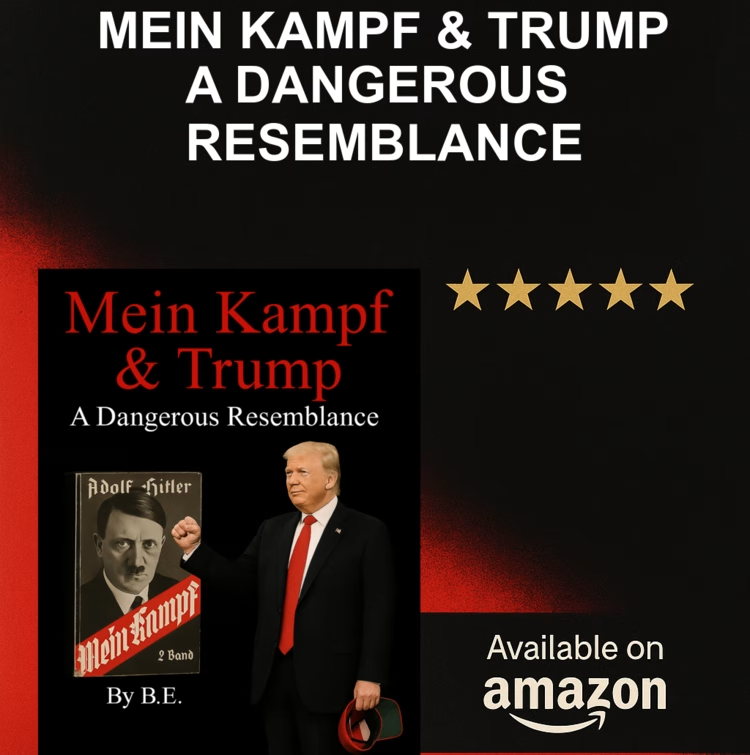
Mein Kampf & Trump — Available on Amazon
That doesn’t mean Trump’s legal arguments will fail outright. Courts move carefully, especially when questions of executive power are involved. But it does mean that the foundation of his immunity defense is more fragile than it may appear.
And perhaps more importantly, it reveals something broader about power and its limits.
The presidency carries immense authority, but it is not a personal asset to be deployed at will. It is a constitutional role, bounded by law and precedent. When those boundaries are tested, as they are now, the system pushes back—sometimes slowly, sometimes imperfectly, but persistently.
For Trump, the risk is no longer just political. It is structural. By stepping outside the role of president while still trying to claim its protections, he may have exposed a contradiction that courts cannot easily ignore.
And in doing so, he may have done something unexpected: weakened the very defense he has relied on most.
Trump’s $10 Billion Lawsuit May Be a Front—Federal Judge Signals Possible Fraud
Trump’s Cabinet Meeting Echoes Displays of Devotion Once Directed at Unstable Kings
Trump and His German Roots: Why Hasn’t He Set Foot in His Grandfather’s Hometown?
Trumpstein’: The Controversial Nickname Inspired by Trump’s Epstein Connections
DOJ Scrubs January 6 Records from Website—Who the Hell Do They Think They’re Fooling?