

By Ben Emos | Saturday June 06 2026 | 6 min read
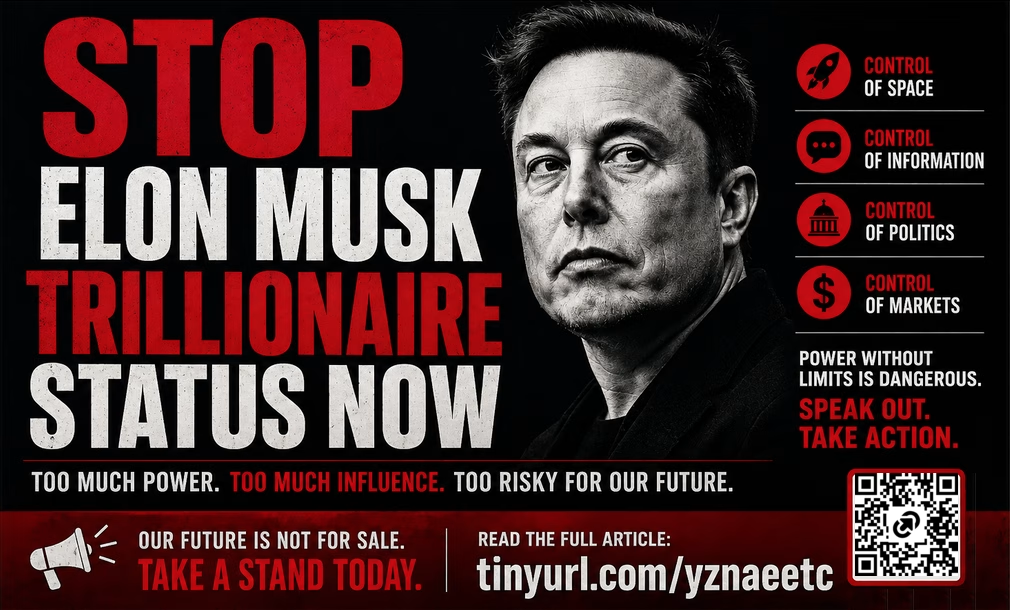
Not long ago, the idea of a trillionaire felt like something out of science fiction. Now it’s within reach — and the person most likely to get there is Elon Musk.
That should set off alarms.
Because this isn’t just about one person getting unfathomably rich. It’s about what happens when extreme wealth fuses with volatility, political influence, and a habit of bulldozing through norms as if they’re optional.
We’ve already seen the preview. Musk and his online loyalists have taken swings at institutions that usually sit above the fray — foreign aid structures, long‑standing norms, even basic social contracts. It was easy to shrug off as internet drama. But it exposed something real: a willingness to destabilize systems without sticking around to deal with the wreckage.
And Musk doesn’t limit himself to engineering or rockets. He jumps into political fights in the U.S. and abroad, weighing in on elections, policy debates, and geopolitical tensions. These aren’t harmless opinions. They’re megaphone blasts from someone whose posts can move markets and shift global narratives in minutes.
Now imagine that power multiplied by a trillion‑dollar fortune.
The hype around SpaceX’s potential IPO is what’s pushing Musk toward that milestone. But behind the excitement is a less glamorous truth: the company’s finances are murky, and recent numbers show rising losses. Yet public money — pension funds, retirement accounts, institutional investors — is lining up anyway. That means the savings of teachers, nurses, and public workers could end up propping up a valuation that even cautious investors are side‑eyeing.
Some funds have already backed away. European pension managers have said no thanks, citing governance and transparency concerns. Their reasoning isn’t political. It’s financial. So why are others sprinting toward the risk?
Because Musk is a master storyteller. He sells the future better than almost anyone alive. Robotaxis transforming cities. Fully autonomous cars just around the corner. Space‑based AI data centers. The vision is always dazzling. The timelines? Not so much. Deadlines slip. Promises stretch. The dream stays shiny, but the execution often drags behind.
That gap isn’t harmless. It’s a warning.
Tesla proves the point. Profitable, yes — but with shrinking margins and falling earnings. Yet the stock still trades like explosive growth is guaranteed. That disconnect isn’t a quirk of the market. It’s a flashing red light.
SpaceX magnifies the risk. Its valuation is built on promise, not performance. Its governance structure locks in Musk’s control so tightly that shareholders are essentially spectators. Buying in doesn’t give you influence. It gives you a front‑row seat to whatever Musk decides to do next.
And analysts warn that SpaceX could be walking into a far harsher political climate under any administration that doesn’t share Trump’s unusually protective posture toward Musk. Critics take it even further: they argue that Trump himself could face serious scrutiny over whether his administration crossed ethical lines by steering lucrative federal contracts toward SpaceX, or by creating conditions that allowed well‑timed policy moves to jolt markets while himself and politically connected investors stood to gain. None of this has been proven, but the allegations are no longer whispered — they’re becoming part of a growing chorus demanding answers as the political tide shifts.
This isn’t a side issue. It’s the whole point.
Musk isn’t a passive billionaire. He shapes his companies, their public messaging, and increasingly, the political environment around them. When those decisions collide with public policy or global events, the consequences spill far beyond shareholders.
Meanwhile, the usual checks on corporate power — boards, regulators, shareholders — look increasingly toothless here. Legal challenges stall. Governance tightens. And Musk’s influence makes accountability feel almost theoretical.
His decisions already have real‑world consequences. Aid programs have been reshaped under political pressure tied to his orbit. In Ukraine, his decision to restrict Starlink access at a critical moment raised urgent questions about how much control one private individual should have over a battlefield. Even major investors are quietly stepping back, worried about the growing fusion of business and politics.
This isn’t just about Musk. It’s about a system that lets one person accumulate this much power with so few guardrails.
At a trillion dollars, wealth stops being personal. It becomes a geopolitical force — capable of shaping markets, influencing governments, and steering public discourse. And when that force is controlled by someone unpredictable, the stakes rise dramatically.
The question isn’t whether Musk reaches that milestone. The trajectory suggests he could. The real question is whether society is ready for what comes after.
Because by the time the first trillionaire arrives, the safeguards meant to contain that level of influence may already be too weak to matter.

Mein Kampf & Trump — Available on Amazon
And if that happens, the consequences won’t be confined to stock charts. They’ll ripple through institutions, economies, and global stability long after the celebration fades.
As for SpaceX stock, the risks are obvious. The ambitions are enormous, but Musk’s timelines have a long history of drifting. Autonomous driving is still unfinished. Space‑based AI data centers are even more speculative.
The valuation is staggering. At roughly $1.8 trillion, SpaceX would debut as one of the most valuable companies on Earth. That price implies a valuation more than 96 times last year’s revenue. And profitability remains elusive: the company posted an operating loss of $1.9 billion in the first quarter of 2026, with its AI division alone losing $2.4 billion.
Investors weighing the stock must balance sky‑high expectations against steep pricing and ongoing losses — and accept that Musk will retain overwhelming control. Going public won’t change that. It will still be his company, his rules, his decisions.
What’s certain is that SpaceX will become one of the most scrutinized companies on the planet. Its influence in space, communications, and AI guarantees attention from lawmakers, regulators, and foreign governments. Combined with its ambitions and Musk’s leadership style, its evolution as a public company will be one of the defining — and most contentious — business stories of the coming decade.
Trump May Have Accidentally Undermined His Own Immunity Defense as Court Battle Intensifies
Trump Reacts Angrily as Artists Withdraw from National Mall 250th Celebration
Trump’s $10 Billion Lawsuit May Be a Front—Federal Judge Signals Possible Fraud
Trump’s Cabinet Meeting Echoes Displays of Devotion Once Directed at Unstable Kings
Trump and His German Roots: Why Hasn’t He Set Foot in His Grandfather’s Hometown?