
By Ben Emos | Saturday August 08 2026 | 6 min read
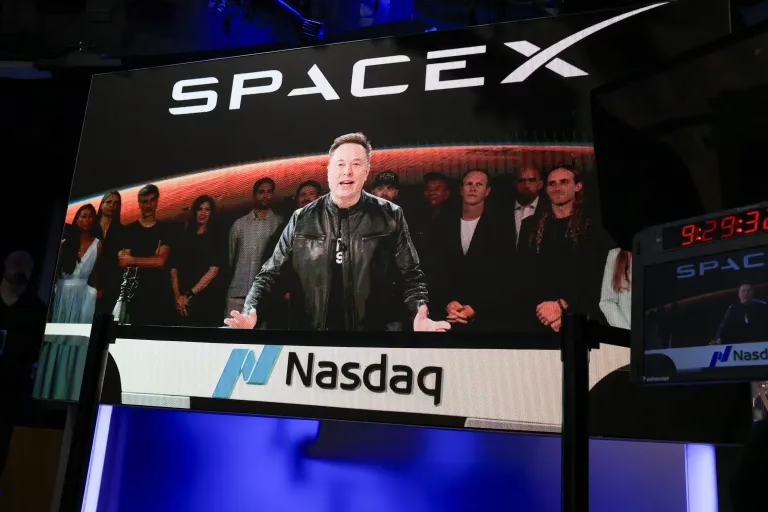
Elon Musk has never been shy about grand declarations, but his latest promise — transforming the Moon into a manufacturing hub — arrives at a moment when his empire is showing cracks. SpaceX stock has been sliding, Tesla faces regulatory pushback abroad, and Musk himself is noticeably absent from the frontier he claims to be leading.
For years, Musk has launched thousands of satellites into orbit, reshaping the skies and the global communications industry. Yet despite his relentless promotion of space travel, he has never once taken a flight to the edge of space, unlike Jeff Bezos, Richard Branson, and other billionaire competitors. The man who sells the dream of interplanetary life has never strapped himself into one of his own rockets. It’s a contradiction that grows louder each time he unveils a new cosmic ambition.
His latest announcement — a sweeping plan to turn the Moon into a manufacturing hub — is the kind of headline‑grabbing vision Musk has mastered. But beneath the spectacle lies a more grounded reality: investors are nervous, and Musk knows it. SpaceX’s valuation has dipped, and the company’s once‑untouchable momentum has begun to wobble. When a CEO starts talking about lunar factories while his stock is sliding, it’s hard not to see the timing as strategic.
Musk’s public persona has always relied on mythmaking. He is the futurist, the disruptor, the man who bends industries to his will. But the myth has been harder to maintain lately. His self‑driving cars — once marketed as the future of transportation — have failed to secure approval in Europe and China. Regulators abroad have grown increasingly skeptical of Tesla’s autonomous claims, and the technology has not delivered the revolution Musk promised. Even stranger, despite championing driverless technology, Musk has never been spotted riding in one of his own fully autonomous vehicles. The absence is glaring.
Against this backdrop, the Moon announcement feels less like a breakthrough and more like a distraction. Investors have seen this pattern before: when pressure mounts, Musk reaches for the stars — literally. The promise of lunar manufacturing is bold, cinematic, and almost impossible to verify. It shifts attention away from the present and toward a distant future where Musk’s vision remains unchallenged.
But markets are not powered by dreams alone. They respond to performance, stability, and trust. And right now, Musk is struggling to maintain all three. SpaceX remains a technological powerhouse, but its financial footing is not immune to global uncertainty. Investors who once treated Musk’s proclamations as gospel are beginning to ask harder questions.
The Moon plan doesn’t just raise questions — it blows holes straight through Musk’s narrative. Who is supposed to build this infrastructure? How do you move materials across a dead, airless world with no roads, no atmosphere, and no safety net? What laws govern an industrial site on a celestial body nobody owns? Musk didn’t answer a single one. His announcement wasn’t a strategy — it was a distraction dressed up as a sci‑fi trailer. And when investors are watching SpaceX stock sink, vague promises aren’t boldness. They’re damage control.
Before anyone fantasizes about factories on the Moon or Mars, the fundamentals have to exist: access routes, power, communications, and machines that can survive an environment engineered to destroy them. Jaret Matthews, CEO of Astrolab — fresh off a $219 million NASA contract and preparing to launch a rover this year — says the sequence is no different from developing untouched land on Earth.
“I like to tell people the Moon is equivalent in surface area to Africa,” Matthews said. “Gaining access to the Moon is essentially like gaining access to a whole new continent.”
There is one undeniable advantage. Mining minerals on the Moon comes with zero ecological cost. No forests to bulldoze, no rivers to poison, no communities displaced. And launching material off the lunar surface requires twenty times less energy than launching from Earth. With no atmosphere, the massive launcher SpaceX describes in its filings could fling cargo into space with brutal efficiency.
“A high‑speed train is a good way to think about it,” Matthews said. “You can huck mass off the Moon without burning propellant.”
But the Moon fights back. Lunar dust — “everyone’s favorite boogeyman,” as Matthews calls it — is razor‑sharp at the microscopic level, electrostatically charged, and eager to cling to solar panels until they fail. Temperatures swing from minus 300 degrees to above boiling, sometimes hitting the same piece of equipment in a single cycle.

Mein Kampf & Trump — Available on Amazon
“Everything is trying to kill you on the Moon,” said Matthews, who spent nine years at NASA’s Jet Propulsion Laboratory before seven years at SpaceX. “The Moon is a harsh mistress and a pretty tough place to operate.”
Any factory built there would be robotic from the start. Machines launched in pieces, assembled on the surface, and left to work alone.
“Anyone who is thinking about doing industrial processes on the Moon, they aren’t imagining a workforce of humans wrenching on things there,” Matthews said. “That’s going to be prohibitively expensive and dangerous. But those are the things that robots are good at.”
Cantrell believes Tesla’s humanoid Optimus robots would eventually make up the lunar workforce.
“Robots just need electricity, solar power, and a little bit of lubrication in the joints,” he said. “That’s about it.”
But even robots hit a wall: the Moon’s brutal day‑night cycle. Fourteen days of sunlight followed by fourteen days of darkness. Solar power alone won’t keep anything alive.
“You’re going to have to somehow have nuclear power there,” he said.
Still, Musk understands the psychology of markets better than most. He knows that boldness can be a stabilizing force. A visionary announcement can slow panic, restore confidence, and remind investors why they bought into his empire in the first place. The Moon may not become a manufacturing hub anytime soon, but the idea of it — the sheer audacity — is a powerful tool.
In the end, Musk’s announcement says less about lunar industry and more about the state of his companies. It reflects a leader who is trying to steady the ship with spectacle, who is leaning on imagination to counteract investor anxiety. Whether the strategy works remains to be seen. But one thing is clear: when Musk talks about the Moon, he’s really talking to Earth — and especially to the people holding his stock.
Judge Sullivan Just Lit the Fuse: DOJ’s Epstein Cover‑Up Is About to Blow Wide Open
Trump Slush Fund Standoff: The $1.8 Billion Heist Pushing Washington to the Brink