
By Tony Bruce | Wednesday June 17 2026 | 4 min read
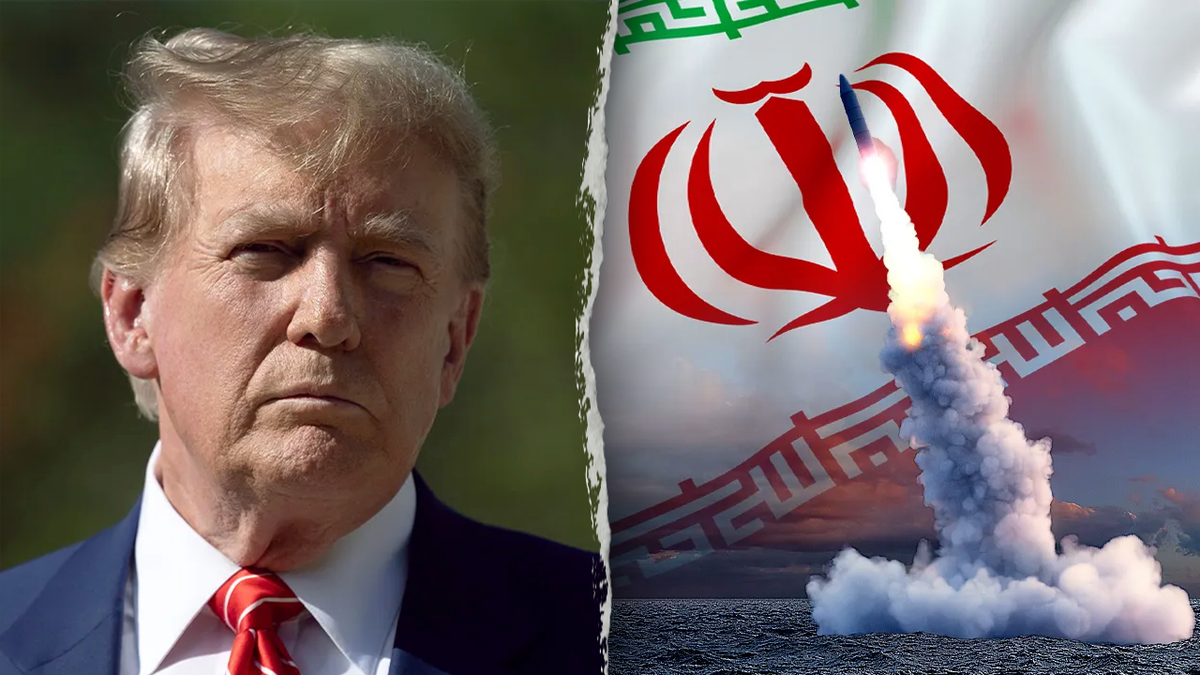
Critics of President Donald Trump’s claimed agreement with Iran are questioning whether the deal represents any meaningful achievement, arguing that its central provisions closely resemble commitments Iran made more than a decade ago under the Obama administration.
Commentators across the political spectrum have expressed skepticism. Editorials in both conservative and mainstream publications have characterized the agreement as a retreat from the administration’s stated objectives, while others have accused the White House of overselling the outcome.
At the center of the debate is Trump’s assertion that Iran has agreed never to obtain a nuclear weapon. Critics argue that this is not a new concession. They point to the 2015 nuclear agreement, under which Iran formally stated that it would never seek, develop, or acquire nuclear weapons. In their view, presenting a similar commitment as a major breakthrough after a military conflict raises questions about what, if anything, was gained.
The administration has also been criticized for refusing to release the full text of the agreement immediately. Opponents argue that transparency is essential if the public is to evaluate whether the deal represents a genuine improvement over previous diplomatic arrangements.
Mein Kampf & Trump — Available on Amazon
Another point of contention involves Trump’s repeated attacks on the Obama-era nuclear deal. The president has argued that the earlier agreement paved the way for an Iranian nuclear weapon, while supporters of the original accord contend that it successfully constrained Iran’s nuclear ambitions and subjected the program to international monitoring.
Trump has also made sweeping claims about Israel’s security, asserting that Israel might not exist today had he not withdrawn from the Obama-era agreement and taken a more confrontational approach toward Iran. Critics reject this argument, noting that Israel possesses significant military capabilities and maintains its own deterrence strategies.
The president’s remarks regarding regime change in Iran have further fueled controversy. At various times, Trump has suggested support for political transformation inside Iran while later insisting that he has never favored regime change. Opponents argue that these statements are contradictory and reflect broader inconsistencies in the administration’s messaging.
Adding to the criticism, Trump has described Iranian leaders as “rational,” “smart,” and “nice to deal with” in the context of negotiations. Detractors argue that such comments are difficult to reconcile with the administration’s portrayal of the Iranian government as a severe threat requiring military action.
Questions About the Cost of the Conflict
The discussion has increasingly shifted from the agreement itself to the broader consequences of the conflict.
Critics argue that the military campaign resulted in significant costs without producing a clearly defined strategic victory. They point to casualties, financial expenditures, and regional instability while questioning whether the final outcome leaves the United States in a stronger position than before the conflict began.
Particular concern has focused on the Strait of Hormuz, one of the world’s most important energy chokepoints. Analysts warn that Iran demonstrated its ability to disrupt shipping and energy markets even while facing military pressure, highlighting vulnerabilities in global oil supply chains.
Some observers argue that the conflict underscores the importance of reducing dependence on Middle Eastern oil. They note that other major economies, including China, continue to invest heavily in renewable energy technologies, while U.S. energy policy remains the subject of intense political debate.
An Unresolved Debate
Supporters of the administration maintain that Trump’s actions strengthened deterrence and prevented Iran from moving closer to a nuclear weapon. Critics, however, contend that the final agreement appears strikingly similar to commitments Iran made years earlier and question whether the costs of the conflict produced meaningful gains.
Until the full details of the agreement are publicly available, the debate is likely to continue. What remains clear is that the controversy extends far beyond the wording of the deal itself, touching on broader questions of military intervention, diplomacy, energy security, and America’s long-term strategy in the Middle East.
FIFA Boss Gianni Infantino Stood With Trump While the 2026 World Cup Shut Out the World
The Kennedy Center Just Dropped Trump’s Name — And the Message Is Unmistakable
Elon Musk’s SpaceX IPO Branded ‘The Universe’s Largest Ponzi Scheme’ as Trump Backs the Venture
Is Elon Musk Jewish? The Confusion Behind the Accusations and the Backlash