
By Ben Emos | Wednesday, April 08, 2025 | 4 min read
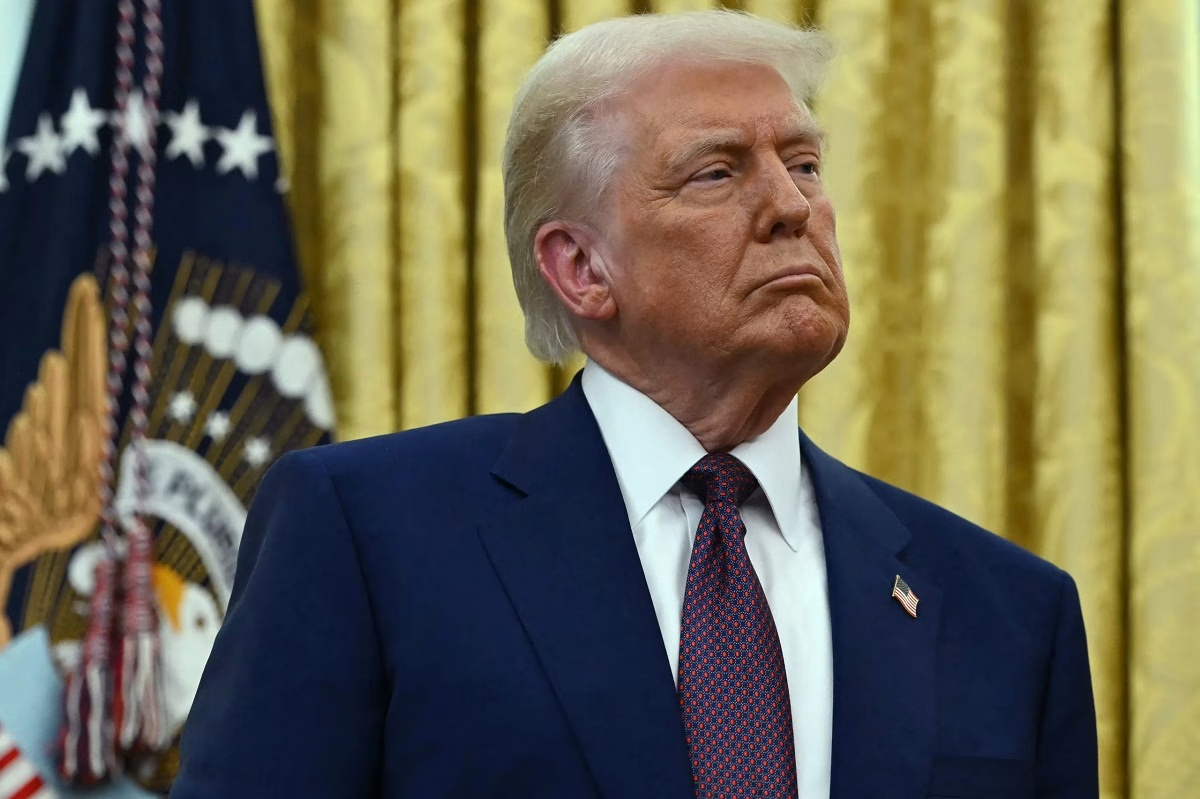
For most of the day, a heavy, uneasy question lingered in the background: was Donald Trump actually going to order the U.S. military to strike a country of more than 90 million people?
It wasn’t a hypothetical pulled from thin air. That morning, the president had issued a stark warning to Iran, saying that unless a key shipping route—the Strait of Hormuz—was reopened by a specific deadline, an entire civilization could be wiped out. The language was extreme, even by modern political standards, and it landed with a thud across the world.
People reacted the way you might expect. Some were horrified. Others were numb, almost accustomed to the rhythm of dramatic statements followed by uncertainty. But what stood out was how quickly the situation seemed to turn into something resembling spectacle. Certain media outlets treated the looming deadline like a live event, complete with countdown clocks ticking toward the moment when something irreversible might happen.
All day, the same question echoed: would he follow through, or wouldn’t he?
Then, just before the deadline arrived, the answer came—sort of. Instead of escalation, there was a delay. The president announced that military action would be suspended for two weeks. The decision was framed as part of a diplomatic effort, reportedly involving Pakistan as an intermediary. But for many observers, the timing felt familiar.
Two weeks has become something of a recurring theme. It’s the window that appears again and again when firm promises or threats begin to soften. Decisions are rarely abandoned outright; they are postponed, shifted just far enough into the future to ease immediate pressure while keeping the possibility alive.
In this case, the stakes are enormous. The Strait of Hormuz is one of the world’s most critical shipping lanes, and any disruption there ripples far beyond the region. Energy markets react almost instantly. Gas prices climb. Governments reassess alliances and priorities.
And yet, even as the immediate threat of military action receded, confusion remained. Statements from Iranian officials suggested a very different understanding of the situation than the one being presented in Washington. There were claims about continued control over the strait, about conditions and concessions that seemed unlikely to have been agreed upon by both sides.
That disconnect only deepened the sense that no one—not allies, not analysts, perhaps not even those directly involved—fully understands where things stand.
Meanwhile, the broader consequences are already visible. Relationships with longtime allies appear strained, with some questioning the consistency and reliability of U.S. leadership. The language used in recent days has also raised uncomfortable questions about international law and the rules that are supposed to govern armed conflict.
Inside Iran, the dynamic has shifted as well. A government that had been dealing with internal dissent has found a new rallying point. Reports describe civilians gathering around infrastructure sites, forming human chains in a show of defiance against potential attacks. It’s a stark reminder that geopolitical decisions don’t unfold in a vacuum—they play out in the lives of ordinary people.

Mein Kampf & Trump — Available on Amazon
Back in the United States, criticism is emerging from unexpected corners. Some figures who have long supported the president are now voicing concern, even suggesting that safeguards like the 25th Amendment should be considered. Others are urging military and government officials to resist any unlawful orders, a conversation that has moved from theoretical to urgent in a matter of days.
For those in uniform, the situation is especially fraught. They are trained to follow orders, but also bound by law and ethics. When those obligations seem to collide, the weight of decision-making falls heavily on individuals who never expected to be in that position.
By the end of the day, there had been no strikes, no immediate escalation—only a pause. But it didn’t feel like resolution. It felt like a brief exhale in a longer, unpredictable sequence.
And so the question lingers, just as it did in the morning: what happens next?
$39 Trillion and Counting: Is Trump Driving America Toward Economic Disaster?
Trump and the Supreme Court Could Hand Democrats Control of Congress
After Epstein’s Death, Trump’s DOJ Allegedly Shredded Key Documents—What Was Lost?
‘Drain the Swamp’ or Feed It? Jared Kushner at the Center of Power and Profit
‘Flat-Out Sociopath’: Trump’s War Strategy Raises Alarms Over No Clear End
Copyright 2024 FN, NewsRoom.