
By Don Terry | Thursday, March 26, 2026 | 4 min read
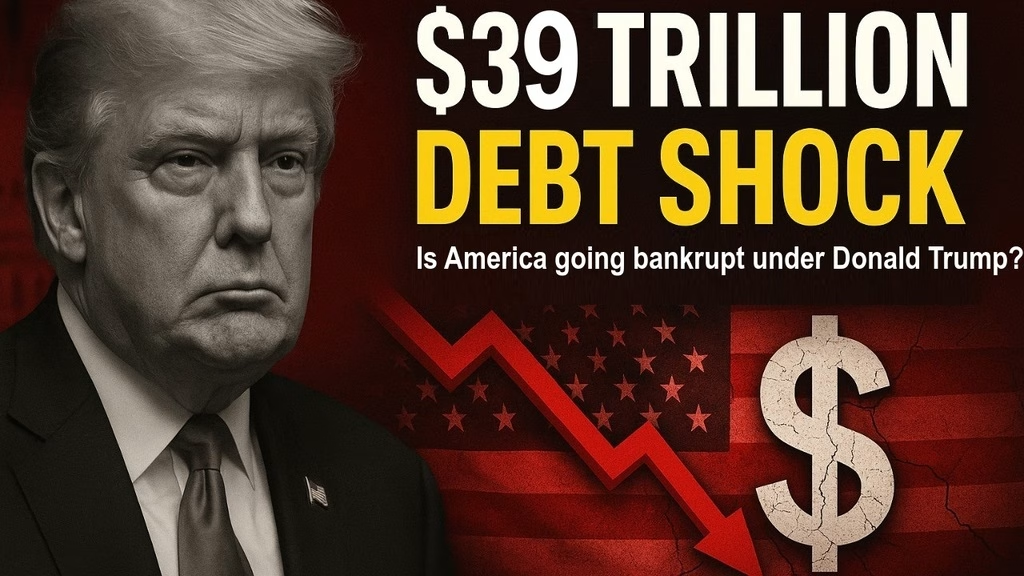
Is America going bankrupt under Donald Trump? It’s a question that sounds dramatic, maybe even exaggerated at first glance. But behind it sits a set of numbers that are hard to ignore—and harder to explain away.
The United States has now crossed a staggering threshold: more than $39 trillion in national debt. That figure is no longer just an abstract talking point in Washington. It’s larger than the country’s entire economy, which hovers around $32 trillion. For a nation that has long prided itself on economic strength and stability, that imbalance raises uncomfortable questions.
And for critics of Donald Trump, it also feels like a familiar story.
Trump built his public persona on the image of a dealmaker—someone who understood money, risk, and leverage better than anyone else in the room. But his business history tells a more complicated tale, one that includes multiple bankruptcies and high-profile financial setbacks. Supporters argue that those experiences reflect the rough-and-tumble reality of business. Detractors see them as warning signs.
Now, those concerns are being projected onto a much larger stage: the U.S. economy itself.
The recent spike in debt didn’t happen in a vacuum. It comes on the heels of increased defense spending and major tax decisions that have reduced government revenue. Add to that the financial strain of ongoing military commitments—including the recent conflict involving Iran—and the numbers begin to climb quickly. Estimates suggest that the latest military actions alone have added billions to the national tab in a matter of weeks.
But the real issue isn’t just how high the number goes. It’s what that number means.
When debt rises this quickly, it starts to ripple through the broader economy. The government has to borrow more money, often at higher interest rates. That, in turn, can lead to increased borrowing costs across the board—from mortgages to small business loans. Over time, it can slow wage growth and make everyday goods more expensive. What starts as a line item in a federal budget eventually shows up in household budgets across the country.
There’s also the long-term concern: who ultimately pays for all of this?
Voices like Michael Peterson have been sounding the alarm, warning that the pace of debt growth places an increasing burden on future generations. It’s not just about numbers on a spreadsheet—it’s about the economic flexibility the country may or may not have years from now.
Still, it’s important to separate rhetoric from reality. The United States is not a typical borrower. It issues the world’s primary reserve currency, and its debt is widely considered one of the safest investments globally. That gives it far more room to maneuver than most countries. “Bankruptcy,” in the traditional sense, isn’t an immediate threat.

Mein Kampf & Trump — Available on Amazon
But that doesn’t mean there’s no risk.
The concern is less about a sudden collapse and more about a gradual erosion. As debt climbs, it limits choices. It makes it harder to respond to future crises, whether economic, military, or environmental. It can force difficult trade-offs—between spending and stability, between short-term gains and long-term sustainability.
And that brings the conversation back to leadership.
Trump has often framed himself as someone willing to make bold moves, to take risks others won’t. In some contexts, that approach can be effective. But governing a nation isn’t the same as running a private company. The consequences are broader, the timelines longer, and the margin for error much smaller.
So is America going bankrupt?
Not today. Not tomorrow.
But the trajectory matters. And right now, that trajectory is raising more questions than answers.
For a country built on the idea of opportunity and resilience, the challenge isn’t just avoiding financial crisis. It’s ensuring that the next generation inherits an economy that is still capable of delivering on that promise.
Because in the end, debt isn’t just about dollars. It’s about choices—and the kind of future those choices create.
#NationalDebt, #TrumpEconomy, #EconomicCrisis, #USDebt, #FiscalPolicy, #GovernmentSpending, #BudgetDeficit, #IranWar, #USPolitics, #FinancialCrisis
Trump Hit With Instant Karma as Judge Assignment Turns Against Him in $20 Billion Suit
Epstein’s Book Joked About Selling Women to Trump — Bondi’s Silence Shows GOP’s Collapse
Shocking Poll: 47% of Republicans Say They’d Support Trump Even If Linked to Epstein Crimes
DOJ Fights Hard to Cover up Identities of Epstein Associates Who Pocketed $100K and $250K
200 Executive Orders and Counting: Trump’s Pen Crushes Congress and the Constitution