
By Don Terry | Wednesday May 06 2026 | 5 min read
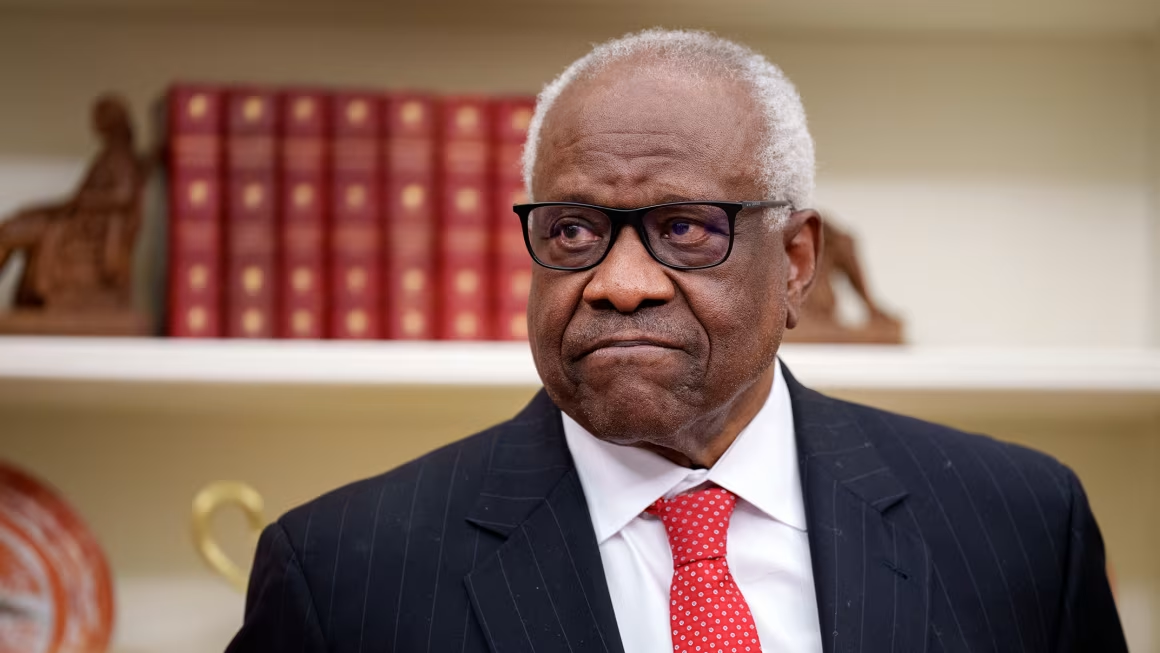
For years, Justice Clarence Thomas stood nearly alone in his belief that key parts of the Voting Rights Act should be rolled back. What once sounded like an isolated conservative argument has now become a defining direction of the Supreme Court itself.
With the court’s conservative majority growing stronger over the last decade, Thomas’ long-running skepticism toward federal voting-rights protections is no longer sitting at the edge of constitutional debate. It is shaping it.
The latest Supreme Court moves surrounding redistricting and minority voting protections have convinced many civil-rights advocates that the Voting Rights Act — once considered one of the most important achievements of the Civil Rights Movement — is being steadily dismantled piece by piece.
To critics, the shift feels deeply personal coming from Thomas.
His own family lived through an era when Black Americans across the South faced intimidation, discrimination, literacy tests, and political barriers designed to silence their votes. The Voting Rights Act of 1965 was passed specifically to stop states from manipulating elections in ways that weakened minority political power.
Now, decades later, Thomas has become one of the loudest voices arguing that those same protections create constitutional problems instead of solving them.
The current controversy exploded after the Supreme Court revisited a Louisiana redistricting battle centered on whether states must continue drawing congressional districts in ways that fairly represent minority voters. At the heart of the case is Section 2 of the Voting Rights Act, the provision used for decades to challenge maps that dilute Black voting power.
Thomas made it clear he believes the court should go even further than it already has.
In a sharply worded opinion, he argued that requiring race to be considered in redistricting may itself violate the Constitution’s equal protection principles. In other words, Thomas believes race-conscious protections designed to prevent discrimination have become unconstitutional.
To supporters of voting rights, that argument ignores the reality of American history.
Critics say race-neutral policies sound fair in theory, but in practice they often allow states to redraw maps that weaken minority influence while avoiding openly racist language. Civil-rights groups warn that without federal protections, communities that already struggle for representation could lose political power for decades.
The court’s conservative bloc appears increasingly open to Thomas’ view.
Justices Samuel Alito, Neil Gorsuch, and Amy Coney Barrett have all signaled support for limiting race-based protections in election law. While Chief Justice John Roberts previously sided with liberals in preserving parts of the Voting Rights Act, many observers believe the court is moving steadily toward narrowing those protections even further.
That fear intensified when the Supreme Court took the unusual step of scheduling additional arguments in the Louisiana case rather than issuing a final ruling immediately. Historically, when the court reopens major constitutional disputes, it often signals deeper disagreement — or preparation for a broader ruling with national consequences.
For voting-rights advocates, the warning signs are impossible to ignore.
Several Republican-led states have already pushed aggressive redistricting strategies that critics say reduce Black representation in Congress and state legislatures. Alabama became a major flashpoint after state officials resisted court orders requiring maps that better reflected the state’s Black population.
At the same time, the federal government’s role in aggressively enforcing voting-rights protections has weakened. Many civil-rights organizations argue that the Justice Department no longer intervenes with the same urgency it once did during earlier decades of voting-rights enforcement.
The political consequences are enormous.
Black voters and other minority communities overwhelmingly support Democratic candidates, meaning changes to redistricting laws could reshape congressional power for years to come. Critics argue the battle over voting rights is no longer just a legal debate — it is a fight over who gets political influence in modern America.
Thomas himself remains one of the court’s most controversial figures. Ethics questions surrounding undisclosed gifts, luxury travel, and wealthy political donors have fueled growing public criticism in recent years. Some of his opponents believe future investigations into Supreme Court ethics could intensify if political power shifts in Washington. His supporters, however, argue he is being unfairly targeted because of his conservative views.
Still, none of that changes the larger reality facing the country.

Mein Kampf & Trump — Available on Amazon
The Voting Rights Act was created because states repeatedly found ways to suppress minority voting power even after discrimination was officially outlawed. Many historians warn that removing those safeguards without addressing the underlying political incentives could reopen old wounds America never fully healed.
To Thomas and his allies, race-conscious voting laws divide Americans and conflict with constitutional equality.
To critics, eliminating those protections while racial disparities in representation still exist feels less like neutrality — and more like abandoning the lessons of history.
That is why the current Supreme Court battle has become about far more than legal theory. For millions of Americans, it represents a deeper question about whether the country is protecting democratic participation equally — or slowly retreating from the protections that once made equal access to the ballot possible in the first place.
#justicethomas #supremecourt #votingrights
Former FBI Director James Comey Charged Over Alleged Threat in ‘8647’ Seashell Post
The Cole Allen Case and Its Potential Risks for DOJ Handling of Epstein-Related Files
Trump fires back: “I’m not a rapist or pedophile” in response to Cole Allen-linked manifesto
Jesus vs. Donald Trump: Comparing Legacy and Impact After Jesus-Like Image Controversy