
By Andrew James | Tuesday April 28 2026 | 5 min read
The case involving Cole Allen has quickly become one of the most closely watched federal prosecutions in recent memory, not only because of the dramatic allegations it contains, but also due to the wider political and legal tensions surrounding it. At its core, the case centers on an alleged attempted attack during one of Washington’s most high-profile gatherings—the annual White House Correspondents’ Association Dinner—raising serious questions about security, intent, and the broader climate in which such incidents unfold.
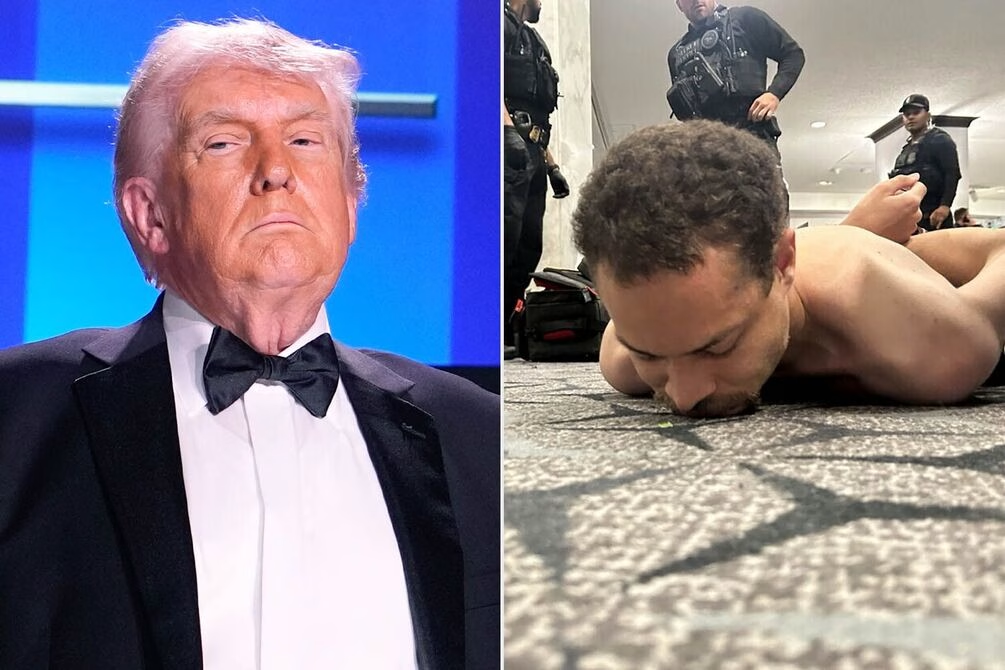
Prosecutors have laid out a stark narrative. During a recent court hearing, Assistant U.S. Attorney Jocelyn Ballantine described the situation in blunt terms, alleging that Allen “attempted to assassinate the president of the United States,” referring to Donald Trump. According to authorities, Allen arrived at the Washington Hilton armed with a 12-gauge pump-action shotgun and three knives, suggesting a level of preparation that prosecutors argue goes far beyond impulsive behavior.
Investigators say the incident unfolded as Allen allegedly tried to gain access to the ballroom where the dinner was taking place. The White House Correspondents’ Dinner is traditionally a mix of journalism, politics, and celebrity, attended by top officials, reporters, and public figures. That such an event could become the target of violence has intensified concerns about the vulnerability of even the most tightly secured venues.
Beyond the weapons themselves, prosecutors have pointed to additional evidence that could prove pivotal in court. Authorities recovered a written document believed to be a manifesto, in which Allen reportedly referred to himself as a “Friendly Federal Assassin.” While the writings included criticism of certain government actions during Trump’s presidency, officials noted that they did not explicitly name the president as a target. Even so, the tone and content have been presented as indicative of motive and state of mind.
The case also paints a complex portrait of the accused. According to available information, Allen had a strong academic background, having studied mechanical engineering at the California Institute of Technology before completing a master’s degree in computer science at California State University, Dominguez Hills in 2025. For some observers, this contrast—between educational achievement and the alleged actions—adds another layer of intrigue, raising questions about what may have driven him toward such extreme behavior.
Family accounts and investigative findings suggest that Allen had shown signs of escalating rhetoric in the period leading up to the incident. He was said to have made increasingly extreme statements and spoke about wanting to “do something” to address perceived problems in the world. Authorities also noted that he frequently visited shooting ranges, a detail that prosecutors may use to argue familiarity and intent in handling firearms.
Legally, the charges against Allen are severe. In addition to the attempted assassination allegation, he faces counts related to transporting firearms across state lines and using a weapon in the commission of a violent crime. Each of these carries significant penalties, and together they form a case that could result in decades of imprisonment if convictions are secured.
Implications of the Cole Allen Manifesto
While the immediate focus is on the criminal case itself, it’s unfolding in a wider climate of political and legal tension. Some observers have noted that ongoing disputes over access to records connected to Jeffrey Epstein could eventually overlap with broader questions about transparency and the role of the Department of Justice. That context has only intensified scrutiny of a statement attributed to Cole Allen in what investigators describe as a manifesto: “I am no longer willing to permit a pedophile, rapist, and traitor to coat my hands with his crimes.”
Donald Trump, who had been relatively restrained up to that point, reacted sharply in a CBS interview. “I’m not a rapist or pedophile,” he said, his tone shifting as he forcefully rejected the claim.
His response fits a familiar pattern, where public figures’ rebuttals quickly become part of the same fast-moving media cycle that produced the original controversy. In that environment, reactions and counter-reactions tend to blur together, shaping how the story evolves in real time.

Mein Kampf & Trump — Available on Amazon
During the interview, Trump also clashed with Norah O’Donnell after she read excerpts from the manifesto. That moment shifted the exchange, bringing the suspect’s own words into focus and cutting across Trump’s attempt to frame the situation on his own terms, despite the fact that the shooting itself was not directly connected to him.
In the end, the Cole Allen case goes beyond a single prosecution. It touches on security concerns, political strain, and the way institutions respond under pressure. As the legal process plays out, its impact could extend to how similar cases are handled—and how the public understands the balance between safety, accountability, and transparency in an increasingly polarized climate.
What happens next is likely to depend less on speculation and more on the courts, particularly whether judges push for broader access to Epstein-related records. That could bring some clarity to an issue that has long been marked by uncertainty.
Critics Call Kash Patel a “Useful Idiot” as Donald Trump Refuses to Fire Him
Jesus vs. Donald Trump: Comparing Legacy and Impact After Jesus-Like Image Controversy
Hungary’s Turning Point: Voters Reject Viktor Orbán—and the Trump–Putin Axis of Evil
Melania Trump’s Surprise Speech Ignites Epstein Firestorm and Raises New Questions