
By Don Terry | Wednesday April 29 2026 | 6 min read
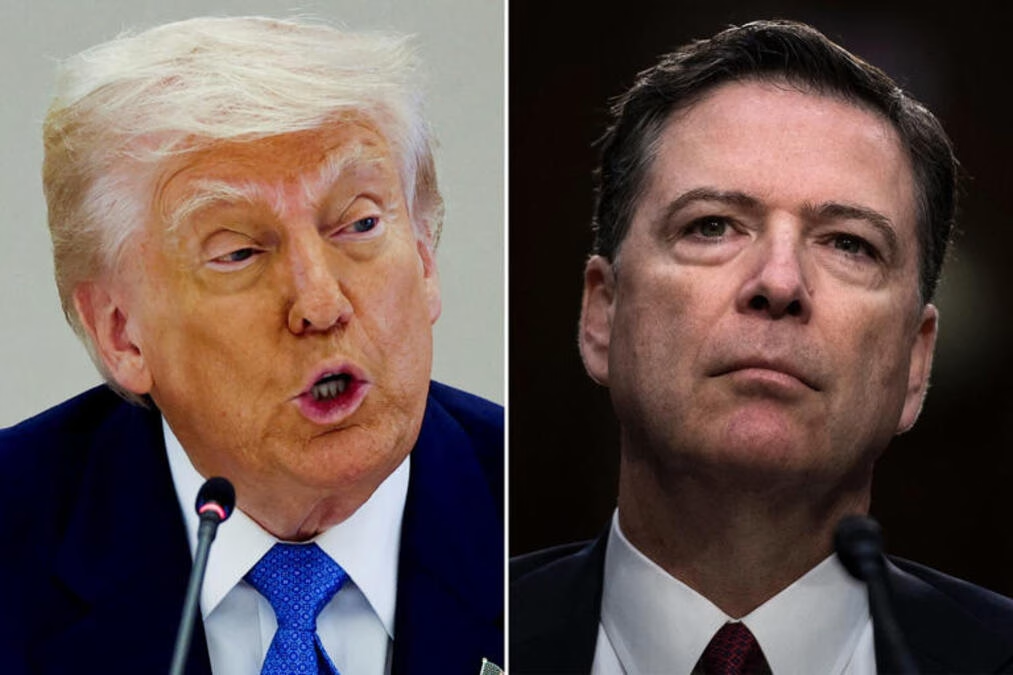
The long and often contentious history between Donald Trump and James Comey has once again taken a dramatic turn—this time with criminal charges tied to something as seemingly trivial as a social media post.
Their clash dates back nearly a decade, beginning during the 2016 presidential campaign. At the time, Comey was leading the FBI and found himself at the center of two politically explosive investigations: one into Hillary Clinton’s use of a private email server, and another examining possible links between Trump’s campaign and Russian interference. Trump’s view of Comey shifted depending on the moment—praising him when it seemed politically advantageous, then sharply criticizing him when scrutiny turned toward his own campaign.
Once Trump entered the White House, tensions escalated quickly. Their relationship ultimately collapsed in May 2017 when Trump fired Comey as FBI director. In the lead-up to a high-profile Senate testimony, Comey alleged that Trump had privately pressured him for “loyalty” and suggested he drop the FBI’s investigation into former national security adviser Michael Flynn. Under oath, Comey did not mince words, accusing the president of lying about the state of the FBI, calling those claims “lies, plain and simple.”
Years later, with Trump back in office for a second term, that fraught relationship has resurfaced in a new and unexpected way. The controversy centers on a now-deleted Instagram post from Comey, which showed seashells arranged to form the numbers “8647.” While “86” is commonly used as slang for getting rid of something, critics argued the phrase could be interpreted as a veiled threat when paired with “47,” a reference to Trump as the 47th president.
According to the Merriam-Webster dictionary, “86” is slang that means to throw something out, get rid of it, or refuse service. The term goes back to soda counter slang from the 1930s, where it was used to indicate that an item had run out.
So when someone tries to claim that posting “8647” is some kind of assassination threat, it just doesn’t hold up. By that logic, you’d have to say the diner staff are “threatening” the burger every time it sells out. It’s absurd.
From a legal standpoint, calling something a threat isn’t that simple. A real criminal threat has to be direct, clear, and unambiguous, with some indication that the person actually intends to carry it out. That’s a high bar—and for good reason. The slang definition of “86” doesn’t include anything about violence or threats.
Framing it that way feels like a stretch at best. Any serious legal review would normally look for clear intent and context, not just latch onto a vague slang term and reinterpret it. Without that, the argument starts to fall apart pretty quickly.
Comey said he removed the post after realizing it could be misunderstood, insisting he had no intention of suggesting violence. Still, the response from federal authorities was swift. The United States Secret Service reportedly questioned him, and surveillance measures were later used to track his movements and communications.
Now, the situation has escalated into formal legal action. A federal grand jury has indicted Comey on charges related to threatening the president and transmitting a threat across state lines. According to prosecutors, the post crossed a legal boundary, despite Comey’s claims that it was misinterpreted.
The indictment marks the second time Comey has faced federal charges since Trump’s return to power in 2025. Notably, previous legal action against him focused not on his role in major investigations like Russian interference or the Flynn case, but rather on allegations that he made false statements to Congress. That distinction has fueled criticism, with some arguing that revisiting earlier investigations could expose sensitive evidence gathered by special counsel inquiries.
Reaction to the latest charges has been deeply divided. Some legal experts and political figures have described the case as an overreach. Mark Warner warned that the prosecution reflects a broader effort to use the justice system against political opponents. Similarly, Dick Durbin called the indictment “baseless,” suggesting it serves political rather than legal purposes.
Others, however, defend the Justice Department’s actions. Acting Attorney General Todd Blanche emphasized that threats against a sitting president—real or perceived—are taken seriously, regardless of who makes them. Each charge carries a potential sentence of up to 10 years in prison, though actual penalties are often significantly lower.
Comey has pushed back forcefully. In a video response, he maintained his innocence and framed the case as a test of democratic principles. “I’m still not afraid,” he said, expressing confidence in the judicial system while warning that the situation reflects a troubling moment for the country.
His attorney, Patrick Fitzgerald, echoed that stance, stating that Comey intends to fight the charges in court and defend his First Amendment rights.
Meanwhile, Trump has responded with characteristic bluntness. Posting on his social media platform, he celebrated the indictment as a victory for justice and hinted that others he considers political adversaries could face similar scrutiny.

Mein Kampf & Trump — Available on Amazon
The broader context adds another layer to the story. The charges come amid heightened tensions following a recent security scare involving an alleged would-be attacker at a major Washington event. Trump allies have argued that inflammatory rhetoric from critics has contributed to a dangerous environment, while opponents counter that such claims are being used to justify aggressive legal action.
Behind it all is a familiar theme: retribution. Even members of Trump’s own circle, including White House chief of staff Susie Wiles, have acknowledged that settling scores has been part of the president’s approach since returning to office.
Whether this case ultimately holds up in court remains to be seen. But one thing is clear—the conflict between Trump and Comey, rooted in the political battles of 2016, is far from over.
The Cole Allen Case and Its Potential Risks for DOJ Handling of Epstein-Related Files
Trump fires back: “I’m not a rapist or pedophile” in response to Cole Allen-linked manifesto
Critics Call Kash Patel a “Useful Idiot” as Donald Trump Refuses to Fire Him
Jesus vs. Donald Trump: Comparing Legacy and Impact After Jesus-Like Image Controversy