
By Don Terry | Thursday May 07 2026 | 6 min read
The question isn’t whether the Supreme Court has become political. That debate is already settled in the minds of millions of Americans. The real question now is more unsettling: what, if anything, can be done about it—and who is willing to try?
A recent opinion piece in The New York Times left many readers with a lingering sense of unease. Not because it revealed something entirely new, but because it connected dots people had long suspected were there. When you step back and look at the arc—from Bush v. Gore to the gutting of the Voting Rights Act, to the expansion of corporate money in politics, and now to presidential immunity—it becomes harder to see these rulings as isolated decisions. They begin to look like a pattern.
Start with Bush v. Gore. In that moment, the Court effectively decided a presidential election, halting a recount and handing victory to George W. Bush despite Al Gore winning the popular vote. It was described at the time as a one-off, a constitutional emergency. But it set a precedent: the Court could step directly into the political arena and shape outcomes.
From there, the trajectory only became clearer. The weakening of the Voting Rights Act signaled a growing skepticism—if not hostility—toward federal protections for minority voters. Then came decisions that opened the floodgates for unlimited corporate spending, fundamentally altering the political landscape and empowering billionaires to exert outsized influence.
With the Court’s sweeping expansion of presidential immunity, the political landscape hasn’t just shifted—it’s cracked open. Critics say the ruling lands like a thunderclap, shaking the foundations of accountability itself. They’re no longer asking polite questions; they’re demanding to know what, exactly, the Court thinks it’s defending. Is it the presidency as a sacred institution—or the individual who stands to gain from this moment?
And many of those critics insist the timing tells its own story. To them, the ruling doesn’t look like a neutral guardrail for future presidents—it looks like a shield hammered together for Donald Trump alone, not for any Democratic leader who might one day face the same level of scrutiny. That belief has only sharpened against the backdrop of January 6, a day Americans witnessed in real time as the Capitol came under attack. The images were stark, unforgettable.
Yet in the years since, critics say they’ve watched a steady effort in some circles to soften, recast, or outright rewrite what happened. That widening gap—between what people saw with their own eyes and what they’re now being told—has deepened a sense of distrust, not just toward politicians, but toward institutions that were once expected to rise above the political fray.
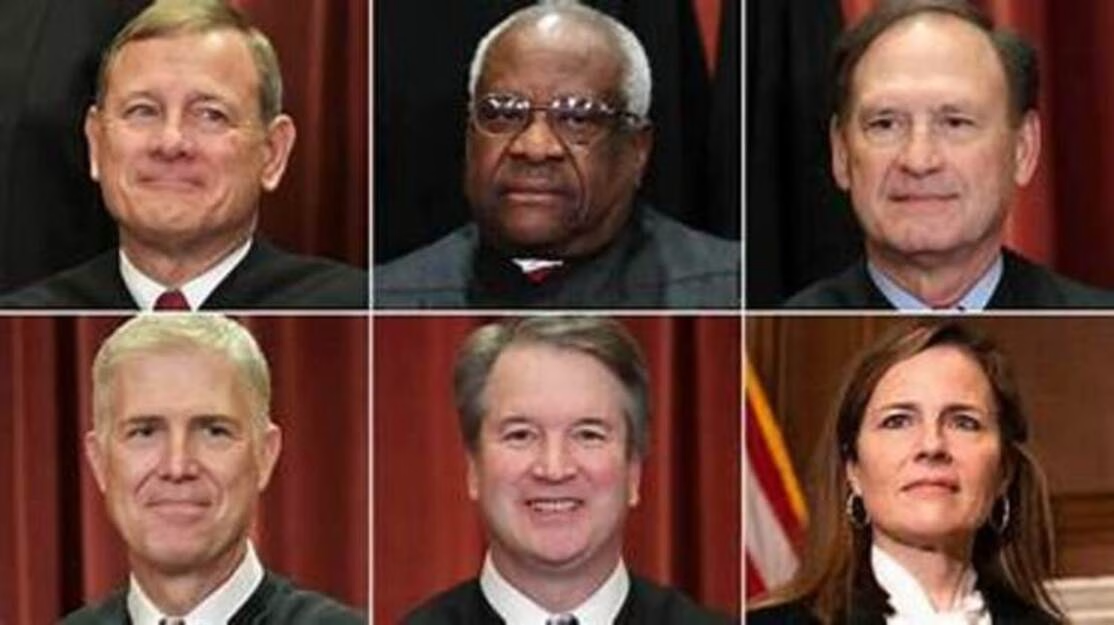
At the same time, reports of ethical concerns surrounding some justices have only fueled suspicion. Investigations have revealed that Clarence Thomas accepted luxury trips and gifts from wealthy benefactors, including Republican donor Harlan Crow. These aren’t minor lapses in judgment; they raise serious questions about influence, access, and accountability. In any other branch of government, such revelations might trigger swift investigations. Here, the response has been muted.
That silence is part of the problem.
The Supreme Court was designed to be insulated from politics, not intertwined with it. Lifetime appointments were meant to protect judicial independence—not to create a body that operates without meaningful oversight. When justices appear untouchable, confidence in the Court erodes. And when confidence erodes, so does the legitimacy of its decisions.
So who steps in?
If one branch of government drifts too far from public trust, the others are supposed to act as a check. But that only works if there is the political will to do so. And right now, that will feels uncertain.
With Donald Trump back in power, it’s difficult to imagine any serious effort to scrutinize the Court. If anything, the opposite seems more likely—further consolidation of power, fewer constraints, and even less accountability.
That leaves the burden on a future administration willing to confront the issue head-on.
But rhetoric won’t be enough. Restoring trust requires action. That could mean enforcing stricter ethics rules for justices, increasing transparency around their financial dealings, or even revisiting the structure of the Court itself. None of these steps are easy, and all would face fierce opposition. But avoiding the conversation altogether is no longer an option.
This is where the idea of R.A.G.E.—Restore America. Guard Elections.—comes into focus. Not as a slogan, but as a framework. The anger many Americans feel isn’t abstract. It’s rooted in a sense that the rules are no longer applied evenly, that power is being protected rather than checked.
But anger, by itself, isn’t a strategy. It has to be channeled into something constructive—into organizing, voting, and demanding accountability from leaders who claim to represent the public.
Winning the next election will matter—but it won’t be enough on its own. The bigger task is restoring faith in the institutions people rely on. That starts with choosing leaders who are not only effective, but beyond reproach—people whose integrity holds up under real scrutiny and whose decisions aren’t instantly written off as just more partisan maneuvering.

Mein Kampf & Trump — Available on Amazon
If Congress fails to act, the outcome is predictable. We’ve seen this pattern before. But history doesn’t just warn us—it also offers a roadmap. Past moments of crisis have shown that Congress is not powerless; it has tools to help shape a more democratic understanding of the Constitution. In that vision, constitutional meaning isn’t left solely to unelected judges—it’s shaped by the people and their elected representatives through lawmaking.
That means Congress shouldn’t simply defer to the Court’s authority. It should assert its own reading of the Reconstruction Amendments through legislation, just as lawmakers did after Dred Scott in 1862 and again following Bolden in 1982. For instance, Congress could argue that a functioning democracy requires a modern Voting Rights Act—one that tackles partisan gerrymandering through proportional representation and puts real limits on the flood of money in politics. And if it wants those interpretations to endure, it should follow the example of earlier Congresses by backing them up with strong, enforceable laws.
Because if there’s one lesson from the past two decades, it’s this: once trust in institutions begins to crack, it doesn’t take much for those cracks to spread.
The Supreme Court may not be on the ballot. But the future of its legitimacy is.
#OffAir #SupremeCourt #VotingRightsAct #Louisiana #Gerrymandering #Midterms2026 Supreme Court
Blood to Ballrooms: How Trump Turned Assassination Attempts Into Power and Profit
Justice Thomas Helped Dismantle the Voting Rights Protections His Parents Once Needed
Former FBI Director James Comey Charged Over Alleged Threat in ‘8647’ Seashell Post
The Cole Allen Case and Its Potential Risks for DOJ Handling of Epstein-Related Files
Trump fires back: “I’m not a rapist or pedophile” in response to Cole Allen-linked manifesto