


By Ben Emos | Friday January 23, 2026 | 6 min read
In the theater of global diplomacy, few acts have been as revealing—or as absurd—as Donald Trump’s ongoing feud with Norwegian Prime Minister Jonas Gahr Støre over the Nobel Peace Prize. What began as a misunderstanding has morphed into a full-blown diplomatic farce, offering a rare, unfiltered glimpse into how Trump governs: with grievance, spectacle, and a relentless need for personal validation.
Støre, a seasoned diplomat, has tried repeatedly to explain a simple fact: the Nobel Peace Prize is awarded by an independent committee, not the Norwegian government. “I’ve told President Trump many times,” he said, “that the Nobel committee is an independent committee… I am informed about the Nobel Prize alongside the rest of the world.” But Trump, never one to let facts get in the way of a good vendetta, has refused to accept this. “Don’t let anyone tell you that Norway doesn’t control the shots,” he told reporters. “I lost a lot of respect for Norway.”
This isn’t just about a golden medallion. It’s about how Trump sees power—not as a responsibility to be wielded with care, but as a stage for personal aggrandizement. His fixation on the Nobel Prize, like his branding of the Kennedy Center or his insistence that the Department of Justice act as his personal legal team, reflects a governing style rooted in ego and spectacle. Institutions are not sacred to Trump; they are tools to be bent, broken, or branded.
The irony is rich. María Corina Machado, last year’s Nobel laureate, was nominated by Marco Rubio—then a senator, now Secretary of State. After the U.S. orchestrated the ouster of Venezuelan President Nicolás Maduro, Machado handed her medal to Trump, hoping to curry favor. Yet even that gesture wasn’t enough. Trump’s administration has since pivoted to support Maduro’s deputies, leaving Machado in the cold. For Trump, loyalty is transactional—and fleeting.
Støre, for his part, has handled the situation with the kind of quiet dignity that contrasts sharply with Trump’s bombast. “We may be a small country, but we are a proud country,” he said. “We stand for our values. We stand for our procedures. We stand for our institutions.” It’s a reminder that diplomacy, at its best, is about patience, principle, and the long game.
What Trump’s Response To The Nobel Snub Exposes
But Trump’s response to the Nobel snub—linking it to threats of tariffs, even suggesting military action to seize Greenland—shows how he governs when he feels slighted. He lashes out, not just at adversaries, but at allies. He conflates personal slights with national interest. And he’s willing to upend global norms to soothe his ego.
This pattern isn’t new. From deploying federal troops to cities that displease him, to undermining the Treasury and turning ICE into a fear-inducing force on American streets, Trump has hollowed out the machinery of government. The Department of Justice, once a pillar of independence, now operates more like a legal defense firm for the president. Schools are threatened with funding cuts for not aligning with his cultural agenda. Even the arts haven’t been spared—witness the rebranding of the Kennedy Center in his image.
What the Nobel spat with Norway ultimately exposes is more than a simple misunderstanding of how international institutions work. It offers a glimpse into Trump’s core approach to power. He does not treat the presidency as a trust, bound by democratic norms and independent systems. He treats it as a stage for personal validation, where every exchange—whether with a foreign leader, a federal agency, or a central bank—is something to be bent, claimed, or “won.”
That perspective also sheds light on why Trump remains so preoccupied with his feud with Joe Biden. To him, the presidency appears to confer almost unchecked authority. He seems to believe that once a president takes office, inconvenient investigations can simply be made to disappear—whether they involve the president himself, close allies, or political rivals.
Because Trump assumed he could shield friends or deploy pardons before cases fully took shape, he expects that Biden should be able to do the same—bringing investigations to a halt, including those connected to the January 6 attack on the Capitol. When that doesn’t happen, Trump doesn’t read it as deference to independent institutions or the rule of law. Instead, he frames it as a personal slight, or even a deliberate act of persecution.
The same logic extends to his clashes with the Federal Reserve. Trump has long bristled at the idea that the Fed operates independently, free from presidential command. Interest rates, in his mind, should move at the will of the person in charge. The notion that there are guardrails—designed precisely to prevent political interference—feels less like a safeguard to him and more like an insult.
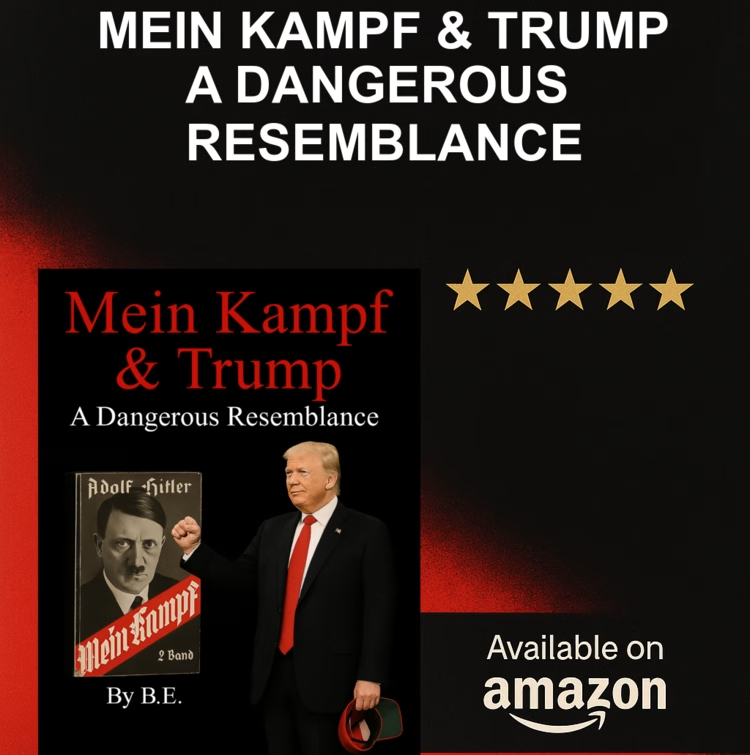
Mein Kampf & Trump Now On AMAZON
Seen this way, the Nobel dispute isn’t an isolated outburst or a moment of wounded pride. It is part of a larger pattern: a belief that authority should be centralized, personal, and responsive to one man’s expectations. Independent institutions, whether in Oslo or Washington, are tolerated only so long as they deliver the outcome he wants. When they don’t, they become suspect.
That is the deeper concern. Democracies rely not just on elections, but on leaders who accept limits on their own power. When those limits are viewed as obstacles rather than protections, every disagreement becomes a grievance—and every institution, an enemy.
In the end, the Nobel Peace Prize is just a symbol. But Trump’s obsession with it reveals something deeper: a governing style that prizes loyalty over law, spectacle over substance, and personal gain over public good. And that, more than any medal, is what history will remember.