

By Ben Emos & Andrew James | Tuesday January 20, 2026 | 6 min read
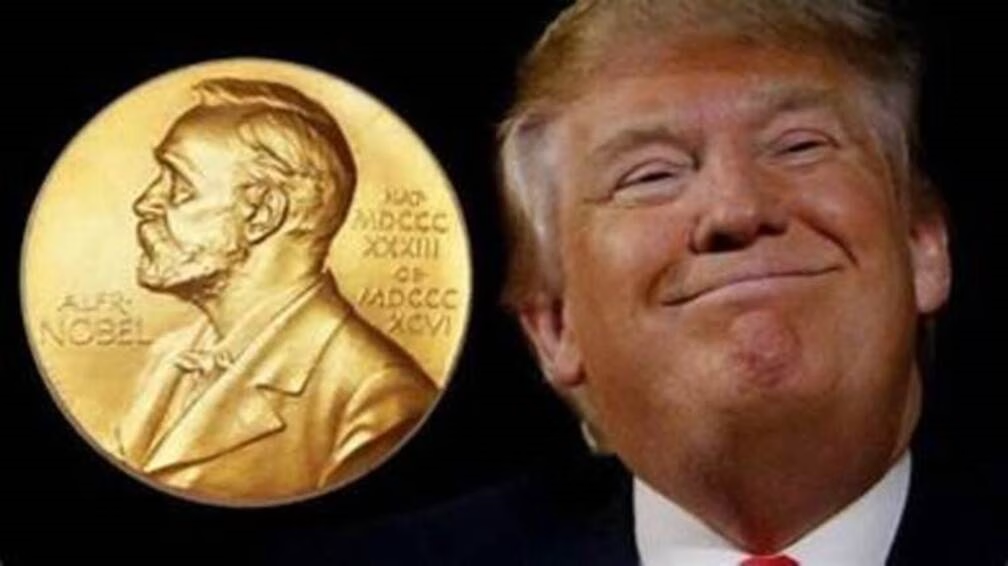
Donald Trump has never hidden his appetite for spectacle, but his latest remarks suggest something darker than mere showmanship. After once again missing out on the Nobel Peace Prize, the US president reportedly told confidants he no longer feels an “obligation to think purely of peace.” Shortly afterward, he sent a letter to Norwegian Prime Minister Jonas Gahr Støre reviving his desire for the United States to take control of Greenland. It is a sequence of events that feels less like strategy and more like a tantrum—yet also something more troubling than that.
Is this the behavior of a petulant child, lashing out because he did not receive the praise he believes he deserves? Or is it the symptom of an aging leader struggling with legacy, relevance, and the fear of being remembered for failure rather than triumph? Or perhaps it is something else entirely—a calculated attempt to change the subject, to pull attention away from the shadows of the Epstein saga and other uncomfortable questions.
The truth is likely messier than any single explanation. What we may be witnessing is a combustible blend of ego, insecurity, and deflection, all supercharged by the extraordinary power of the presidency. And when that mix spills into public life, it stops being a personal drama and starts becoming a global concern.
Trump has always seemed to judge success by how loudly the applause comes back to him. In that sense, the Nobel Peace Prize was never just an award; it was a symbol of global admiration, a seal of approval from the world’s elite. He has chased it openly for years, and failing to secure it appears to have cut deeper than he lets on. His comment about no longer feeling an “obligation to think purely of peace” is therefore more than a throwaway line. It is a jarring thing to hear from any world leader—especially one who controls the most powerful military on the planet.
Peace is not something a president can set aside when recognition fails to arrive. It is not a favor extended in exchange for praise, nor a posture adopted only when it feels personally rewarding. It is a duty that comes with power, one that persists regardless of bruised egos or unmet ambitions. Suggesting otherwise exposes a deeply personal way of viewing global responsibility, where principle bends to emotion.
The defensiveness surrounding the Nobel snub only reinforces that impression. Even Trump’s White House spokesperson, Steven Cheung, jumped into the fray, angrily lashing out at the Nobel Foundation after it dryly noted that its prizes cannot be transferred or “re-gifted”—not even to sitting presidents. The episode felt less like a dignified disagreement and more like a public sulk, played out on the international stage.
Taken together, it paints an uncomfortable picture: a president who sees peace not as a constant obligation, but as a transaction tied to personal validation. That mindset may play well to loyal supporters, but it is a dangerous lens through which to view the world. When the pursuit of applause begins to outweigh the responsibility of leadership, the cost is rarely borne by the leader alone.
The renewed push to acquire Greenland underscores this point. Trump first floated the idea years ago and was met with disbelief and outright rejection. Greenland is not a trophy to be bought, nor a chess piece to be seized in a fit of wounded pride. It is an autonomous territory with its own people, history, and political aspirations. Yet Trump’s letter to Norway suggests that he still views the issue through the lens of possession and dominance, rather than diplomacy or respect for sovereignty.
Europe, understandably, is alarmed. The leaders of all 27 European Union nations are now set to convene an extraordinary meeting in response to Trump’s escalating pressure campaign. Such a gathering is not called lightly. It signals that European governments see this not as idle talk, but as a genuine destabilizing force—one that threatens to upend transatlantic relations and revive old anxieties about American unilateralism.
Mein Kampf & Trump Now On AMAZON
What makes this moment especially unsettling is the emotional undertone driving it. World leaders are expected to absorb setbacks, criticism, and disappointment without turning them into policy vendettas. When personal grievance begins to shape foreign policy, the consequences ripple far beyond bruised egos. They affect alliances, global security, and the lives of people who never had a vote in the matter.
There is also a deeper sense of decline at play. Trump’s fixation on legacy—how history will judge him—appears to be hardening into resentment. Instead of asking why his actions failed to earn him the accolades he wanted, he seems to be questioning the value of peace itself. That is not the thinking of a confident leader secure in his place in history. It is the thinking of someone who feels cornered by time, criticism, and unmet expectations.
Yet reducing this to an “old age crisis” would be too easy, and perhaps too forgiving. Trump is not confused about the power he wields. He is choosing, consciously, to frame global politics as a personal scorecard. That choice is what should worry both allies and adversaries.
If this episode tells us anything, it is how thin the line can be between a leader’s personal resentments and consequences that spill across borders. When ego starts to fuse with state power, it is never just the leader who absorbs the fallout. Nations do. Alliances do. Ordinary people do. Europe appears to grasp that danger, which is why its leaders are scrambling to respond with urgency rather than indifference.
The rest of the world would do well to look past Trump’s bruised pride and focus instead on where this road leads. History is littered with moments when personal grievance was mistaken for strategy, and ambition for destiny. Those moments rarely end well.

And then there is the farce that hovers around the Nobel Prize itself. Watching Venezuela’s opposition figure María Corina Machado symbolically hand Trump a Nobel as if soothing a restless child, one can almost imagine Alfred Nobel spinning in his grave. His prize was meant to honor restraint, humanity, and the hard work of peace—not to serve as a pacifier for wounded egos or a prop in political theater. If this is what the Nobel has been reduced to, the tragedy is not just Trump’s obsession with it, but what the obsession says about how cheap global honors have become in the hands of power.