

By Andrew James, Don Terry & Ben Emos | Sunday January 18, 2026 | 5 min read
For months, the world has watched a strange geopolitical drama unfold—one that began with bluster, escalated into something resembling a manufactured crisis, and is now sputtering toward an anticlimax. Donald Trump’s latest threat to impose tariffs on countries that refuse to support a U.S. bid for Greenland is not the move of a leader confidently steering global affairs. It looks far more like the final kick of a child backing out of a fight he started, determined to save face on the way out.
In an op‑ed published on January 16, 2026, titled Trump Won’t Invade Greenland. But He’s Already Damaging America’s Alliances, we argued that a U.S. military attack on Greenland was extraordinarily unlikely. Greenland is part of the Kingdom of Denmark—a NATO ally. Any military action would risk triggering Article 5, splintering the alliance from within, and igniting resistance across Congress, the Pentagon, the courts, financial markets, and allied capitals. Even Trump, who has pushed the boundaries of presidential behavior more aggressively than any modern leader, has never crossed into direct military aggression against a treaty ally. That line, we wrote, still held.
It still does. And that is precisely why we are now witnessing this awkward pivot.
Trump got the attention he wanted. He stirred the pot. He dominated headlines. But somewhere between the theatrics and the reality of governing, someone—likely a collection of generals, intelligence officials, and sober‑minded advisers—reminded him that invading Greenland would be catastrophic. So instead of marching toward a war he could never win, he is retreating. But he refuses to do so quietly.
“I may put a tariff on countries if they don’t go along with Greenland, because we need Greenland for national security,” Trump said during a White House roundtable on Friday. The remark landed with the emotional maturity of a playground ultimatum. If he cannot have Greenland, he can at least punish those who won’t indulge the fantasy.
European allies have not budged. Leaders across the continent—including Britain’s Sir Keir Starmer—have reiterated Denmark and Greenland’s position: the island is not for sale. Not at any price. Not under any pressure. Not even under the threat of American economic retaliation.
Trump’s fixation on Greenland intensified after the dramatic raid on Nicolás Maduro’s compound in Caracas on January 3. The Venezuelan leader is now in U.S. custody, facing drug‑related charges. That operation, successful on its own terms, seems to have emboldened Trump’s belief that bold, unilateral action can reshape the world to his liking. Greenland became the next target of that impulse.
But Denmark and Greenland have remained firm. Their ministers met with Vice President JD Vance at the White House this week, and both sides acknowledged what diplomats often call “fundamental differences.” They will keep talking, but the gulf between them is not narrowing.
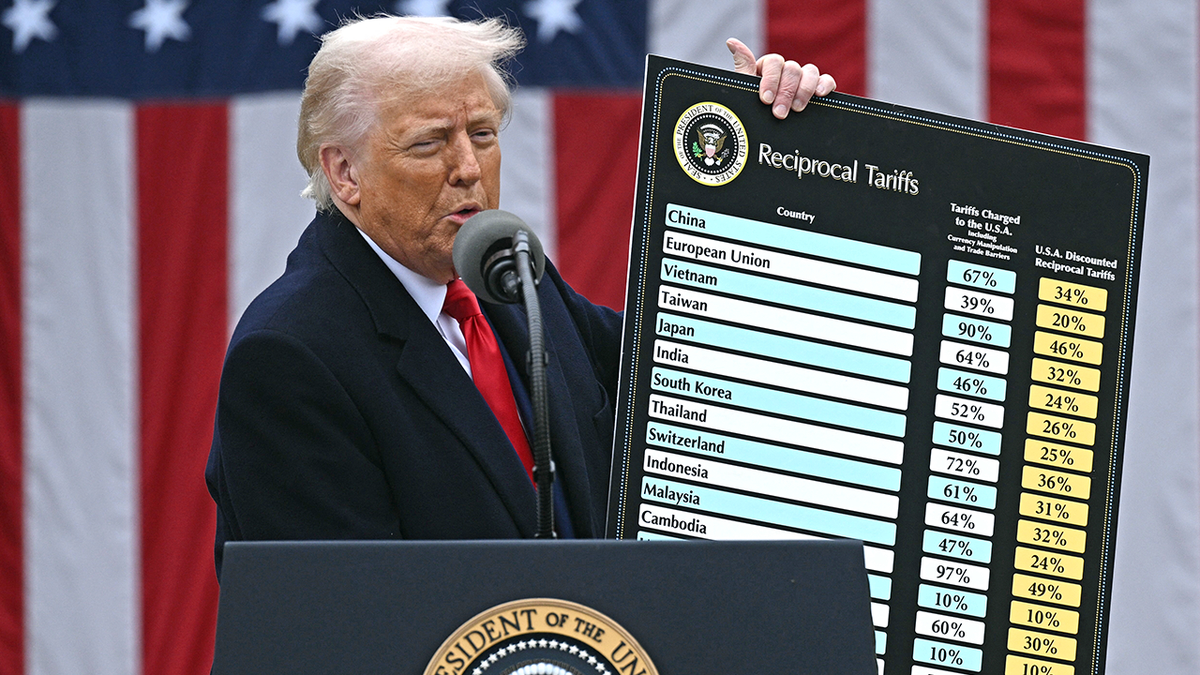
Tariffs, however, are familiar terrain for Trump. Throughout his second term, he has wielded them as a blunt instrument—sometimes to extract concessions, sometimes simply to demonstrate power. His latest threat comes just days after announcing a 25 percent tax on imports from countries that do business with Iran. The Greenland tariff threat fits neatly into this pattern: when diplomacy fails, or when reality refuses to bend, Trump reaches for economic punishment.

Since returning to office, he has insisted that the United States must acquire Greenland for national security reasons. Anything less, he said earlier this week, would be “unacceptable.” He has accused Denmark of failing to protect the island from Russia and China, and he has framed U.S. acquisition as a strategic necessity. European nations, in response, have begun sending small contingents of military personnel to Greenland at Denmark’s request—a symbolic but unmistakable signal of solidarity.
Officials from France, Germany, the United Kingdom, the Netherlands, Finland, Norway, and Sweden arrived on the island Thursday. Their presence underscores a simple truth: the West is not divided on this issue. Only Washington is.

Mein Kampf & Trump Now On AMAZON
And that is the real cost of Trump’s Greenland gambit. Not a war that was never going to happen, but the erosion of trust among allies who increasingly see the United States as unpredictable, impulsive, and willing to destabilize long‑standing partnerships for the sake of spectacle.
Trump may be backing away from the brink, but he is doing so in a way that still damages America’s standing. Tariffs, threats, and theatrics cannot disguise the fact that this crisis was unnecessary from the start. The world is left to clean up the diplomatic mess, while the United States—once the anchor of the Western alliance—looks more like the source of the storm.
Y