

By Mary Jones & Ben Emos | Wednesday January 21, 2026 | 5 min read
While CNN, and other major networks flooded the airwaves with breathless coverage, parsing every stray remark Trump made about Greenland and wrapping it in a fog-of-war narrative, Fedlan News chose a different path. Instead of amplifying speculation, it offered a more measured view—laying out why the idea of the U.S. military attacking Greenland is not just unlikely, but implausible.
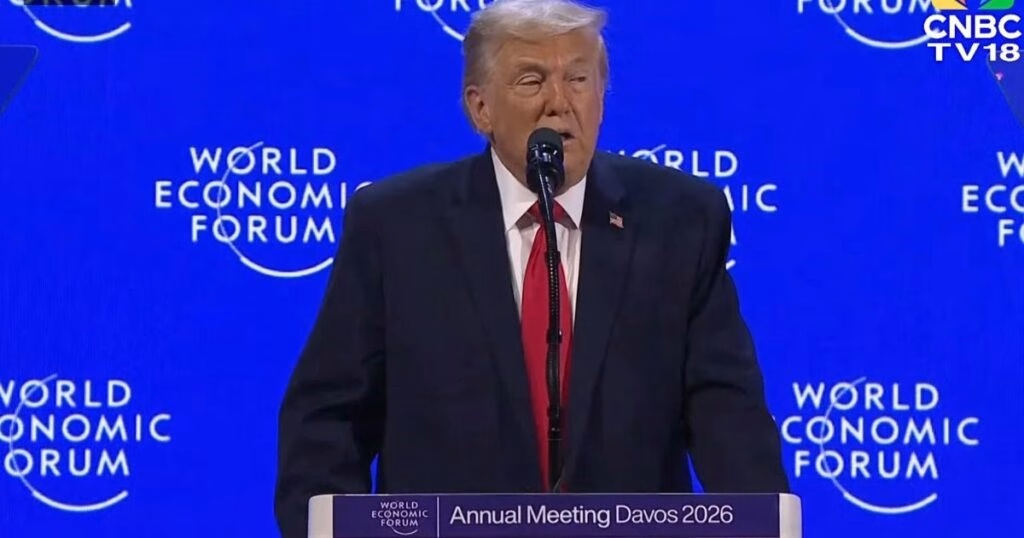
That context mattered when President Donald Trump stepped onto the stage at the World Economic Forum on Wednesday. The audience was already primed for a speech that would drift well beyond interest rates and trade balances. Trump did not disappoint. What followed was a familiar mix of swagger, grievance, and off-the-cuff geopolitics. And tucked into it, almost casually, was the revival of one of the strangest notions of his presidency: the idea that the United States should acquire Greenland.
Trump’s comments were unmistakably bold and nasty. He spoke about wanting to “get Greenland, including right, title and ownership,” a line that drew a mix of laughter, confusion, and raised eyebrows across the hall. But buried beneath the theatrics was a point that matters far more than the headline‑friendly soundbite. Trump made it clear he would not pursue any form of military action to obtain the island. For all the talk of expansionism, he insisted force was not on the table.
That distinction matters. In an era where political rhetoric often blurs into policy speculation, Trump’s clarification — however casually delivered — signals a boundary he is not willing to cross. And it comes at a moment when U.S. relations with European allies are already strained, making any suggestion of territorial ambition especially sensitive.
Throughout his speech, Trump repeatedly took aim at European leaders, accusing them of complacency, hypocrisy, and an overreliance on American defense commitments. He returned to familiar criticisms of NATO, arguing that the alliance should not obstruct what he described as America’s “rightful interests.” The message was unmistakable: the United States, under his leadership, would not allow international institutions to dictate its strategic ambitions.
Yet even as he leaned into this posture of defiance, Trump drew a line around the Greenland idea. He framed the concept not as a military objective but as a strategic opportunity — one he believes the United States should pursue through negotiation, influence, and economic leverage rather than force. It was a rare moment of restraint in a speech otherwise filled with confrontational energy.
For observers in Europe, the remarks landed with a mix of skepticism and unease. Greenland, an autonomous territory within the Kingdom of Denmark, has long been a point of strategic interest due to its location in the Arctic and its natural resources. Trump’s earlier interest in purchasing the island was widely dismissed as unserious, even comical. But his renewed focus suggests he sees the Arctic as a frontier where the United States must assert itself more aggressively.
Still, the insistence that military action is off the table may offer some reassurance. Trump’s comments suggest he understands the geopolitical cost of escalating tensions with Denmark and NATO allies over a territorial dispute. Instead, he appears to be positioning the Greenland idea as part of a broader argument about American influence — a symbolic gesture meant to underscore his belief that the United States should think bigger, act bolder, and challenge the assumptions of post‑Cold War diplomacy.
What remains unclear is whether this renewed interest in Greenland is a serious policy direction or simply another example of Trump using provocative ideas to frame a larger narrative. His speeches often blend genuine strategic instincts with improvisational showmanship, making it difficult to separate intention from performance.

Mein Kampf & Trump Now On AMAZON
One point cuts through all the noise. For all the sharp lines and the digs at America’s European partners, Trump’s posture on Greenland never edges toward an actual showdown. Fedlan News noted this early — the idea of the United States launching any kind of military action against Greenland is, in practical terms, almost impossible. Greenland is part of the Kingdom of Denmark, a NATO member.
Any strike would risk triggering Article 5, splinter the alliance from within, and ignite resistance across every major American institution — Congress, the Pentagon, the courts, financial markets, and allied governments. Even Trump, who has pushed political boundaries more than most modern presidents, has never stepped into the territory of direct military aggression against a treaty ally. That line, at least for now, remains firmly in place.
In the end, the talk about Greenland made plenty of noise but amounted to very little. It’s a useful reminder that even in an unpredictable political moment, some lines in global politics still don’t move. The media, however, took the bait. By now, there should be a clearer sense of when Donald Trump is making a serious proposal—and when he’s simply putting on a show. The Trump media diversion should end now.