
By Ben Emos | Tuesday January 27, 2026 | 5 min read
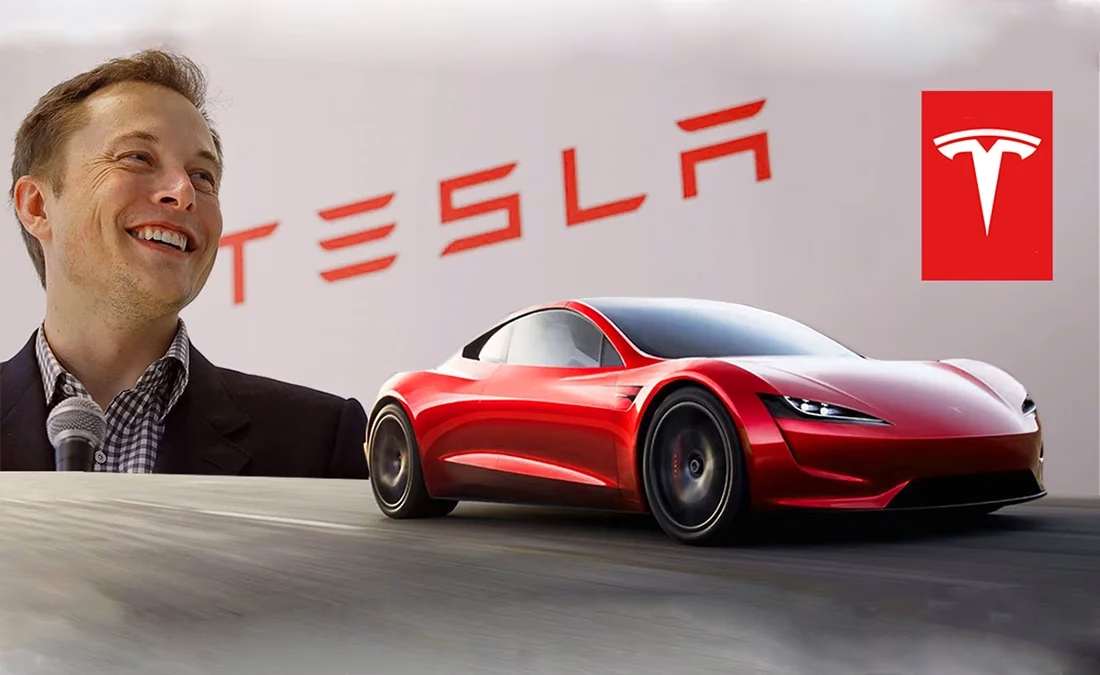
When Elon Musk took the stage at the World Economic Forum in Davos, he delivered the kind of bold, headline‑ready statement that has become his trademark. With cameras rolling and investors listening closely, he claimed Tesla’s supervised Full Self‑Driving system was on the cusp of winning regulatory approval in Europe—“as early as next month,” he said. Coming just weeks after shareholders signed off on his staggering $1 trillion pay package, the remark landed with the kind of jolt that can send markets buzzing.
But outside the Davos spotlight, the people who actually make these decisions in Europe tell a very different story.
For all of Musk’s trademark confidence, the reality is straightforward: no European regulator has signed off on FSD. Not a single one. And just as importantly, none of them have given Tesla anything close to the timeline Musk floated in Davos. The European Union hasn’t published a schedule, and the Dutch vehicle authority, RDW — the body that oversees Tesla’s approvals for the entire EU — hasn’t offered a date either. In fact, RDW has been unusually clear, stressing that it has made no promises to Tesla about when, or even if, supervised FSD will be approved.
What is true is that RDW and Tesla have agreed on a procedural step: Tesla is expected to demonstrate in February 2026 that FSD Supervised meets the technical and safety standards required for the next stage of the review. That’s a milestone, not a green light — and it’s a long way from the certainty Musk projected on stage in Davos.
That’s the part Musk left out.
Musk’s optimism is nothing new. He has been predicting imminent breakthroughs in autonomous driving for nearly a decade. Each year brings a new promise: full autonomy by the end of the year, robotaxis around the corner, regulatory approval just months away. And each time, the timeline slips.
In the United States, Tesla’s supervised FSD is already operating on public roads, and regulators have largely looked the other way — even as people have died in crashes involving the system. The fatalities haven’t triggered the kind of decisive oversight you’d expect for a technology this powerful. Instead, the pattern has been hesitation, fragmented investigations, and a willingness to let Tesla push ahead while the body count becomes part of the learning curve.
Europe is different. The EU’s regulatory framework is stricter, more methodical, and far less swayed by corporate bravado. Safety systems must meet harmonized standards. Software updates require formal review. And claims about autonomy are scrutinized with a level of skepticism that Silicon Valley rarely encounters at home.
So when Musk told the Davos audience that approval could come “next month,” European regulators didn’t scramble to confirm it. They simply reiterated the facts: the review is ongoing, the process is complex, and no timeline has been set.
To understand the disconnect, it helps to look at how Europe approaches vehicle automation. The EU’s rules are built around the idea that safety systems must be predictable, transparent, and thoroughly validated before they reach public roads. Tesla’s FSD, by contrast, is a constantly evolving software suite that relies heavily on real‑world data and frequent updates. That model clashes with Europe’s preference for fixed, certifiable systems.
Language is part of the problem too. Tesla markets its software as “Full Self‑Driving,” despite the fact that the system still needs a fully attentive human behind the wheel. European regulators have been raising red flags about that branding for years, warning that it can give drivers a false sense of what the technology can actually do. Until Tesla addresses those concerns, getting approval in the EU will remain a steep climb. Even California has stepped in recently, telling Musk to fix the public perception that Tesla vehicles are capable of true self‑driving when they aren’t.
Musk’s Davos comment didn’t just stir regulatory debate—it raised eyebrows among investors. After securing the largest compensation package in corporate history, Musk is under pressure to deliver growth narratives that justify the valuation Tesla continues to command. Autonomous driving has long been his most ambitious promise, the one that could transform Tesla from a car company into a software‑powered mobility giant.
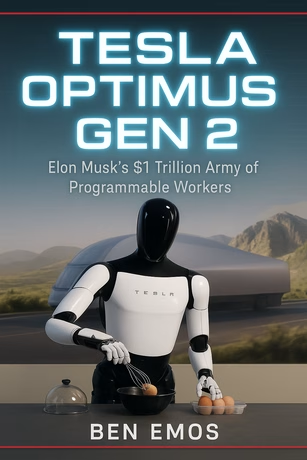
Optimus Gen 2 Tesla Army of Workers
Europe’s response highlights a truth Musk can’t talk his way around: regulatory approval isn’t a marketing slogan. It’s a legal process, and it moves according to its own rules, not his timelines. And if he believes that patching things up with Donald Trump after their public fallout will somehow pressure European regulators into dropping their standards out of fear or political leverage, he’s fooling himself. Europe doesn’t operate that way, and no amount of posturing will change that.
Strip away the noise, and the situation is straightforward. Musk expects approval soon. Europe does not. The EU has not endorsed his timeline. RDW has not promised anything. And until regulators finish their review, supervised FSD remains unapproved across the continent.
Musk may be comfortable making bold predictions on global stages. European regulators, however, are not in the business of validating optimism. Their message is simple: the process continues, and nothing is guaranteed.
Musk’s Tesla FSD Approval Hits a Wall in China — and Shareholders Feel the Strain
Not Every Republican Is Racist. Every Racist Knows Which Party Welcomes Them
Inside Elon Musk’s Neuralink and the Difficult Road to Human Brain Implants
Barron Trump’s FaceTime Romance Unravels in London Courtroom Drama
How the Media Keeps Falling for Trump’s Feud With Biden—as if It’s About the 2020 Election
Jack Smith: A Jury Would Have Found Trump Guilty Beyond a Reasonable Doubt
Copyright 2024 FN, NewsRoom.