

By Andrew James | Sunday January 25, 2026 | 5 min read
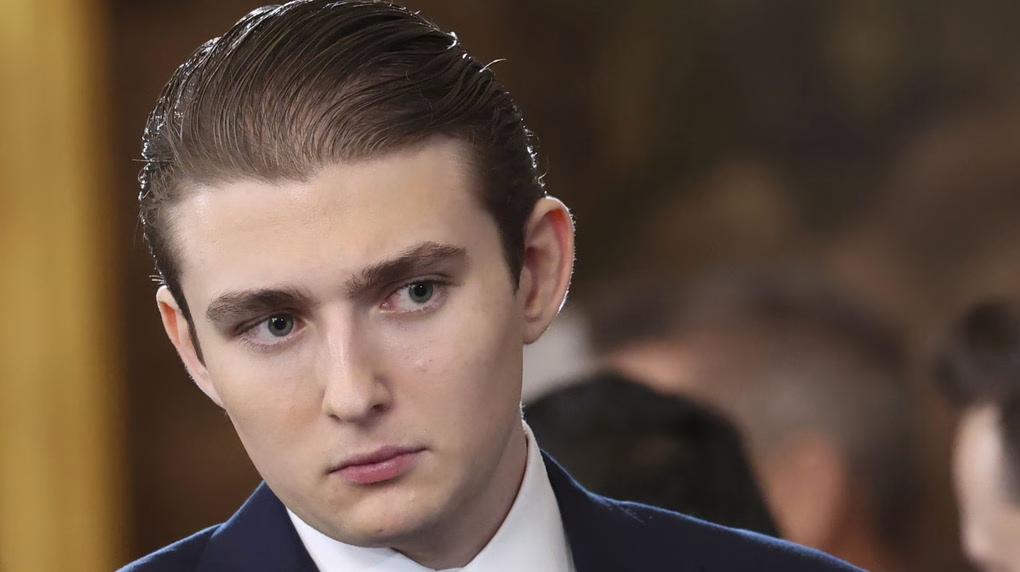
What began as a seemingly heroic tale of a young man calling police from across the Atlantic to save a woman’s life has spiraled into a tangled web of late-night calls, jealousy, and courtroom revelations. At the center of it all is Barron Trump, the 19-year-old son of U.S. President Donald Trump, whose private life has suddenly been thrust into the spotlight.
The headlines first painted Barron as a long-distance savior. According to court testimony, he was on a FaceTime call with a 22-year-old woman in London when he allegedly witnessed her being assaulted by her then-boyfriend, Matvei Rumiantsev. Barron, alarmed by what he saw and heard, dialed emergency services from the U.S., prompting British police to intervene. The woman later credited him with saving her life.
But as the trial unfolded at Snaresbrook Crown Court in East London, the story took a more complicated turn. The woman, whose identity remains protected, testified that she and Barron had developed a “very close” online relationship. They exchanged frequent messages and FaceTime calls, often late into the night. She affectionately referred to him as “sweetheart,” a term that reportedly infuriated her then-boyfriend.
Rumiantsev, a 22-year-old Russian-born former MMA fighter, is now on trial for multiple charges, including assault and rape. He claims the woman was “leading on” Barron and that her feelings for the young Trump were not genuine. His defense paints the relationship as a flirtatious distraction that fueled the couple’s already volatile dynamic.
The courtroom revelations have offered a rare glimpse into Barron Trump’s personal life—territory that has largely remained off-limits during his father’s political career. Known for his towering height and low public profile, Barron has mostly stayed out of the limelight. But this case has changed that.
Adding to the intrigue are reports that Barron has recently been in contact with controversial internet figure Andrew Tate. Sources suggest he has taken “dating advice” from someone close to the Tate brothers, who are known for their misogynistic rhetoric and legal troubles. While there’s no indication that Barron has adopted their views, the association has raised eyebrows.
The timing of the courtroom drama is hard to ignore. It has unfolded against a backdrop of political noise in the United States, with renewed attention on the Epstein files and growing anticipation around a second report from Special Counsel Jack Smith. In that context, some observers have begun to wonder whether the sudden media fixation on Barron’s role in the London case is doing more than simply reporting the facts. To them, it looks like a convenient distraction from stories that could prove far more damaging politically.
Trump, as he often does, added his own twist. Rather than dampening the attention, he appeared to redirect it—floating the provocative suggestion that Barron should set his sights on the crown princess of Denmark. The remark, half spectacle and half provocation, shifted headlines once again, creating a fresh diversion just as scrutiny elsewhere was intensifying.
Still, the emotional core of the story remains deeply human. A young woman caught in a toxic relationship. A teenage boy, thousands of miles away, trying to help. A jealous ex spiraling into violence. And a courtroom trying to untangle it all.
For Barron Trump, this incident could very well be a defining moment—one that shifts him from the periphery of public life into the center of a deeply personal and emotionally charged narrative. Whether he saw himself as a protector, a close friend, or something more, his decision to act that night carried weight. The woman at the heart of the case described his intervention as “a sign from God,” a phrase that underscores just how much his call to the authorities meant in a moment of crisis.
As the legal process unfolds, what’s becoming increasingly evident is that Barron is no longer just the tall, silent figure glimpsed in the background of official events. He’s now part of a story that blends digital intimacy, emotional vulnerability, and the darker edges of a relationship gone wrong. It’s a story that feels more like a streaming drama than real life—but for those involved, the consequences are all too real.

Optimus Gen 2 Tesla Army of Workers
The courtroom has become a stage for painful revelations, and one particularly disturbing possibility now hangs in the air. If investigators determine that Matvei Rumiantsev, acting out of jealousy or malice, used FaceTime to expose Barron to the act of raping his former girlfriend, which was alleged, the consequences would be profound for everyone connected to the case.
Such an act would not only be a grotesque violation of the victim’s dignity but also a calculated attempt to inflict psychological harm on both her and Barron. It’s a scenario that, if true, demands serious scrutiny from prosecutors.
Regardless of how the case concludes, the emotional toll is undeniable. Both Barron and the young woman have been pulled into a maelstrom of trauma, public exposure, and legal complexity. Healing from this will likely require more than time—it will require professional support, compassion, and space away from the glare of public judgment.
In the end, this isn’t just a tabloid curiosity or a political distraction. It’s a human story—messy, painful, and raw. And for Barron Trump, it may be the moment he steps out from behind the curtain and into a world that’s far more complicated than anyone imagined.
How the Media Keeps Falling for Trump’s Feud With Biden—as if It’s About the 2020 Election
Jack Smith: A Jury Would Have Found Trump Guilty Beyond a Reasonable Doubt
Greenland Is a Distraction—Epstein Island Is the Scandal That Still Haunts Trump
A Nobel Snub, a Wounded Ego, and a World at Risk: Trump’s Dangerous Meltdown
Trump’s Tariff Threats Over Greenland Reveal a Leader Backing Away From a Crisis of His Own Making

Copyright 2024 FN, NewsRoom.