

By Jane Lewis | Tuesday June 09 2026 | 4 min read
The Trump administration has opened a new and volatile chapter in U.S. immigration enforcement, announcing the largest denaturalization sweep in American history. Seventeen naturalized citizens now face the possibility of losing their U.S. citizenship—an extraordinary escalation of a tool that, for decades, was used sparingly and only in the most egregious cases.
For most of modern history, denaturalization was a legal relic, invoked only when the government could prove clear, intentional fraud. Between 1990 and 2017, the Justice Department averaged just 11 such cases a year. The process was slow, complex, and treated as a last resort. But the administration’s new posture signals a dramatic shift: denaturalization not as a rare corrective, but as an active enforcement strategy.
Officials say the 17 individuals targeted in this latest round concealed serious crimes, including child sexual abuse, fraud, and money laundering. The list is grim: a Haitian man accused of abusing his daughter; a former Yugoslav national convicted of assaulting a minor; a Colombian‑born ex‑priest facing child sex‑abuse allegations; a Filipino man who pleaded guilty to a child‑sex offense. Others are accused of financial crimes, identity fraud, or falsifying immigration documents.
Acting Attorney General Todd Blanche framed the campaign as a matter of public safety, saying the government would show “zero tolerance” for those who “lie about their past crimes.” Homeland Security Secretary Markwayne Mullin echoed the sentiment, insisting that citizenship is a privilege that must be “earned honestly.”
But the scale and speed of the effort raise deeper questions—about precedent, about selective enforcement, and about the political currents shaping immigration policy in 2026.
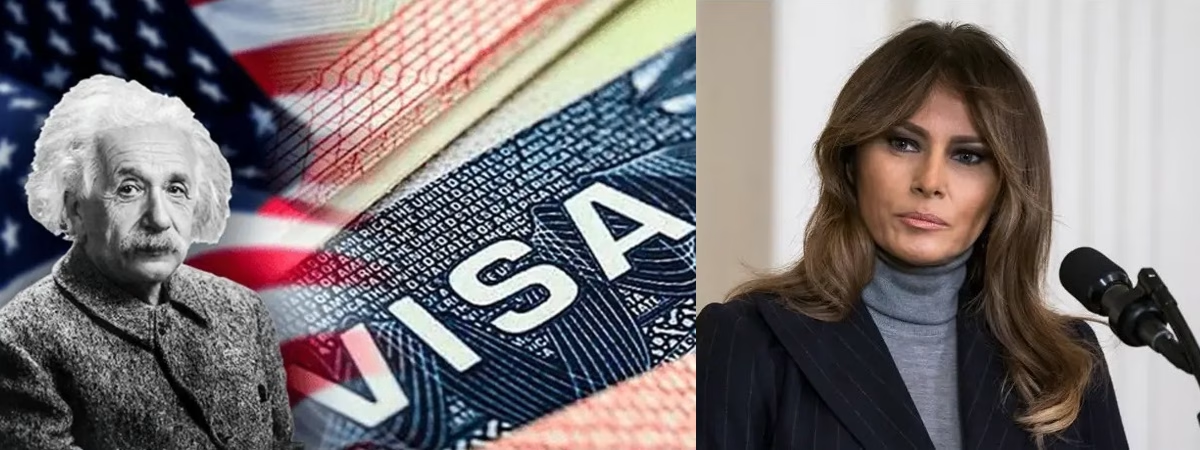
And inevitably, one question resurfaces: If the government is now aggressively scrutinizing past immigration filings, could high‑profile cases like Melania Trump’s so‑called Einstein visa face renewed public attention? And let’s be honest: it would be a complete dereliction of duty if Democrats, should they return to power, refused to investigate how she secured an EB‑1 visa and how her parents later used family‑based immigration rules, often labeled “chain migration,” to obtain their own U.S. citizenship.
If this administration insists on setting a new standard for accountability, then that standard should apply to everyone, not just the people they choose. Melania Trump received an EB‑1 visa in 2001, a category reserved for individuals with “extraordinary ability.” At the time, immigration experts publicly questioned how a fashion model—successful, yes, but not widely regarded as a world‑leading figure—qualified for a category typically used by Nobel laureates, Olympic athletes, and groundbreaking researchers. Those questions have never fully disappeared.
Now, as the administration expands denaturalization to unprecedented levels, critics argue that the government cannot selectively apply scrutiny. If the new standard is total transparency and zero tolerance for misrepresentation, they say, then all high‑profile immigration cases deserve the same level of examination. Some commentators have even suggested that the government’s renewed interest in historical immigration fraud could extend to reviewing sealed or long‑dormant files, including those connected to figures like Jeffrey Epstein—though no such review has been announced.

Mein Kampf & Trump — Available on Amazon
The administration rejects the idea that politics plays any role in its denaturalization push. Officials insist the campaign is narrowly focused on individuals who concealed crimes or lacked the “good moral character” required for naturalization. But the sheer breadth of the new effort—combined with the administration’s broader crackdown on both legal and illegal immigration—has left immigrant communities uneasy.
For the 17 individuals now facing denaturalization, the stakes could not be higher. If they lose their citizenship, they revert to their previous immigration status, typically as permanent residents. That change strips them of voting rights, federal protections, and—most critically—protection from deportation. In many cases, denaturalization is only the first step toward removal.
The legal battles ahead will be long, public, and deeply personal. And as they unfold, the country will confront a larger question: What does it mean to belong in America when citizenship itself can be undone?
Why Critics Believe Trump and Six Justices Are Suddenly Afraid of the Midterm Fallout
The Danger of Making Elon Musk a Trillionaire: Power, Volatility, and Unchecked Influence
Brutal Court Dismissal Opens the Floodgates on Trump DOJ’s Vindictive Prosecutions
The Role of Philip Alito in the $1.776 Billion Fund: Questions of Ethics, Recusal, and Public Trust
Trump May Have Accidentally Undermined His Own Immunity Defense as Court Battle Intensifies