

By Andrew James | Monday March 23 2026 | 5 min read
“Drain the swamp” was never just a slogan—it was a promise. When Donald Trump first delivered that line on the campaign trail, it resonated because it tapped into something real: a widespread belief that Washington had become too cozy, too self-serving, too disconnected from ordinary people. The idea was simple. Clean it up. Make it accountable. Put the public first.
But years later, it’s fair to ask whether the swamp was ever drained—or simply redesigned.
There’s a passage often quoted in moments of moral clarity: why focus on the speck in someone else’s eye while ignoring the plank in your own? It’s not a political line, but it applies uncomfortably well here. Because the deeper you look into how power has been exercised, the harder it becomes to ignore the contradictions.
Take something as seemingly mundane as event planning. The same firm that helped stage Trump’s early political rise later found itself deeply embedded in government contracts, transitioning from campaign work to becoming one of the most prominent event contractors tied to federal activities. On its own, that might not raise alarms—governments hire private companies all the time. But the lack of open competition, the reliance on loopholes, and the proximity to power all start to blur the line between access and advantage.
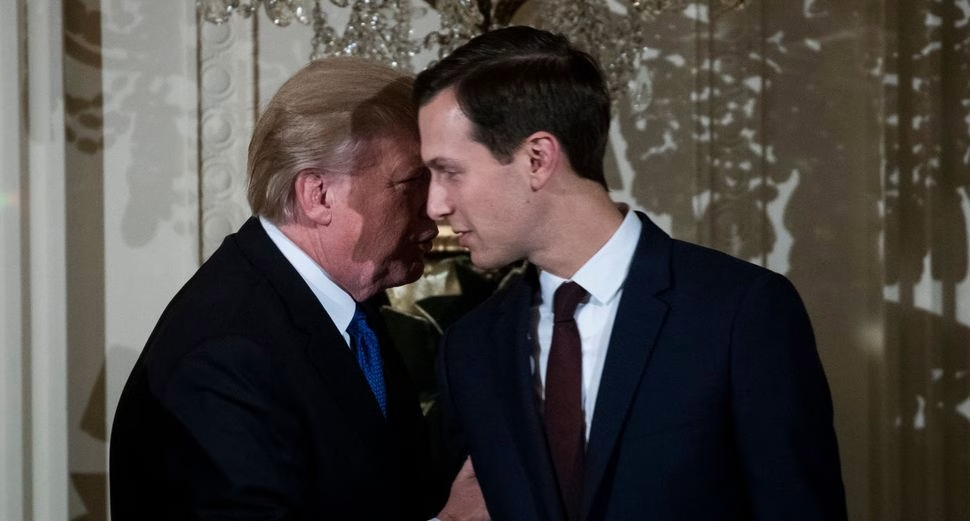
Then there’s the way the lines between public duty and private ambition seem to blur—not in a one-off moment, but in a way that starts to feel like a pattern. Take Jared Kushner. He occupies a space that’s hard to define: not quite an official, not quite a private citizen. On paper, he stepped back from government. In reality, he never really left the room.
He still operates in the same orbit—sitting down with world leaders, staying involved in regions that are central to U.S. foreign policy—while, at the same time, growing his investment firm and seeking billions in backing. It’s the kind of overlap that would draw serious scrutiny in almost any other setting.
And it’s hard to believe that Donald Trump is somehow unaware of it. The idea that this is all happening in the background while he continues to campaign on drain the swamp doesn’t quite hold up. If anything, it suggests a deeper understanding within the administration of how power, access, and opportunity can move together—often in plain sight.
Nowhere is that tension more visible than in the current tensions involving Iran. As Gulf powers like Saudi Arabia, Qatar, and the United Arab Emirates push Washington toward a more decisive end to the conflict, Kushner remains closely connected to the same players. And while they are focused on shaping the outcome of a war, he appears to be navigating those same relationships with an eye on future investment.
Maybe that overlap is coincidental. Maybe it’s just the reality of operating at that level. But it’s hard to ignore how neatly influence and opportunity seem to intersect—and how easily one can start to look like the other.
Maybe that’s all above board. Maybe it’s perfectly acceptable for someone to navigate both worlds at once—negotiating in one capacity, fundraising in another. But it’s hard to ignore how unusual that arrangement would be in any other administration. If a cabinet official attempted something similar, the legal and ethical scrutiny would be immediate and intense. Here, the ambiguity seems to be the point.
And that raises a larger question: what exactly counts as “the swamp”?
If it’s defined as backroom deals, blurred lines between public duty and private gain, and a system that rewards proximity to power, then it’s difficult to argue that those dynamics have disappeared. If anything, they’ve become more visible—less hidden, more normalized.
What’s perhaps most striking is not just the behavior itself, but the reaction to it—or lack thereof. For years, outrage over corruption and insider advantage was a driving force in American politics. It fueled campaigns, shaped narratives, and energized voters. Yet now, similar concerns often seem to land with a shrug, as though fatigue or partisanship has dulled the instinct to question.
Part of that may be the complexity. These aren’t always clear-cut cases of wrongdoing; they exist in gray areas, where legality and ethics don’t always align neatly. Another part may be the shifting expectations of leadership—where disruption is valued so highly that traditional standards are treated as optional.
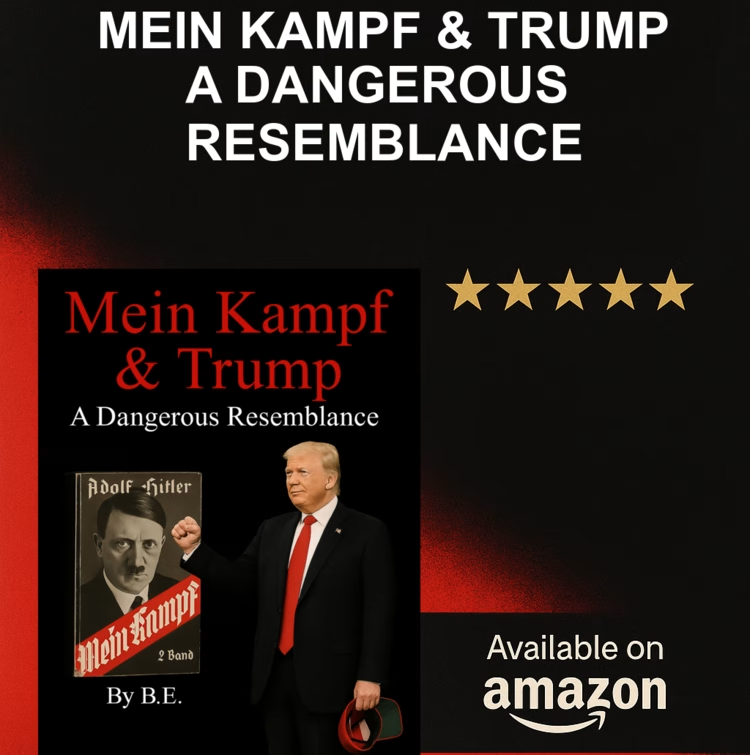
Mein Kampf & Trump — Available on Amazon
Still, the underlying issue remains. When those closest to power are able to operate in spaces where personal and public interests intersect so freely, it challenges the very premise of accountability. It creates a system where influence becomes currency, and access becomes opportunity.
None of this proves intent. It doesn’t require assuming bad faith to recognize the pattern. But it does invite a more honest assessment of what was promised versus what has been delivered.
“Drain the swamp” implied a clearing out—a reset. What it appears to have produced instead is something more familiar, just with different names attached. And perhaps that’s the most unsettling part. Not that the system is broken in a new way, but that it may not have changed nearly as much as people hoped.
#draintheswamp #Trump #Donaldtrump