
By Ben Emos | Wednesday January 28, 2026 | 5 min read
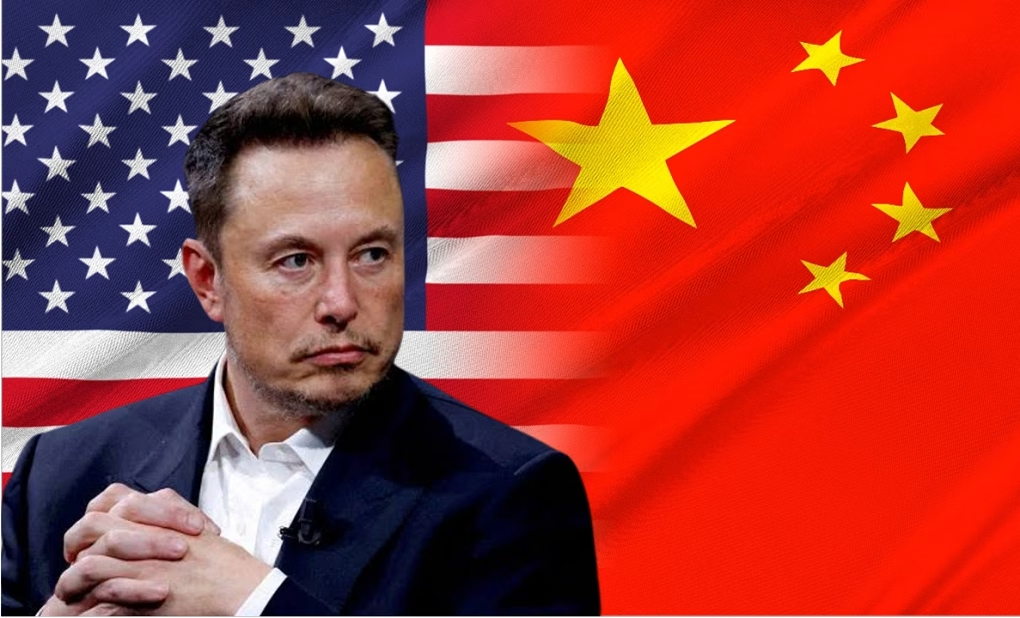
Elon Musk has always driven like a man convinced the road will part for him. He barrels through timelines, controversies, and geopolitical boundaries with the same instinctive confidence he brings to product launches and late‑night pronouncements. For a long stretch of Tesla’s rise, that swagger worked. Investors treated his optimism as prophecy. Fans treated his certainty as genius. And in the United States, regulators often found themselves scrambling to keep up rather than setting the terms.
But China is not the United States. And Beijing is not in the business of indulging Silicon Valley mythology.
This week, Musk ran into something he rarely encounters: a firm, unmistakable “no.” His claim that Tesla’s Full Self‑Driving (FSD) system would win regulatory approval in China “next month” didn’t just fail to land—it was publicly contradicted by government‑linked sources. Not massaged. Not reframed. Rejected outright.
For Tesla shareholders who have been clinging to the hope that China would be the next major unlock for FSD revenue, the message was a cold, bracing dose of reality.
At Davos, Musk painted a picture of global momentum. Europe and China, he suggested, were both on the cusp of approving FSD. It was a neat narrative: Tesla’s most controversial software product was finally about to go international, opening the door to a wave of high‑margin revenue at a moment when Tesla’s core business is under pressure. With margins tightening, competition intensifying, and EV demand no longer growing at breakneck speed, the promise of software profits has become the backbone of the bullish Tesla story.
China, in that vision, wasn’t just important—it was essential.
But Beijing quickly dismantled the storyline. A source close to regulators told state‑linked media that approval was not coming next month, or the month after, or any time in the foreseeable future. China Daily went even further, quoting a government‑connected voice who said Musk’s claim was “not true” and hinted it bordered on misleading. For a state outlet known for its careful, often understated language, the bluntness was unmistakable. This wasn’t a polite correction. It was a public scolding.
And honestly, no one paying attention should be surprised.
Tesla’s FSD isn’t just a driver‑assistance tool—it’s a data‑hungry system that depends on constant collection, processing, and iteration. In China, data is not a commodity. It’s a national security asset. Mapping, video capture, and real‑time telemetry are tightly controlled, especially when foreign companies are involved. Beijing has been clear for years: autonomous systems will advance on China’s terms, under China’s rules, and at China’s pace.
There’s also a more strategic layer Musk seems to gloss over. China has built its own EV powerhouses—BYD, NIO, XPeng, Geely—and they’re not just competing domestically; they’re exporting aggressively. Why would Beijing rush to approve a foreign company’s flagship software, especially one that could give Tesla a competitive edge? There is no upside for China in fast‑tracking FSD. Domestic automakers are already winning. Helping Tesla win too is not a priority.
That alone makes Musk’s confidence look misplaced.
But there’s a broader context Musk himself has created. Over the past few years, he has waded into political and cultural conflicts with a level of abandon that would make most CEOs blanch. From amplifying claims that undermine democratic institutions in the U.S. to spreading racially charged misinformation abroad, or disrupting Starlink’s support for Ukraine, Musk has shown a willingness to provoke without considering how those provocations land internationally.
China notices. So do other governments.
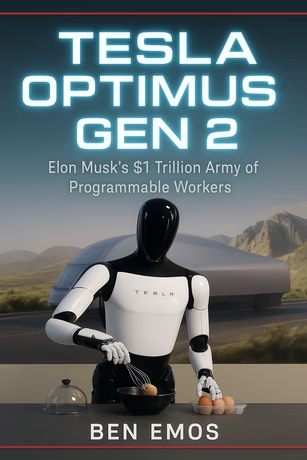
Optimus Gen 2 Tesla Army of Workers
Beijing does not separate technology from politics or power. A CEO who appears erratic, politically disruptive, or dismissive of regulatory authority is not someone Chinese officials are eager to reward. Musk’s habit of announcing outcomes before governments have spoken doesn’t read as confidence in Beijing—it reads as disrespect.
For investors, the lesson is uncomfortable but overdue: Musk’s timelines are not regulatory timelines. His predictions are not policy. And China is not a market where pressure campaigns, public shaming, or optimistic declarations move the needle. When Beijing decides to slow‑walk something—or block it entirely—that decision holds.
Tesla is still a formidable company with real strengths. But the fantasy of near‑term FSD approval in China has evaporated. What was pitched as an imminent catalyst now looks like a long‑term uncertainty. The stock will have to absorb that shift.
Musk may continue racing ahead, eyes fixed on the horizon. China, however, is standing at the intersection, arms folded, reminding him—and the shareholders who follow his lead—that not every road bends just because he wants it to.
Europe Rejects Musk’s FSD Timeline, Creating New Headaches for Tesla Shareholders
Not Every Republican Is Racist. Every Racist Knows Which Party Welcomes Them
A Nobel Dispute With Prime Minister Jonas Gahr Støre Offers a Window Into Trump’s Governing Style
Barron Trump’s FaceTime Romance Unravels in London Courtroom Drama
The Real Reasons Behind Europe’s Troop Deployment to Greenland After Failed Vance–Rubio Talks
Copyright 2024 FN, NewsRoom.