

By Andrew James | Monday June 03 2026 | 5 min read
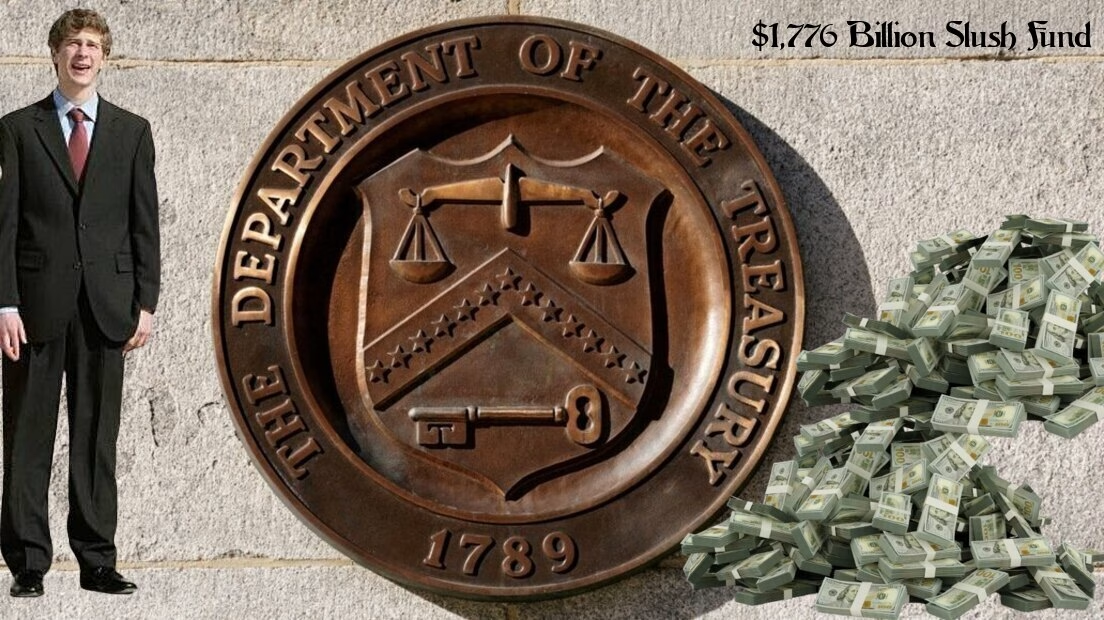
Americans are told that justice is blind. Increasingly, they have reason to wonder whether it is simply looking the other way. Recent reporting by NOTUS revealed that Philip Alito, the son of Supreme Court Justice Samuel Alito, has reportedly been working as an attorney in the Treasury Department’s Office of the General Counsel for months. On its own, that fact does not establish wrongdoing. Children of public officials are entitled to pursue careers in public service. But when the Supreme Court is hearing cases involving the very department where a justice’s son works, the public deserves transparency.
The question is not whether Philip Alito should have the job. The question is whether sufficient safeguards exist to protect public confidence in the Court’s impartiality.
If Treasury officials debated or reviewed matters connected to the administration’s reported $1.776 billion fund, or other controversial policies likely to face judicial scrutiny, Americans have a right to know what ethical firewalls were in place. Was Philip Alito screened from those discussions? Did he recuse himself from matters that could eventually come before the Supreme Court? Were disclosures made? These are not partisan questions. They are basic questions of accountability.
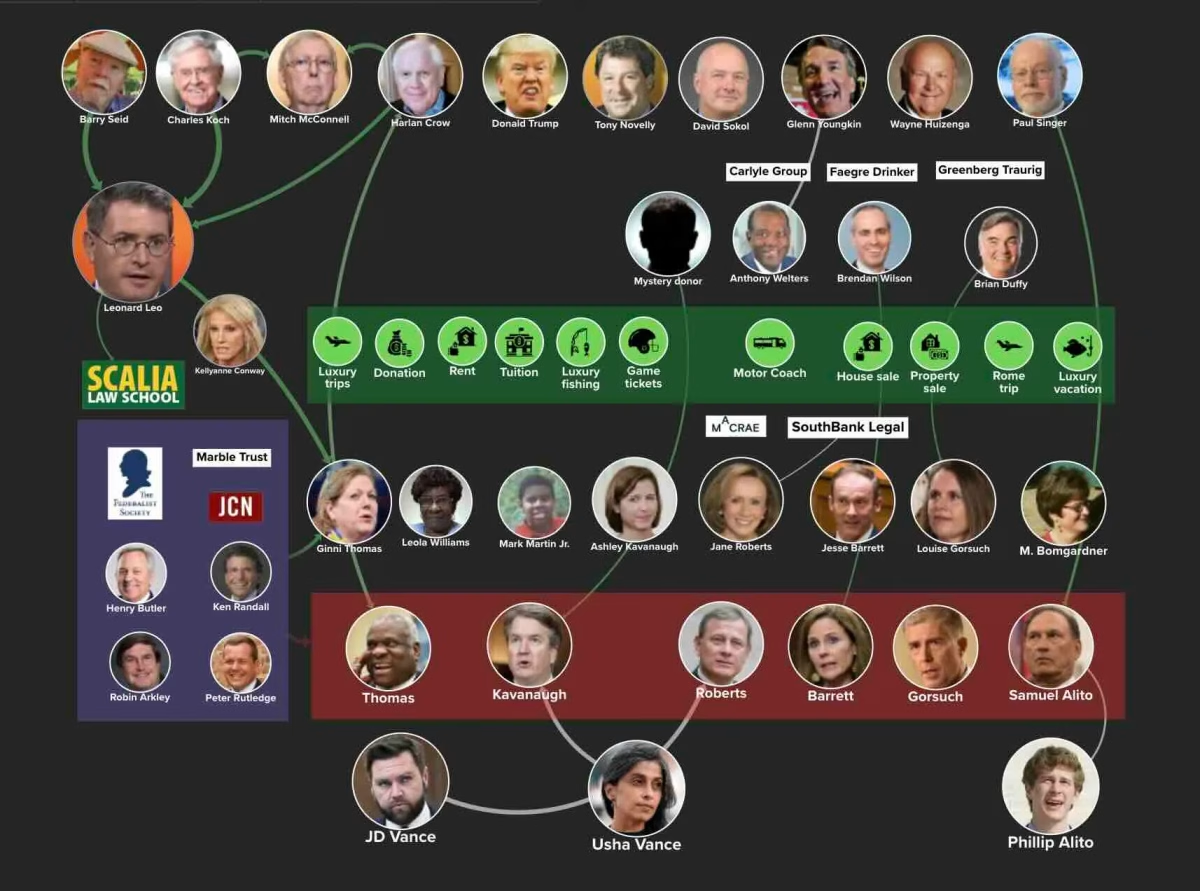
The same concerns arise whenever personal, professional, or family relationships intersect with the nation’s highest court. Reports highlighting Usha Vance’s previous clerkships with Chief Justice John Roberts and Justice Brett Kavanaugh have fueled speculation online about potential influence networks surrounding the Court. To be clear, clerkships are common pathways into elite legal careers, and there is no evidence that those relationships have improperly influenced judicial decisions.
But perception matters.
The Supreme Court possesses neither an army nor a budgetary power. Its legitimacy depends on public trust. When Americans see an increasingly interconnected network of political figures, former clerks, family members, and government officials operating within overlapping circles of power, skepticism is inevitable.
And that skepticism did not emerge from nowhere.
For years, the Court hasn’t just been shadowed by ethics scandals—it’s been engulfed by them. Undisclosed gifts, billionaire‑funded vacations, political back‑channels, and recusal standards that seem to bend for convenience have all carved deep cracks in the Court’s credibility. Public trust hasn’t merely slipped; it has collapsed across the ideological spectrum, and the polling makes that collapse impossible to ignore.
Now critics are pressing an even more volatile line of inquiry. With reporting about Philip Alito’s possible involvement in the Treasury’s decision to steer $1.776 billion to the Justice Department, they’re asking whether that money could ultimately benefit justices like Alito—whether through retirement‑adjacent perks or through influence over ally justices that Trump may be trying to sway. Critics point to his past attempt to pressure FBI Director James Comey to drop an investigation as evidence that this isn’t an abstract concern but part of a larger pattern they believe deserves scrutiny.
It’s an uncomfortable question, but critics argue it can’t be dodged—because the statute authorizing the transfer was written to require no transparency at all.
Chief Justice John Roberts has often presented himself as a defender of the Court’s integrity and independence. During his confirmation hearings, he famously compared judges to umpires who simply call balls and strikes. Critics argue that the Court’s recent decisions have increasingly reflected a broader ideological project rather than neutral constitutional interpretation. Supporters strongly disagree, pointing to rulings they view as faithful applications of the law.
Reasonable people can debate specific cases.
What should not be debatable is the need for stronger ethics rules.
Federal judges across the country operate under ethical standards that require disclosure, caution, and recusal when conflicts arise. The Supreme Court should not be held to a lower standard than the judges it oversees. If anything, the opposite should be true.

Mein Kampf & Trump — Available on Amazon
Americans should not have to rely on investigative journalism to discover potential conflicts. They should not have to guess whether family members participated in discussions connected to cases that could reach the Court. They should not have to wonder whether powerful political and legal networks receive scrutiny unavailable to ordinary citizens.
Transparency is not punishment. Disclosure is not persecution. Recusal is not an admission of guilt.
They are the minimum requirements for maintaining trust in democratic institutions.
The issue extends far beyond any one justice, any one family member, or any one administration. The larger question is whether the Supreme Court is willing to embrace the level of accountability that Americans increasingly expect from every other branch of government.
If the Court wants the public to believe that justice is impartial, it must do more than insist upon it. It must demonstrate it.
Because once faith in the Court collapses, every ruling becomes suspect, every decision becomes political, and every constitutional dispute becomes another battle over power rather than law.
It’s the kind of crisis no democracy can survive for long. And yet the idea that Justice Alito — or any of his conservative colleagues — might retire before the storm hits feels increasingly far‑fetched. With this president’s alleged criminal exposure and Philip Alito’s reported involvement in the $1.776 billion slush‑fund transfer barreling toward the courts, the stakes are only rising.
And if the Philip Alito case ever lands before the Supreme Court, critics say there’s little reason to expect Justice Alito to recuse. The prevailing assumption is the opposite: that he would stay on the case, personal entanglements and all. It’s a scenario that, in the eyes of legal ethicists, edges dangerously close to a constitutional stress test no country should willingly run.
Trump’s $10 Billion Lawsuit May Be a Front—Federal Judge Signals Possible Fraud
Trump’s Cabinet Meeting Echoes Displays of Devotion Once Directed at Unstable Kings
Trump and His German Roots: Why Hasn’t He Set Foot in His Grandfather’s Hometown?
Trumpstein’: The Controversial Nickname Inspired by Trump’s Epstein Connections
DOJ Scrubs January 6 Records from Website—Who the Hell Do They Think They’re Fooling?