
By Andrew James | Monday June 01 2026 | 5 min read
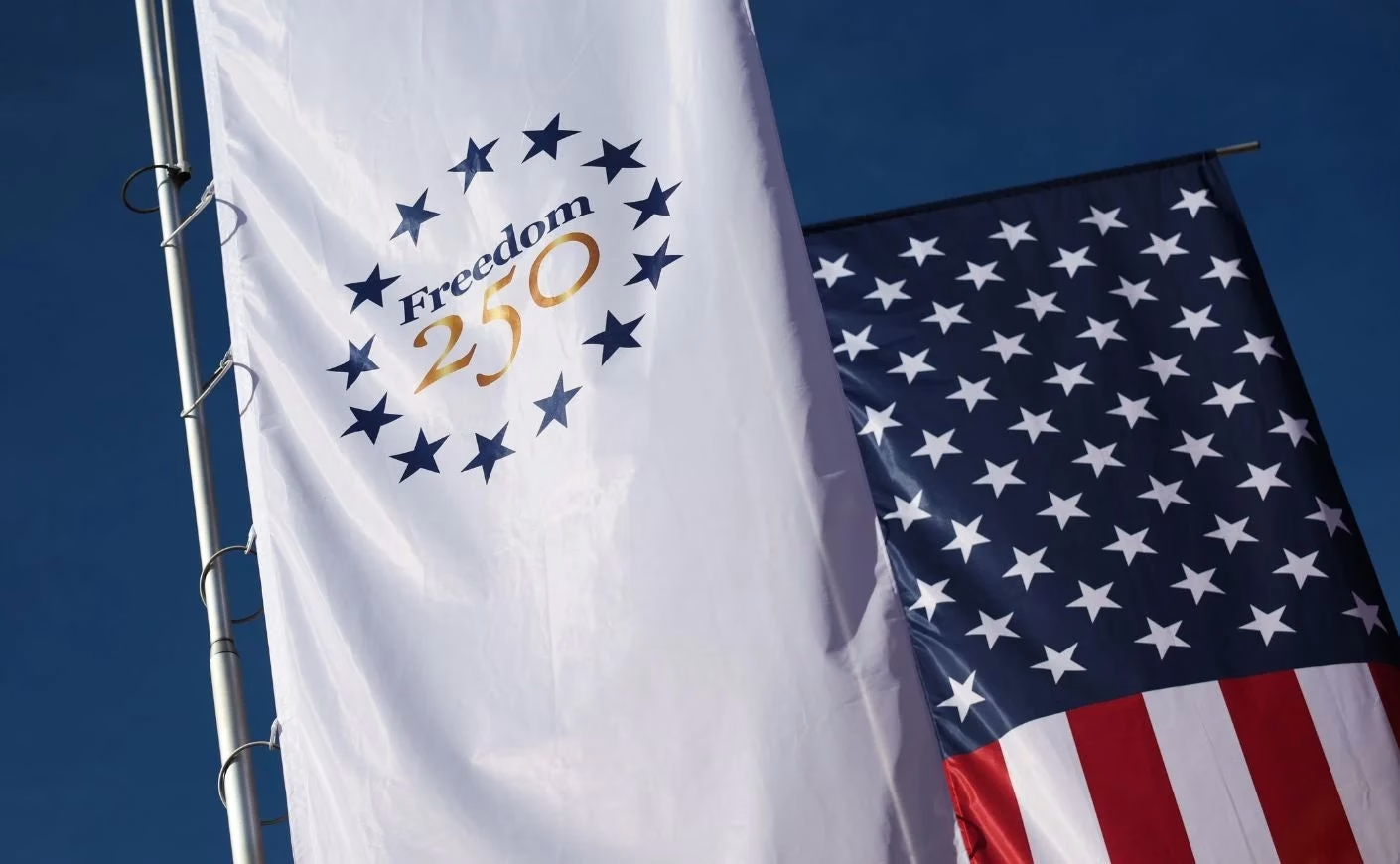
There comes a point when spectacle crosses a line and reveals something deeper. The wave of artists quietly pulling out of Trump’s planned National Mall 250th celebration wasn’t just about scheduling or confusion. It meant something.
Creative people tend to have a finely tuned radar for authenticity. They work with emotion, narrative, and truth for a living. When something feels off—overproduced, overly political, or simply dishonest—they notice. And increasingly, they walk away.
That’s what makes the recent withdrawals so telling.
President Donald Trump has made no secret of his desire to turn America’s 250th birthday into a grand, unforgettable event. In theory, that should be a unifying moment—a chance to step back, reflect, and celebrate a shared national story. But what’s unfolding instead feels less like a national celebration and more like a branded production.
Over the past months, the lines between public commemoration and personal promotion have blurred to the point of near invisibility. There are plans for a UFC fight on the White House lawn. Talk of a $250 bill bearing the president’s likeness. A steady stream of merchandise, slogans, and trademark filings tied not just to the anniversary—but to Trump himself.
At a recent Cabinet meeting, Trump even promoted bright red “America 250” hats sold by his family company. It was a small moment, easy to overlook. But it captured something larger: a presidency that struggles, or refuses, to separate the office from the brand.
Supporters argue this is simply politics as usual. Every president, they say, puts a personal stamp on major national events. That’s true—up to a point. Gerald Ford, during the bicentennial in 1976, certainly understood the political stakes. But even then, the emphasis remained on the country, not the individual. The symbolism pointed outward, not inward.
That distinction matters.
Because what we’re seeing now isn’t just personalization—it’s saturation. The message isn’t “America at 250.” It’s “Trump at 250.”
And artists noticed.
Within days of being announced for the National Mall’s two-week celebration, several performers began pulling out. Some said they were led to believe the event would be nonpartisan. Others were more blunt: the tone, the framing, the context—it didn’t feel like a neutral celebration of the country.
It felt political.
One by one, they stepped back.
The response from Trump was predictable: frustration, anger, and a familiar refrain that critics and dissenters are acting in bad faith. But that explanation is too easy—and too incomplete.
Artists don’t operate like political operatives. They’re not calculating polling data or hedging against partisan backlash in the same way. When they disengage, it’s often because something feels fundamentally misaligned with their values or their audience.

Mein Kampf & Trump — Available on Amazon
In this case, the concern seems clear. A celebration meant to unify is being perceived, rightly or wrongly, as something more narrow—more ideological, more commercial, more about one figure than the country itself.
That perception is the story.
And it’s not happening in a vacuum.
The broader context only sharpens the contrast. As Americans navigate rising costs, political division, and global uncertainty, the imagery of gold coins, branded merchandise, and VIP donor tiers for a national celebration lands differently. It raises questions about priorities—about who these events are really for, and what they’re meant to represent.
None of this means the 250th celebration is doomed. It doesn’t mean people won’t show up, or that there won’t be moments of genuine pride and reflection. There will be.
But something has shifted.
What should have been an easy, shared milestone—one of the few moments in modern life that could cut across political lines—has instead become another arena for division. Another test of loyalty. Another stage.
And the artists who walked away? They didn’t just cancel appearances.
They made a choice.
A quiet one, but a meaningful one—to step back from a celebration that, in their view, no longer felt like it belonged to everyone.
That’s not a logistical problem. It’s a cultural one.
And it may be the clearest signal yet that, for all the spectacle, something essential is being lost in the performance.
Trump’s $10 Billion Lawsuit May Be a Front—Federal Judge Signals Possible Fraud
Trump’s Cabinet Meeting Echoes Displays of Devotion Once Directed at Unstable Kings
Trump and His German Roots: Why Hasn’t He Set Foot in His Grandfather’s Hometown?
Trumpstein’: The Controversial Nickname Inspired by Trump’s Epstein Connections
DOJ Scrubs January 6 Records from Website—Who the Hell Do They Think They’re Fooling?