
By Andrew James | Thursday May 21 2026 | 4 min read
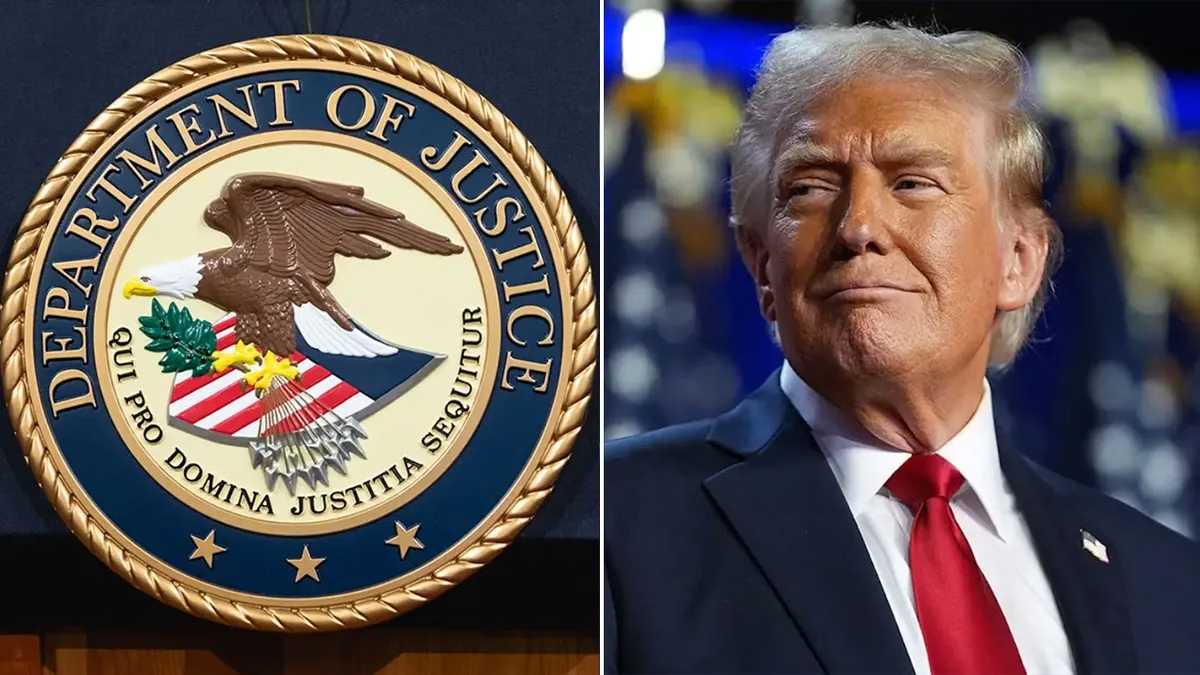
The DOJ didn’t arrive at a $1.8 billion fund by accident. With so few details and so little clarity around how it will work, it feels less like a carefully constructed policy and more like a concession. Strip away the legal framing, and it begins to look like an attempt to steady a president who has long operated on demands for loyalty, retribution, and validation—especially in the wake of his abandoned $10 billion IRS lawsuit, even as the same deal now effectively shields his taxes from further IRS scrutiny.
Those close to the situation have described a moment of real frustration when it became clear that sweeping financial demands weren’t going anywhere. What followed wasn’t a direct payout, but something that, to critics, looks like a workaround—a new mechanism, assembled quickly, that raises as many questions as it answers.
Because the structure, timing, and vagueness surrounding this fund don’t read like a carefully designed justice mechanism. They read like something else—something closer to a political concession.
The fund makes up to $1.776 billion available—an oddly symbolic number—and yet offers remarkably little clarity. Who qualifies? What standard of proof is required? How will claims be verified? On all of that, the Justice Department has said very little.
We’re told there are no partisan requirements. But without clear criteria, that assurance doesn’t carry much weight. A system without defined rules is not neutral—it’s discretionary.
And discretion, in this case, will sit with a five-member commission appointed largely by the attorney general. No names. No transparency. No clear guardrails.
That’s not a system designed to build confidence. It’s one that invites doubt.
Critics see something more direct: an attempt to manage a president who has repeatedly framed himself—and his allies—as victims of a weaponized government. In that context, the fund starts to look less like a legal remedy and more like a political release valve.
Not because there’s proof of intent—but because of how it fits into a broader pattern.
When a president demands accountability on his terms, and a multibillion-dollar mechanism appears with few defined limits, it raises a basic question: is this about correcting injustice, or containing pressure?
That question matters because of what’s at stake. Nearly $2 billion is not a symbolic gesture. It’s real money, drawn from public resources, to be distributed under a framework that remains largely undefined.
If individuals were genuinely wronged, they deserve compensation. That principle is not in dispute.
But compensation requires structure. It requires independence. It requires transparency.
Right now, this fund offers none of those in sufficient measure.
Instead, it offers something else: flexibility—broad, undefined, and potentially open to interpretation.
And in Washington, flexibility at that scale rarely exists in a vacuum. It exists in response to pressure.

Mein Kampf & Trump — Available on Amazon
The Justice Department says this is about fairness. But fairness without clear rules is hard to measure—and even harder to trust. And fairness that overlooks the Capitol police officers who were beaten, injured, and in some cases later died in the aftermath starts to feel less like justice and more like selective memory.
Because that’s where this argument runs into a wall. The moment you begin to fully acknowledge and compensate those officers, you’re also acknowledging the reality of what happened on January 6th—something many still try to downplay.
Until the rules are clearly defined, the oversight is visible, and the process is transparent, this $1.8 billion fund will carry a credibility problem it won’t easily shake:
It doesn’t look like a tool of justice—it feels more like an effort to keep the peace, even if it rests on shaky ground.
Trading the Presidency: Did Trump’s Stock Buys Suspiciously Track His Presidential Actions?
Tesla Spins FSD Setback: Drops Autopilot in Netherlands, Cancels Denmark Purchase
Blood to Ballrooms: How Trump Turned Assassination Attempts Into Power and Profit
Justice Thomas Helped Dismantle the Voting Rights Protections His Parents Once Needed
Former FBI Director James Comey Charged Over Alleged Threat in ‘8647’ Seashell Post
The Cole Allen Case and Its Potential Risks for DOJ Handling of Epstein-Related Files
Trump fires back: “I’m not a rapist or pedophile” in response to Cole Allen-linked manifesto