
By Mary Jones | Wednesday May 20 2026 | 4 min read
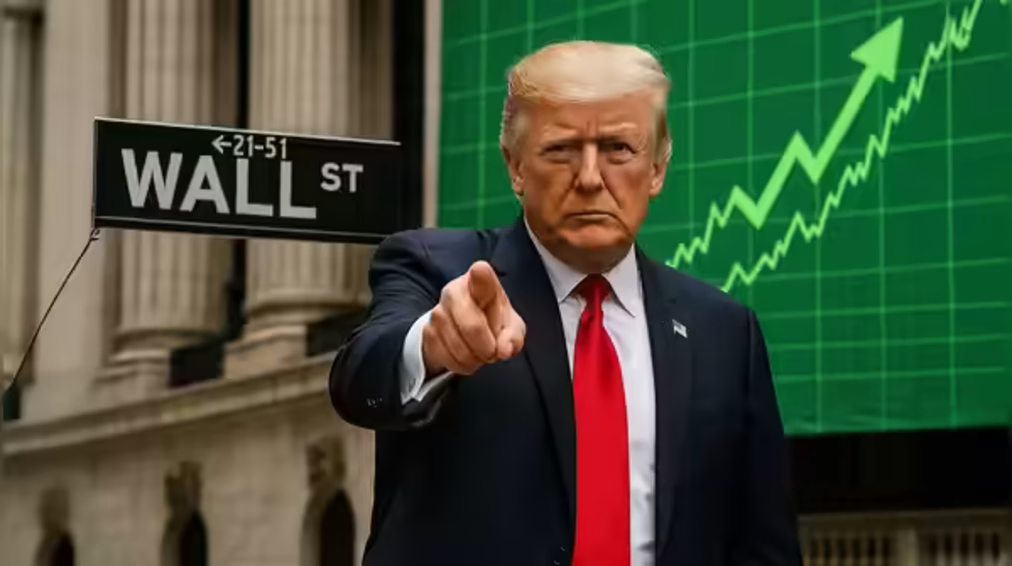
In American government, not every boundary is spelled out in law—but some are understood. One of them is the expectation that a president won’t use the power of the office in ways that overlap with personal financial interests, especially when it involves buying stocks and then publicly promoting the very companies tied to those investments. Yet that’s the pattern that appears to be taking shape around Trump.
Recent financial disclosures raise questions about whether that boundary is being tested.
The filings show that Donald Trump engaged in active stock trading while serving as president, purchasing shares in a series of major technology and pharmaceutical companies. That alone distinguishes him from recent predecessors, including Joe Biden and Barack Obama, who avoided individual stock transactions while in office.
What emerges from the disclosures, however, is not just a record of trading—but a pattern of timing that invites closer examination.
In January, Trump purchased hundreds of thousands of dollars’ worth of stock in Nvidia. Within days, his administration approved the sale of advanced chips to China, a decision with clear commercial implications for the company.
That same month, he acquired between $50,000 and $100,000 in shares of AMD. Shortly thereafter, regulatory barriers eased for the company’s operations in China.
In February, Trump expanded his holdings, buying millions of dollars in Dell Technologies. Nine days later, during a public speech, he urged Americans to “go out and buy a Dell computer”—an unusual endorsement from a sitting president, particularly one with a direct financial stake.
The pattern continued into March. Trump made repeated purchases of Thermo Fisher stock before visiting the company in an official capacity, where he praised its work and encouraged broader industry engagement. On the same day as that visit, he also purchased hundreds of thousands of dollars’ worth of Apple stock, later singling out the company and its chief executive, Tim Cook, for public commendation.
Additional transactions followed. After buying between $50,000 and $100,000 in Micron stock, Trump described the company on national television as “one of the hottest.” He also made multiple purchases—seven in total—of Palantir stock, amounting to hundreds of thousands of dollars, before promoting the company online and even posting its ticker symbol.
Taken together, the timing of Trump’s trades and his public promotion of those companies begins to look less like coincidence and more like behavior that invites comparisons to market manipulation.
Presidents wield unmatched influence over markets. Their words can shift valuations, and their policies can alter the trajectory of entire industries. When that authority coincides with personal financial activity, even the appearance of overlap can raise concerns about the independence of decision-making.
For decades, presidents have sought to avoid such questions by placing distance between themselves and individual investments. The rationale has been straightforward: public confidence depends not only on the absence of impropriety, but on the absence of doubt.
Here, that separation appears less defined.

Mein Kampf & Trump — Available on Amazon
The disclosures don’t prove that policy decisions were driven by personal investments. But they do reveal a pattern in which private trading and official actions occur in strikingly close proximity.
That alone warrants closer scrutiny. It also raises a broader question: whether similar financial interests extend beyond the president—to members of Congress or even allies within the Supreme Court. Any serious inquiry would need to follow the money carefully, examining whether overlapping investments exist and, if so, whether they create the appearance of shared incentives shaping decisions at multiple levels of government.
Because in a system built on trust, it is not only actual conflicts that matter—it is the perception that decisions are being made for reasons beyond the public interest.
And once that perception takes hold, it is not easily undone.
Tesla Spins FSD Setback: Drops Autopilot in Netherlands, Cancels Denmark Purchase
While the World Faces Real Crises, Trump Fixates on a Costly Ballroom and a Vanity Makeover
How Democrats Could Win Despite GOP Gerrymandering and Trump’s Unpopularity
The Supreme Court Isn’t Neutral Anymore—Who Will Stop Politicized Justices?
Blood to Ballrooms: How Trump Turned Assassination Attempts Into Power and Profit