

By Ben Emos | Tuesday March 17 2026 | 5 min read
At the start of the week, Europe sent a message that was difficult to misread: it has no intention of joining efforts to secure the Strait of Hormuz at the request of Donald Trump. That stance has held firm even as Trump has tried to frame the situation in historical terms, drawing comparisons to World War II, when the United States stepped in to support Europe.
The statement came after foreign ministers from all 27 European Union countries gathered in Brussels for a series of closed-door discussions. On the table was Washington’s call for European allies to help patrol and protect one of the world’s most critical shipping lanes—now increasingly threatened as tensions with Iran escalate.
By the end of those talks, the position from Europe was firm. While leaders acknowledged the strategic importance of the waterway, they made it clear they do not see direct military involvement as their role—at least not under current circumstances.
The Strait of Hormuz is no ordinary passage. Roughly a fifth of the world’s oil supply passes through the narrow corridor each day, making it a chokepoint for global energy markets. Any disruption there sends ripples far beyond the Middle East, affecting fuel prices, supply chains, and economic stability worldwide. That reality is not lost on European leaders.
Yet for many in Europe, the question is not whether the strait matters—it’s whether joining a U.S.-led effort risks pulling the continent into a broader and potentially prolonged conflict.
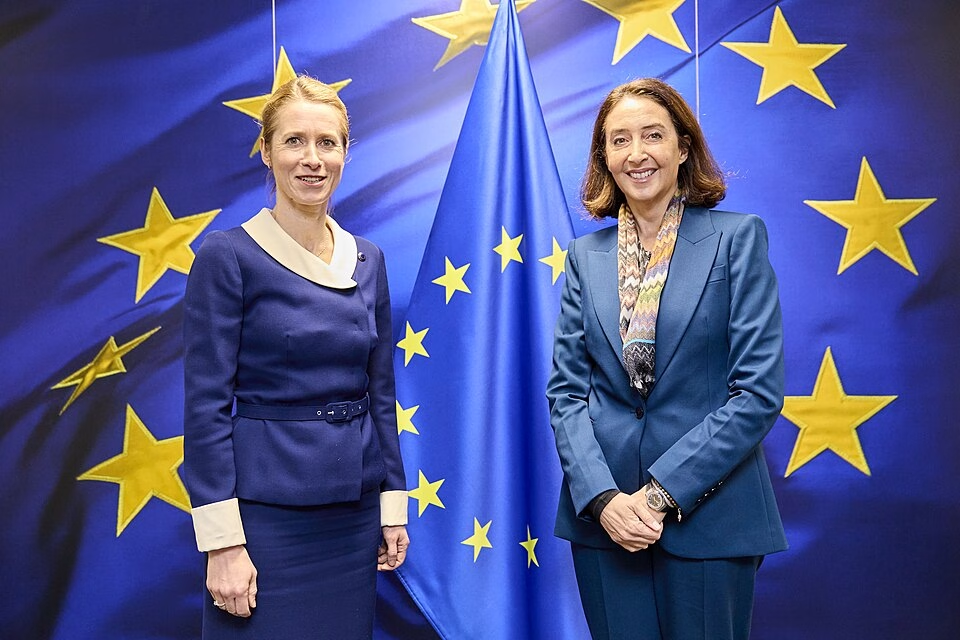
Speaking after the meeting, EU foreign policy chief Kaja Kallas captured that concern directly. Europe, she said, has no appetite for “an open-ended war.” It was a carefully chosen phrase, one that reflects both caution and experience. Over the past two decades, European governments have watched conflicts in the Middle East evolve into drawn-out engagements with uncertain outcomes.
Kallas also made another point that sits at the heart of Europe’s dilemma: while this may not be Europe’s war, Europe’s interests are undeniably tied to what happens next. Energy security remains a pressing concern, especially as the continent continues to navigate the economic aftershocks of previous global disruptions.
That tension—between staying out of conflict and protecting vital interests—is shaping Europe’s current stance. Rather than committing to military involvement, EU leaders appear to be leaning toward diplomatic pressure, economic measures, and coordination with international partners as their preferred tools.
Behind the scenes, a bigger calculation is shaping Europe’s stance. Many officials are cautious about signing up for a strategy they don’t fully control. There’s still a lingering memory of past alliances where European countries backed Washington in conflicts that later came at a high cost.
The war in Iraq is often cited in those discussions. In its aftermath, the rise of ISIS and its sympathizers led to a wave of deadly attacks that reached into several European cities. For many policymakers, that experience remains a warning about how quickly foreign conflicts can spill over and reshape security at home.
At the same time, the decision not to participate does not come without risks. If instability in the Strait of Hormuz worsens, Europe could face rising energy costs and supply disruptions that would affect industries and households alike. The consequences would be felt quickly—and politically.
Why Is NATO Staying Out of the Strait of Hormuz Crisis?
For Donald Trump, the hesitation from Europe and NATO creates a real challenge. His push for allied involvement was likely about more than just manpower—it was about sharing responsibility and giving any action in the Strait of Hormuz broader international backing. Without that support, the United States risks appearing more isolated in whatever path it chooses next.
Mein Kampf & Trump — Available on Amazon
It’s also notable that Article 5—NATO’s collective defense clause—has not been invoked here. That clause was famously triggered for the first time in support of the U.S. after the September 11 attacks, leading to the alliance’s involvement in the war in Afghanistan. The current situation, however, is being treated very differently.
Still, Europe’s stance doesn’t amount to a complete break with Washington. Officials have been careful to leave room for cooperation, especially when it comes to diplomacy and efforts to prevent further escalation.
As tensions continue to simmer, one thing is clear: Europe is trying to strike a careful balance. It wants to protect its economic interests without becoming entangled in a conflict it neither started nor controls.
Whether that balancing act can hold will depend largely on how the situation in the Strait of Hormuz evolves—and whether diplomacy can keep a volatile standoff from tipping into something far more dangerous.