

By Jane Lewis & Ben Emos | Monday June 15 2026 | 5 min read
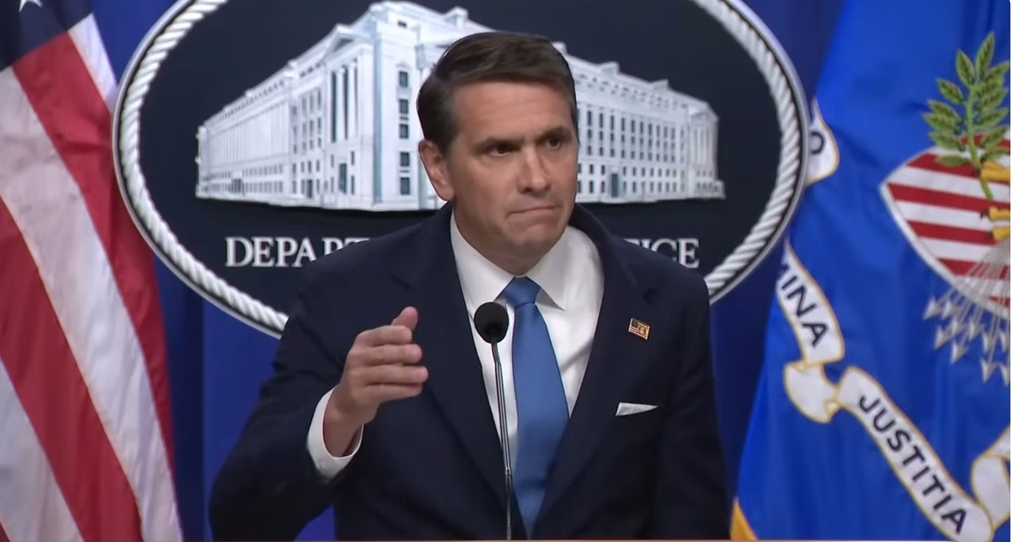
When Todd Blanche stepped to the podium on January 30, 2026, no one expected history to shift. People anticipated a procedural update, maybe a few lines about redactions or privacy rules. Instead, Blanche delivered something far heavier: a quiet, almost clinical admission that the Epstein files contained child pornography, images of death, and photographs of physical abuse or injury—and that federal investigators had reviewed all of it.
Then, with the same steady tone, he announced that no further prosecutions would follow. For survivors who have waited years for accountability, it felt like the floor dropping out from under them. For the public, it raised a question that refuses to fade: how does a case containing evidence of child exploitation and violence end with only two people ever charged?
Blanche didn’t hint or imply. He said it outright. “Any depiction of CSAM or child pornography was obviously excluded.” A moment later: “Anything that would jeopardize an active federal investigation.” And then the line that should have stopped the room cold: “Anything that depicts or contains images of death, physical abuse, or injury, also not produced.” These aren’t vague categories. They are descriptions of crimes—crimes with victims, perpetrators, and consequences. Crimes that, in any other context, would trigger immediate law‑enforcement action. Yet Blanche spoke as if he were reading from a shipping invoice, not describing evidence of human suffering.
It’s easy, when hearing phrases like “CSAM” or “images of injury,” to forget that these are not abstractions. They are moments in real people’s lives—children who were exploited, individuals who were harmed, scenes someone recorded because they believed no one would ever hold them accountable. Behind every withheld image is a person who lived through something they should never have had to endure. And behind every decision not to prosecute is another person who walks free. That is the human cost buried beneath the bureaucratic language.
Blanche’s statement creates a contradiction so stark it borders on surreal. The Justice Department admits the files contained child pornography. It admits the files contained images of death and physical abuse. It admits some materials were tied to active federal investigations. And then it insists that no additional prosecutions will occur. If the files contained child pornography, someone created it, someone possessed it, and someone distributed it. Those are federal crimes with mandatory reporting requirements. If the files contained images of death or physical injury, someone committed those acts. If the files were tied to active investigations, those investigations should have led somewhere. But Blanche’s message was unmistakable: the case is closed.
There’s a phrase prosecutors use when dealing with cold cases: death has no statute of limitations. It’s a reminder that time doesn’t erase truth, and it doesn’t absolve wrongdoing. The same principle applies here. The victims whose images appear in those files deserve more than a footnote in a government briefing. They deserve answers.

Mein Kampf & Trump — Available on Amazon
They deserve justice. And the public deserves to know why a case containing evidence of child exploitation and violence was allowed to end with only two defendants. This isn’t about conspiracy theories or political agendas. It’s about the simplest moral equation: when the government acknowledges the existence of criminal evidence, it must explain why it chose not to act.
Blanche’s statement leaves the country with questions that won’t go away. Who created the CSAM found in the files. Who appears in the images of death and physical abuse. What “active federal investigations” existed—and why none resulted in charges. Why the DOJ decided that only Epstein and Maxwell would face prosecution. These are not abstract policy questions. They are matters of life, death, and justice. And they do not stop at America’s borders.
If the Epstein files contained images of dead victims—as Blanche’s own words imply—then countries whose citizens may be among the unidentified dead have a moral obligation to act. Countries such as Great Britain, France, Germany, and every EU member with missing or unaccounted‑for citizens who moved through Epstein’s world have a duty to press the DOJ for the withheld records. They need to know whether their people are among the victims. Silence doesn’t keep the peace — it protects the wrong side.
Death has no statute of limitations. Neither should the truth. And if the United States will not pursue every lead, then other governments must. The victims deserve more than a closed case file. They deserve to be named, acknowledged, and defended—even if the justice they are owed arrives from across an ocean.
The Kennedy Center Just Dropped Trump’s Name — And the Message Is Unmistakable
Elon Musk’s SpaceX IPO Branded ‘The Universe’s Largest Ponzi Scheme’ as Trump Backs the Venture
Is Elon Musk Jewish? The Confusion Behind the Accusations and the Backlash
FIFA Should Award Omar Artan $100K in Compensation for World Cup U.S. Ban
Jon Ossoff’s “Something Is Happening in Georgia” Speech Fuels 2028 Presidential Buzz