
By Don Terry | Friday May 29 2026 | 5 min read
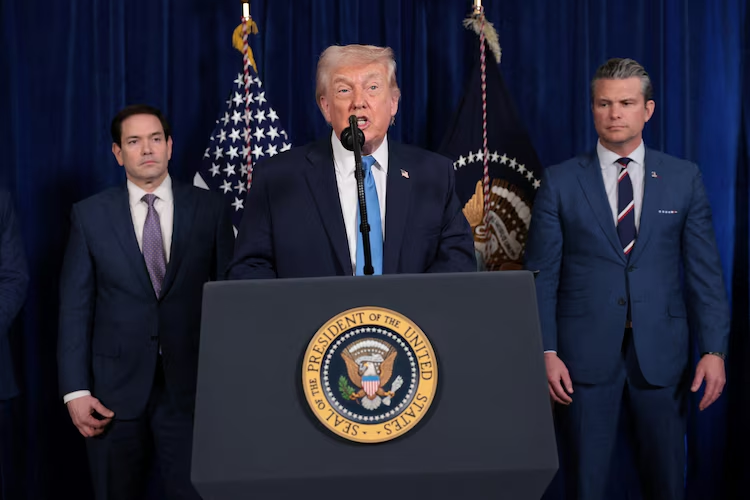
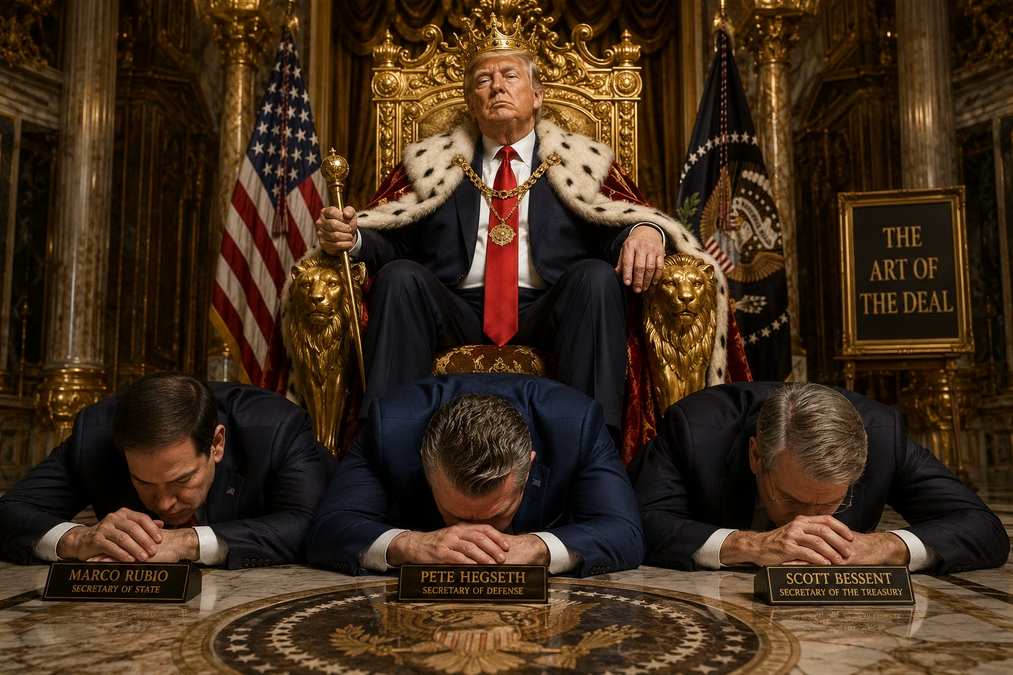
At some point during the marathon Cabinet meeting, the question ceased to be rhetorical and became unavoidable: what exactly are we witnessing? Because this did not resemble a functioning government—it looked like a court, with Trump’s Cabinet performing loyalty rituals from the age of kings.
Three hours. A 45-minute monologue. Then, one by one, senior officials—people entrusted with running the most powerful government on earth—took turns praising the president with a fervor that felt less like politics and more like ritual. Not debate. Not policy. Praise.
It is tempting to dismiss the spectacle as just another strange chapter in the long, chaotic story of Donald Trump. But that misses something deeper—and more troubling. This wasn’t improvisation. It wasn’t off-the-cuff awkwardness. It looked coordinated. Structured. Almost required.
And that raises an uncomfortable question: who is orchestrating this?
Because grown adults—cabinet secretaries with decades of experience, families, reputations—don’t spontaneously line up to deliver near-identical tributes unless they understand, clearly, that it is expected of them. That there is a cost to not participating. That silence, or worse, dissent, is no longer acceptable currency in the room.
We’ve seen a version of this before.
Back in June 2017, during his first Cabinet meeting, Trump stunned even seasoned observers by turning a routine gathering into a televised display of personal loyalty. He went around the table, inviting each member to speak—not about policy, not about priorities, but about him. The result was a cascade of awkward gratitude and exaggerated praise. Veteran journalist John Harwood called it what many were thinking: creepy.
It felt aberrational at the time. A strange early misstep.
Now it looks like a blueprint.
Fast forward to May 2026, and the spectacle has grown more elaborate—and more unsettling. The latest Cabinet meeting didn’t merely echo those earlier displays; it intensified them. Each speaker seemed to raise the stakes, as if competing in an unspoken contest of devotion. The president was hailed as “the greatest in history,” his policies cast in sweeping, almost mythic terms. One official went further still, framing his presidency as nothing less than a national rebirth.
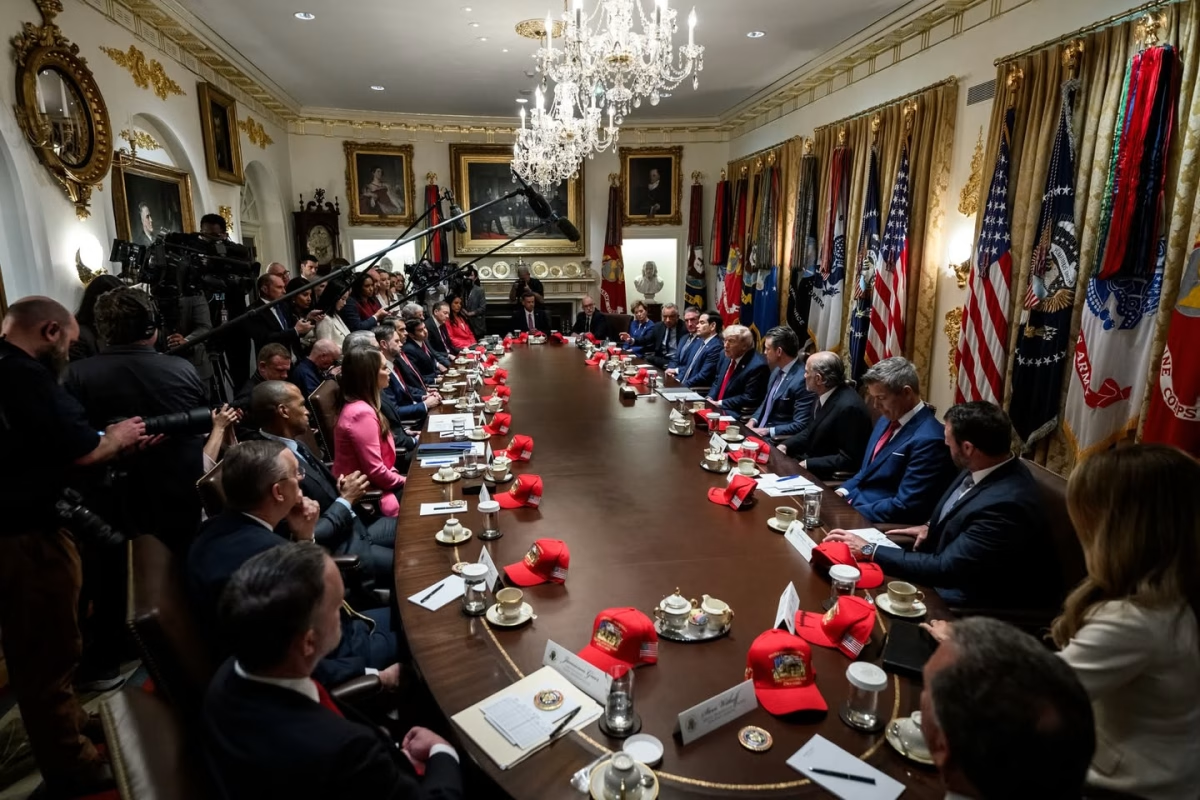
If this were satire, it would be dismissed as too on the nose.
Instead, it was real—and broadcast live.
At one point, Trump returned to familiar talking points about the strength of the economy and his administration’s performance, insisting that “we have more people working today than we’ve ever had before… last night was incredible… the numbers were fantastic.” He also described the room as filled with “very happy people” and praised what he called a “great team” around the table. But leaders who operate comfortably within democratic norms rarely feel the need to repeatedly reinforce that kind of self-assessment in real time.
And here’s where the spectacle stops being merely embarrassing and starts becoming consequential.
Cabinet meetings are not supposed to be theater. They are supposed to be where hard questions are asked, where disagreements surface, where policy is tested under pressure before it reaches the public. They are, in theory, one of the last internal guardrails in a system built to prevent power from concentrating unchecked.
But what happens when that guardrail becomes a stage?
What happens when the incentive is no longer to challenge the president, but to impress him?
You get what we saw: a room full of officials speaking not to inform, but to affirm. Not to govern, but to perform. Reality becomes secondary to loyalty, and governance becomes a kind of choreography—who speaks, how effusively, how often.
History has a way of repeating its more uncomfortable patterns. When power concentrates around an unpredictable or dominant leader, the institutions surrounding that leader often develop their own internal logic. Survival becomes a matter of proximity, and proximity becomes a matter of praise. Over time, the system stops rewarding competence or independence and instead elevates those who signal loyalty above all else. The consequences aren’t just cosmetic; they distort decision‑making and detach leaders from reality.
A recent example is Lori Chavez-DeRemer, who resigned from her position as Secretary of Labor after report of drinking and misconducts. Reports described internal controversies involving both her and members of her family within the department, even as she continued to publicly elevate the president.
At one point, she drew attention for hanging a large banner of Trump across the Labor Department’s headquarters. During a Cabinet meeting, she even told him his “big, beautiful face” was on display outside and invited him to come see it. The moment was striking—not just for its optics, but for what it suggested. Personal devotion seemed to be taking center stage, while the institution itself faded into the background.
To be clear, this is not about diagnosing anyone from afar. That kind of speculation is both irresponsible and beside the point. The issue isn’t what is happening inside one man’s mind—it’s what is happening inside the system around him.
Because systems matter.

Mein Kampf & Trump — Available on Amazon
And the system on display in that Cabinet meeting looked less like a functioning executive branch and more like a loyalty loop—one that rewards affirmation and quietly punishes deviation. It is a structure that doesn’t just tolerate flattery; it depends on it.
That has real-world consequences.
When economic policy is shaped in an environment where disagreement is risky, blind spots grow. When foreign policy is discussed in a room calibrated for praise, not pushback, miscalculations become more likely. When public officials spend their time reinforcing a narrative instead of interrogating it, the gap between rhetoric and reality widens—and the public is left to absorb the fallout.
Perhaps the most unsettling part of the entire spectacle wasn’t Trump’s role in it. It was everyone else’s.
Because no one pushed back. No one broke the rhythm. No one said, even gently, that this wasn’t what the moment required. Instead, they leaned in. They played their parts. They made the performance work.
That’s how systems change—not all at once, but gradually, as people adapt to new expectations and convince themselves it’s normal.
It isn’t.
And the longer it continues, the harder it becomes to remember what normal governance is supposed to look like.
Trump and His German Roots: Why Hasn’t He Set Foot in His Grandfather’s Hometown?
Trumpstein’: The Controversial Nickname Inspired by Trump’s Epstein Connections
DOJ Scrubs January 6 Records from Website—Who the Hell Do They Think They’re Fooling?
Is Elon Musk the New Bernie Madoff—Selling Investors and Buyers Empty Promises?
Trump’s $1.8 Billion DOJ Fund Reignites Controversy Over His January 6 Pardons