


By Don Terry | Friday, March 20, 2026 | 4 min read
Every so often, it becomes necessary to confront an uncomfortable thought: the person occupying the most powerful office in the world may lack the basic instincts most people take for granted—restraint, empathy, and a sense of proportion. That concern feels especially urgent now, as Donald Trump oversees yet another escalating conflict in the Middle East, one that shows little sign of slowing down.
By most accounts, the situation on the ground is deteriorating. What began as a targeted confrontation has expanded into a broader regional conflict, now touching more than a dozen countries. Casualty numbers continue to climb into the thousands, with civilians, soldiers, and aid workers caught in the crossfire. American service members are among the dead and wounded. Meanwhile, global markets are reacting predictably—oil prices are rising, and the economic ripple effects are being felt far beyond the battlefield.
And yet, from the Oval Office, the tone has been strikingly disconnected from that reality. The president has repeatedly insisted that things are going well, even suggesting the conflict could wrap up soon. He has described enemy military capabilities as “obliterated” and framed the campaign as decisive and controlled. But those claims sit uneasily alongside reports of ongoing operations, emergency maneuvers, and mounting instability.
This gap between rhetoric and reality is not new. Observers point out that it mirrors patterns seen during past crises, where confident assertions often replaced clear-eyed assessments. The difference now is the scale of the stakes. Military force is not an abstract concept—it translates directly into lives lost or saved, into regions destabilized or stabilized.
What has also raised eyebrows is the administration’s handling of allies. During a recent Oval Office meeting with Fumio Kishida, a question from a journalist about coordination prompted a response that many found jarring. Rather than addressing the substance of allied communication, the president pivoted to a remark referencing Attack on Pearl Harbor, invoking the idea of “surprise” in a way that seemed out of place—and, to some, deeply inappropriate—given the historical weight of the comparison.
The moment underscored a broader concern: a tendency to treat serious, often painful history as rhetorical material rather than something requiring care and context. For a country like Japan, the only nation to have experienced nuclear war firsthand, such remarks carry an added layer of sensitivity. That context made subsequent comments about the power of modern weaponry—suggesting the conflict could end almost instantly if more extreme measures were used—all the more unsettling.
Critics argue that these are not isolated missteps but part of a larger pattern: a leadership style that prioritizes dominance and spectacle over deliberation and empathy. They point to moments where personal stories—sometimes involving illness or death—are shared in ways that feel more performative than compassionate, as though the human dimension is secondary to the narrative being constructed.
Supporters, of course, see it differently. They argue that bluntness and unpredictability can be strategic advantages, particularly in high-stakes geopolitical conflicts. From that perspective, projecting strength and confidence—even in the face of uncertainty—is part of the job.
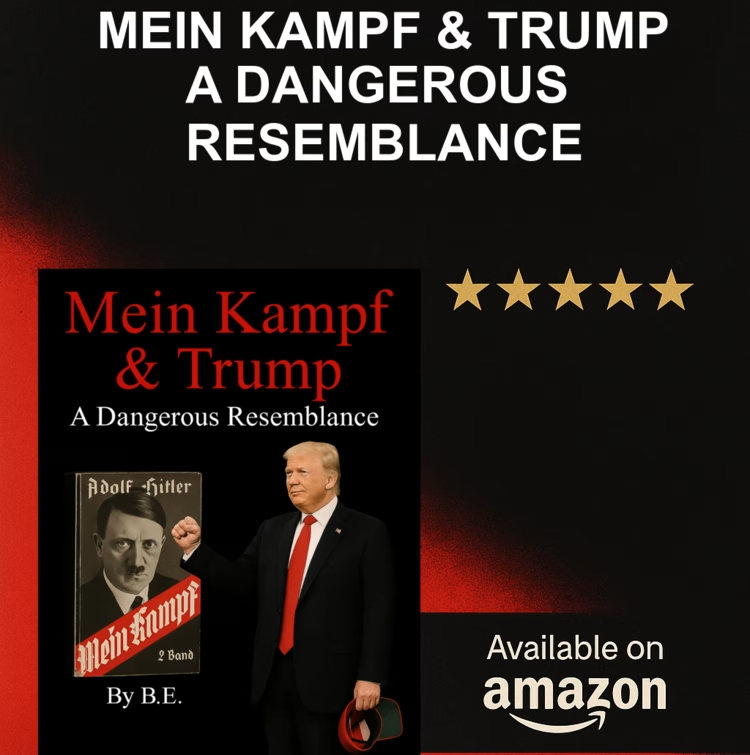
Mein Kampf & Trump — Available on Amazon
But even granting that argument, the question remains: where is the line between strategic ambiguity and reckless communication? When decisions carry consequences measured in lives, misjudgments—whether in tone or action—can have lasting effects.
At the center of it all is a simple, sobering reality. The authority vested in the U.S. presidency includes control over the most powerful military arsenal on Earth. That power demands not just decisiveness, but judgment, restraint, and an awareness of the human cost behind every decision.
In moments like this, the debate is no longer just about policy. It becomes a question of character—of whether the person making those decisions fully grasps the weight of what’s at stake.
#Trump, #DonaldTrump, #USPolitics, #MiddleEast, #War, #ForeignPolicy, #GlobalSecurity, #Geopolitics, #BreakingNews, #WorldNews, #Trump #IranWar #OvalOffice
Yahoo