

By Don Terry | Monday March 16 2026 | 8 min read
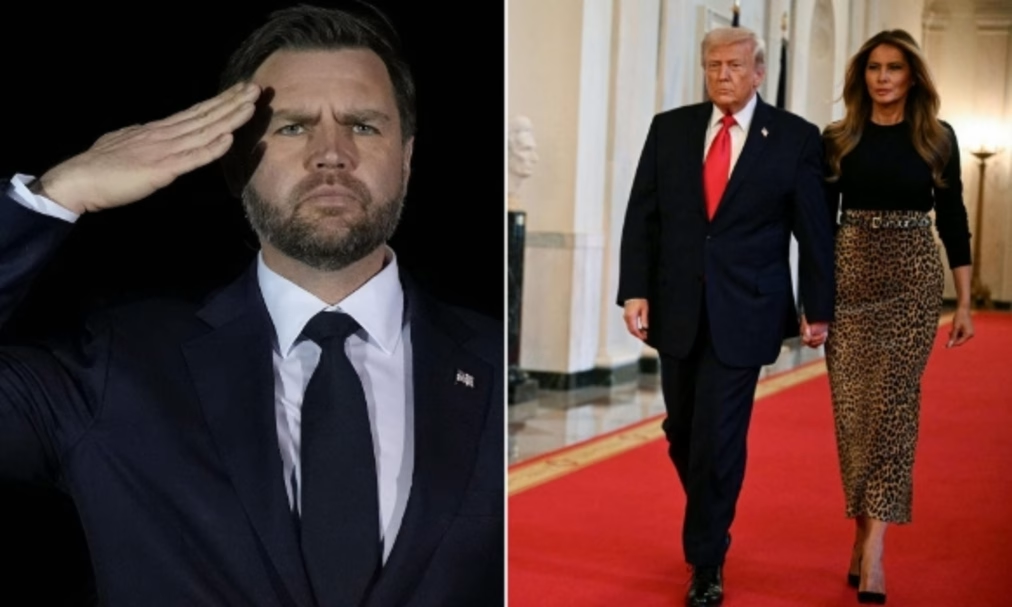
At 40, J.D. Vance became the first millennial vice president of the United States—a milestone that says as much about generational turnover as it does about the changing character of American conservatism. For some on the right, Vance represents a formidable intellectual force. Allies and admirers have described him as a future leader of the conservative movement, someone who blends cultural critique with political ambition. For critics, however, his rise raises a different question: what exactly does J.D. Vance believe now, and how did he get here?
That question matters because Vance’s political evolution has been unusually dramatic. In the early days of Donald Trump’s political ascent, Vance was not a supporter. During the 2016 campaign he cast himself as part of the Republican “Never Trump” faction, publicly considering protest votes and privately warning about what Trump’s leadership might mean for the country. Yet only a few years later he was campaigning alongside Trump, praising his presidency and aligning himself closely with the populist energy of the MAGA movement.
Political reinvention is hardly rare in Washington. Politicians recalibrate positions all the time, especially when the electorate shifts. But Vance’s transformation has been striking because it coincided with his own meteoric rise—from bestselling author to venture capitalist to senator, and ultimately to vice president.
Much of Vance’s early public identity came from his memoir, Hillbilly Elegy. Published during the turbulence of the 2016 election, the book told the story of his upbringing in Ohio and Kentucky: a childhood shaped by economic instability, a mother struggling with addiction, and the steady presence of a tough, protective grandmother. It resonated widely because it seemed to offer an insider’s explanation for the frustrations of the white working class during a period of intense political upheaval.
At the time, Vance often spoke in relatively measured tones about those frustrations. He acknowledged that economic grievances in struggling communities were real while also warning against the temptation to blame immigrants or cultural outsiders for complex economic changes. His commentary positioned him as a kind of translator between worlds—someone who could speak to both elite institutions and communities that felt ignored by them.
Over time, that voice shifted.
As Vance entered politics more directly, his rhetoric hardened and his alliances changed. His Senate campaign marked the point when he fully embraced the populist style of politics that had first propelled Trump. The campaign featured sharply worded messaging about immigration, cultural decline, and political elites—arguments that resonated strongly with a Republican base that had grown increasingly skeptical of traditional conservatism.
Behind the scenes, another figure played an important role in Vance’s rise: tech investor Peter Thiel. The Silicon Valley billionaire has long supported unconventional political candidates, and his financial backing helped propel Vance’s 2022 Senate campaign. Their relationship began when Thiel spoke at Yale while Vance was a student and evolved into a mentorship that Vance has repeatedly credited with shaping his career.
The influence of that relationship extends beyond campaign funding. Thiel is known for provocative critiques of modern democracy and for encouraging political thinkers who challenge established institutions. Critics worry that Vance’s proximity to those ideas reflects a broader shift within parts of the conservative movement—away from traditional small-government conservatism and toward a more confrontational, anti-establishment ideology.
Vance himself has embraced the role of provocateur at times. He has acknowledged using inflammatory remarks online or in speeches to provoke political opponents, framing it as a strategic way to challenge what he sees as media narratives or cultural orthodoxies. Supporters view this as a willingness to confront powerful institutions; critics see it as a form of trolling that fuels polarization.
That polarization appears most clearly in the issues Vance emphasizes. Immigration, demographic change, and family policy have become central themes in his political rhetoric. He frequently argues that American society is struggling because of declining birth rates, weakening family structures, and policies he believes prioritize newcomers over citizens. On immigration in particular, his language has often been blunt, describing the issue not just as an economic challenge but as a cultural one.
Another theme in Vance’s speeches is the importance of family life. He has argued that having children grounds people in responsibilities and traditions that strengthen society. Yet some of his comments—particularly criticisms of political leaders who do not have children—have drawn backlash for suggesting that childless adults are somehow disconnected from the nation’s future.
His policy positions on family issues also reflect a traditionalist approach. Vance has expressed skepticism about expanding federal childcare programs and has emphasized solutions rooted in extended family support. For supporters, this reflects a belief in community and family networks. For critics, it ignores the economic realities faced by many working families.
The same tension appears in his views on abortion and divorce. Vance has taken strongly anti-abortion positions and has questioned the cultural legacy of no-fault divorce, arguing that easier separations may have harmed family stability. Those stances align him with the most socially conservative wing of the Republican Party.
Yet despite the intensity of many of his views, Vance has also demonstrated an ability to present himself differently when the audience demands it. During major national appearances—such as televised debates—he has often adopted a calmer, more measured tone. Commentators from across the political spectrum have noted that when the spotlight is brightest, Vance can appear pragmatic and reasonable in ways that contrast with his more combative moments online or on the campaign trail.
Are Trump and Vance Beginning to Diverge on Iran?
Even Donald Trump has hinted that he and Vice President JD Vance don’t always see foreign policy the same way. In a recent remark, Trump said the two are “philosophically a little bit different” when it comes to the possibility of a U.S. war with Iran.
The comment came after reporting by ABC News that Vance had privately raised concerns about recent strikes carried out late last month. According to those reports, the vice president may be more cautious about escalating tensions with Iran than his public rhetoric sometimes suggests.
If true, it hints at a quieter debate unfolding behind the scenes. Publicly, Vance has often adopted the tough posture that dominates Washington’s foreign policy conversations. Privately, however, he may be weighing the risks of a deeper military confrontation and the long-term consequences of another conflict in the region.
That tension reflects a broader balancing act in Vance’s political identity. He has built much of his public image around being a populist voice—someone who speaks for working-class Americans and challenges the political and cultural elite. His message often emphasizes skepticism toward the foreign policy decisions that have led the United States into costly overseas conflicts.
At the same time, critics point out that his rise in politics has also been supported by influential donors and powerful ideological networks. Those connections add complexity to the populist narrative he presents to voters.
This contrast may ultimately shape how Vance’s political future unfolds. On one side is the image of a leader rooted in the frustrations and experiences of ordinary Americans. On the other is the reality of a career built partly within circles of wealth and influence.
Mein Kampf & Trump — Available on Amazon
As tensions with Iran continue to dominate headlines, those competing pressures could become harder to reconcile. Whether the differences between Trump and Vance grow into a meaningful policy divide—or remain just a matter of tone—may depend on how events in the region develop in the months ahead.
As the country looks toward future elections, the question surrounding J.D. Vance is not simply whether he will seek higher office. It is whether voters believe the measured debater, the online provocateur, or the memoirist who once tried to explain a divided America.
All three versions of Vance exist at once. The challenge for the public—and perhaps for Vance himself—is deciding which one truly defines him.