
By Tony Bruce & Ben Emos | Monday, July 06, 2026 | 5 min read
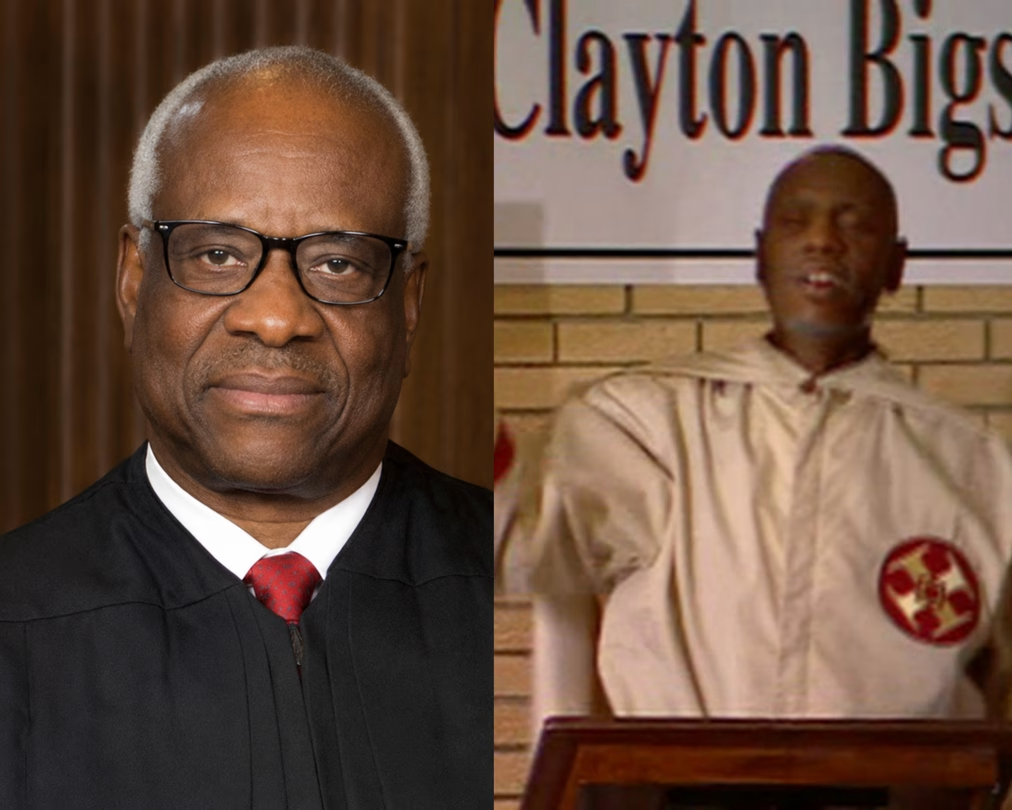
Dave Chappelle never intended Clayton Bigsby to be subtle. The sketch was designed as a cultural Molotov cocktail — a blind Black man who becomes a celebrated white supremacist because he literally cannot see who he is. It was meant to be absurd, shocking, and hilarious in the way only Chappelle can manage. But beneath the laughter was a razor‑sharp critique: the idea that ideology, once internalized, can make people act against their own identity with absolute conviction.
Two decades later, the Bigsby sketch has taken on a second life. Not because the joke changed, but because America did. And for many critics, the paradox Chappelle exposed — the collision between identity and ideology — feels eerily familiar when they look at the judicial record of Justice Clarence Thomas.
This comparison is allegorical, not literal. It’s not about mocking Thomas; it’s about interrogating a contradiction that has become impossible to ignore.
I. The Blindness of Satire — and the Blind Spots of Power
Clayton Bigsby’s blindness is the engine of the joke, but it’s also the metaphor that makes the sketch endure. Bigsby is raised in a segregated environment, told he is white, and absorbs the ideology around him without ever seeing himself. He becomes a bestselling author, a hero to racists, and a symbol of how prejudice is taught, not inherited. When his supporters discover he is Black, the shock is played for laughs — but the message is deadly serious. Racism is a learned blindness, a refusal to see reality even when it’s standing right in front of you.
Critics argue that Justice Thomas’s jurisprudence reflects a different kind of blindness — not literal, but ideological. Over the years, Thomas has built a judicial legacy that consistently aligns with conservative originalism, even when those decisions collide with the interests of many African‑Americans. His defenders call this principled. His critics call it paradoxical.
They point to case after case:
- In Students for Fair Admissions v. Harvard, Thomas defended ending race‑conscious admissions — a move civil rights groups say guts tools designed to counter historic discrimination.
- In Shelby County v. Holder, he supported striking down key parts of the Voting Rights Act, a decision voting‑rights advocates consider catastrophic.
- In Brnovich v. DNC, he joined the majority limiting challenges to voting restrictions under Section 2 of the VRA.
- In Allen v. Milligan, he dissented when the Court required Alabama to create another majority‑Black district.
- In Parents Involved v. Seattle Schools, he opposed voluntary integration plans, arguing the Constitution forbids race‑conscious school policies.
- In Trump v. CASA (2026), he supported restricting birthright citizenship — a position rejected by the majority and criticized by civil rights organizations.
Beyond race‑specific cases, Thomas has supported expansive gun rights, narrower civil rights interpretations, and skepticism toward disparate‑impact claims — positions critics argue disproportionately harm Black communities.
Thomas rejects all of this. He insists the Constitution is colorblind, that race‑conscious policies perpetuate stigma, and that courts should not engineer social policy. To him, these decisions are not anti‑Black; they are anti‑judicial activism.
To his critics, the pattern isn’t just unmistakable — it’s alarming. After issuing his opinion, he was seen walking down the halls of Congress, a moment some observers interpreted as him heading to strategize with Republican lawmakers on their next move.
II. The Bigsby Paradox: When Identity and Ideology Collide
The Clayton Bigsby comparison is not about race; it’s about contradiction. Bigsby is a Black man who becomes the face of white supremacy because he cannot see himself. Thomas is a Black justice whose decisions, critics argue, often undermine protections designed to support Black political representation, educational access, and civil rights.

Mein Kampf & Trump — Available on Amazon
The comparison is allegorical — a way to explore how ideology can override identity, how belief can eclipse community, and how power can reshape the meaning of representation. It’s not that Thomas resembles Bigsby; it’s that the paradox Chappelle exposed still exists in American life, and Thomas has become its most consequential real‑world example.
This is why the sketch still resonates. Chappelle wasn’t just mocking racism; he was exposing how people can internalize ideas that work against their own lived reality. He was showing how systems shape beliefs, how environments shape loyalties, and how blindness — literal or ideological — can lead people to defend positions that shock the communities they come from.
Thomas’s defenders say he is principled. His critics say he is contradictory. But both sides agree on one thing: his jurisprudence is not accidental. It is deliberate, consistent, and deeply rooted in a worldview that sees race‑conscious remedies as unconstitutional, no matter the historical context.
Satire Doesn’t Solve Contradictions — It Exposes Them
Chappelle’s Clayton Bigsby sketch remains one of the most fearless pieces of racial satire ever aired on American television. It was outrageous because racism is outrageous. It was absurd because prejudice is absurd. And it was unforgettable because it forced viewers to confront contradictions they would rather ignore.
The allegorical comparison to Justice Thomas is not about ridicule. It’s about using satire as a lens to examine the complexities of race, identity, and ideology in America. It’s about asking why representation sometimes fails to align with community interests. It’s about interrogating how power shapes belief — and how belief shapes justice.
Satire becomes reality not because the world is funny, but because the contradictions are real.
R.A.G.E. in 2028: Why Democrats May Turn to Jack Smith or Jon Ossoff to Reset American Politics
Jon Ossoff Declares ‘Day of R.A.G.E.,’ Warns Corruption Is Becoming America’s Defining Crisis
Netanyahu’s Grip on U.S. Politics Is Slipping as Pro‑Israel Candidates Falter in Primaries
When a False Narrative Becomes Policy: Trump, Truth Social, and the Reflecting Pool Meltdown