

By Don Terry & Ben Emos | Wednesday March 04 2026 | 6 min read
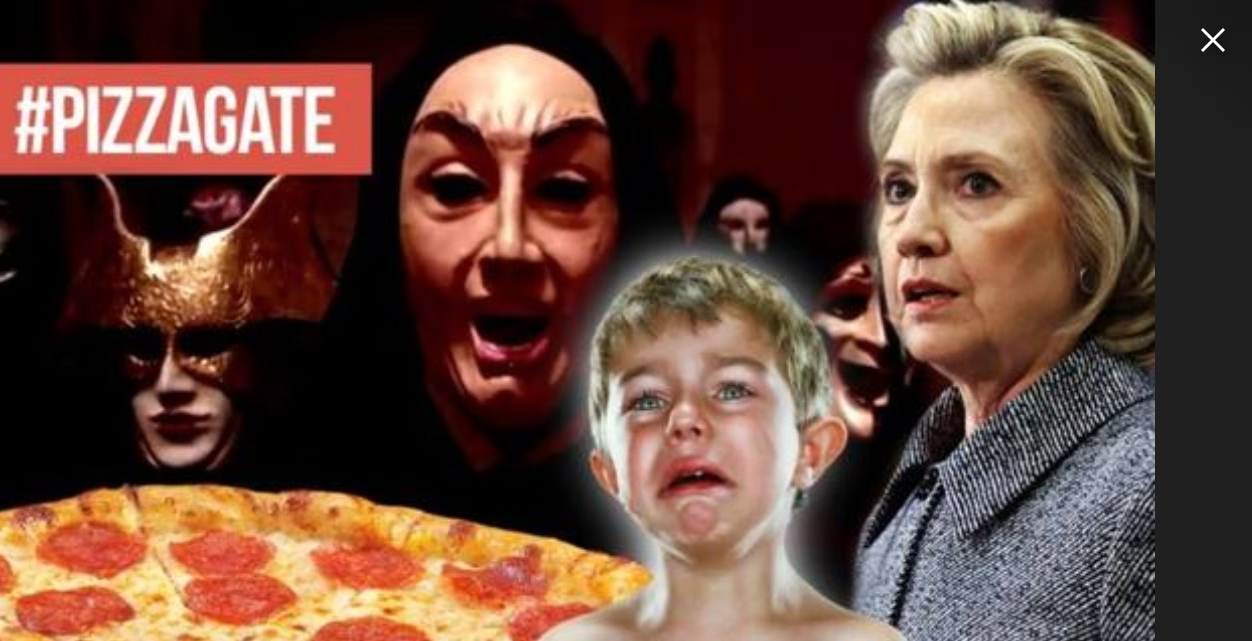
The strange afterlife of the Pizzagate conspiracy theory says as much about the digital age as it does about the political moment in which it was born. In late 2016, as the presidential race reached its most fevered pitch, a fringe theory claiming that coded emails revealed a child‑trafficking ring in a Washington, D.C. pizzeria spread across social media with astonishing speed. It was baseless, disproven, and ultimately dangerous — culminating in an armed man entering the restaurant to “investigate” a crime that never existed.
Years later, with the release of extensive documents related to the Jeffrey Epstein case, the public conversation has shifted. The Epstein files contain real victims, real crimes, and real networks of power. And in that contrast, some observers have begun to revisit the timing and intensity of Pizzagate’s rise. Not to revive the conspiracy, but to ask a different question: why did such an implausible story capture so much attention at the exact moment another, far more consequential story was quietly unfolding?
Pizzagate did not emerge from nowhere. Promoted by pro-Trump figures such as Alex Jones, Jack Posobiec, Lauren Boebert, Elon Musk and Marjorie Taylor Greene, the theory claimed that leaked emails from Clinton campaign chairman John Podesta revealed a Democratic-run child sex-trafficking ring operating out of a Washington, D.C., pizzeria. The accusation was not merely political mudslinging; it was monstrous. It named a real restaurant, with real employees, and transformed it into the imagined center of unspeakable crimes.
Meanwhile, the Epstein case — which involved wealthy, well‑connected individuals and allegations of long‑running abuse — remained largely in the background. Epstein had been a known figure in legal and journalistic circles for years, but his story did not explode into mainstream consciousness until much later. The contrast between a fabricated scandal dominating headlines and a real one simmering quietly has led some people to wonder whether the noise of one helped obscure the gravity of the other.
There’s no hard proof that Pizzagate was cooked up by Trump or anyone on his team as a calculated smokescreen ahead of the Epstein story before the 2016 elections — even though Trump’s own ties to Epstein would later come under scrutiny. No document, no recorded meeting, no insider confession has surfaced to show it was a master plan.
Intent and impact don’t always move together.
Still, it’s worth considering who might have seeded the Pizzagate narrative in the first place. The story was too detailed, too emotionally charged, and too perfectly calibrated to tap into public fears to have emerged entirely in a vacuum. Whoever amplified it clearly understood the power of stories about children in danger and elites operating in secret — the same fears that the Epstein scandal had already stirred in the public imagination.
They didn’t have to name Epstein directly; they just needed to evoke a world in which powerful figures exploit the vulnerable, in a way that felt urgent and real. In that sense, Pizzagate can be seen as a kind of shadow narrative: it borrowed the emotional architecture of Epstein’s crimes, transplanting it to a familiar, everyday location — a D.C. pizzeria — so that outrage could spread without ever directly touching the Epstein name or drawing attention to his real properties in New York, New Mexico and Virgin Islands.
Whether this was intentional strategy or simply opportunistic amplification, the effect was the same: attention, fear, and suspicion were directed away from more substantive lines of inquiry, leaving the public chasing a story that was almost entirely invented.
Conspiracy theories have a way of thriving in chaotic seasons. When trust in institutions is already frayed and news spreads faster than anyone can fact-check it, wild claims don’t just survive — they multiply. They offer something seductive: a clear villain, a dramatic plot, a sense that hidden knowledge is finally being exposed. In that atmosphere, complexity feels boring. Patience feels naïve.
Fear becomes a shortcut. Instead of wrestling with murky facts or waiting for investigations to unfold, people latch onto narratives that feel emotionally satisfying. The spectacle takes center stage, and substance slips quietly into the background. Whether by accident or design, that shift in focus can reshape an entire political conversation.
Did Pizzagate Distract From the Epstein Scandal in 2016?
The themes surrounding Pizzagate and the Epstein case — abuse, secrecy, and powerful social circles — are one reason the two are sometimes discussed in the same breath. In reality, though, they were very different. Pizzagate grew out of unverified claims aimed at political opponents, while the Epstein case involved documented crimes and real victims.
When the full scope of Jeffrey Epstein’s activities finally became widely known, it raised an uncomfortable question: how much public attention had been spent chasing rumors while a genuine criminal network operated in plain sight for years? It also invites speculation about how the political climate might have shifted if the Epstein story had exploded during the 2016 election cycle instead of allegations being directed at Hillary Clinton.

Mein Kampf & Trump — Available on Amazon
The topic hasn’t completely disappeared from political conversation. References to Pizzagate surfaced again in recent public remarks by Lauren Boebert, a reminder of how long certain narratives can linger. Even after investigators dismissed the original claims, the story continues to circulate in some corners of political culture.
That persistence says something about the nature of conspiracy narratives. Once they become part of a group’s shared story, they rarely fade away entirely. Instead, they tend to evolve, reappear, and attach themselves to new events over time.
In the end, the more revealing question may not be whether Pizzagate was designed to distract from Epstein at all. A more important issue is why so many people were ready to believe the story in the first place. Part of the answer lies in today’s fractured media landscape, where mistrust runs high and simple explanations — even unsupported ones — can spread quickly if they tap into existing fears or suspicions.
That pattern hasn’t gone away. If anything, it has become easier for the next viral claim to take hold before the facts have a chance to catch up.