
By Andrew James | Tuesday August 18 2026 | 4 min read
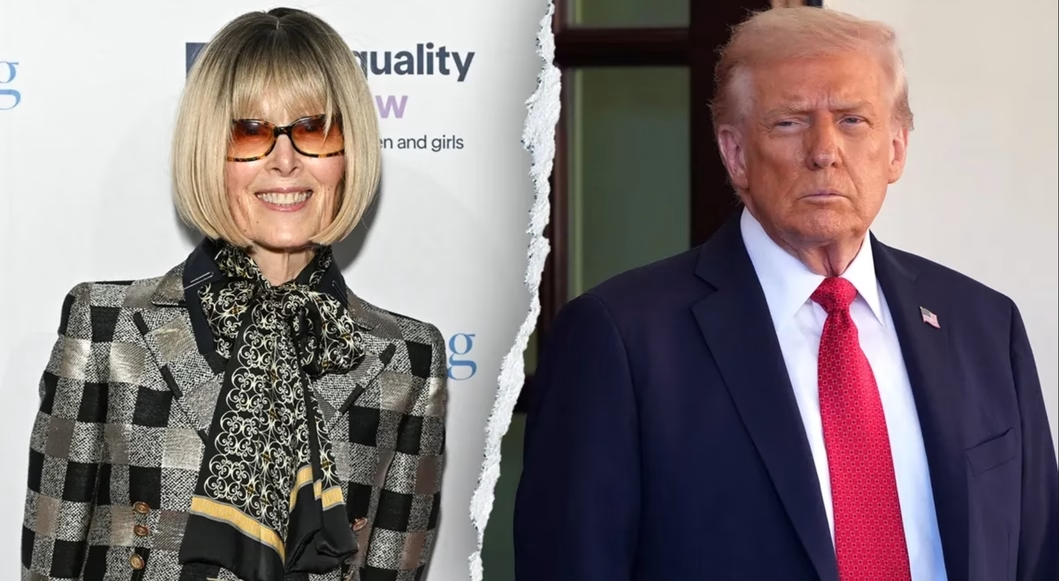
The Supreme Court’s refusal to revisit Donald Trump’s appeal in the E. Jean Carroll case marks yet another legal defeat in a saga that has stretched across years, headlines, and courtroom battles. The takeaway is blunt: Trump must pay the $5.6 million judgment, and no amount of legal maneuvering could convince the justices otherwise.
What makes this moment hit harder is not just the financial penalty. It’s the fact that the courts—after exhaustive litigation—have affirmed findings of sexual assault and defamation against a man who once dismissed Mexican immigrants as “rapists,” who has spent years attacking political rivals’ families, and who has built a public persona on the idea that consequences are for other people. The Supreme Court’s refusal to reopen the case is a reminder that even Trump’s trademark bravado can’t bend the judicial system to his will.
E. Jean Carroll, now 82, is not a political operative, not a partisan warrior, not a figure seeking relevance. She is a former magazine columnist who says she was raped in a Bergdorf Goodman fitting room in 1996. For decades, she carried the weight of that memory alone. When she finally spoke publicly, Trump responded with the familiar playbook: deny, demean, and destroy. He mocked her appearance, questioned her sanity, and insisted she was part of a conspiracy to smear him.
But courts don’t operate on cable‑news theatrics. They operate on evidence, testimony, and law. And in Trump’s case, the evidence was damning enough that multiple juries and judges reached the same conclusion: he lied about Carroll, and he harmed her.
Trump’s legal team tried to stretch the fight further, asking the Supreme Court to reconsider its June rejection of his appeal. The justices declined. No dissent. No ambiguity. Just a firm, final “no.”
This ruling lands in a broader context that Trump cannot escape. His name appears 38,000 times in the Epstein files, a staggering number that raises questions he has never meaningfully answered. His history with Stormy Daniels—another case involving allegations of sexual misconduct and hush money—continues to shadow him. And his habit of attacking opponents’ spouses, from El‑Sayed to Ted Cruz to Barack Obama, has long revealed a pattern: when cornered, Trump lashes out at the nearest target, often women.

Mein Kampf & Trump — Available on Amazon
The Carroll case breaks that pattern. He cannot insult his way out of a judgment. He cannot intimidate a jury. He cannot bully the Supreme Court. The legal system has drawn a line, and for once, Trump is on the wrong side of it with no escape hatch.
For Carroll, the ruling is more than a legal victory. It is vindication. It is proof that speaking up—despite the inevitable backlash—can lead to accountability. Her courage forced a reckoning that many believed would never come.
For Trump, the implications stretch far beyond the $5.6 million. This decision cements a narrative he has fought desperately to avoid: that the courts have found him responsible for sexual assault and defamation. That stain doesn’t wash off. It follows him into every interview, every rally, every future legal battle.
And for the country, the ruling is a reminder that institutions still matter. The Supreme Court’s refusal to reopen the case signals that even the most powerful figures cannot endlessly delay justice.
The DOJ Isn’t Just Broken — Trump Has Repurposed It Into His Own Enforcement Arm
Trump Slush Fund Standoff: The $1.8 Billion Heist Pushing Washington to the Brink