
By Don Terry | Thursday July 23 2026 | 5 min read
Spain woke up to a diplomatic slap in the face—one delivered not in a closed‑door meeting or a tense NATO session, but in front of the world. “Bad people,” Donald Trump said, sweeping an entire nation into a single insult. Not a rogue actor, not a hostile regime—Spain, a NATO ally. A country that has stood beside the United States in war, intelligence sharing, and counterterrorism. And yet, in Trump’s telling, Spain is “hopeless,” “a wasted cause,” and no longer worth doing business with.
Those words didn’t vanish into the ether. They lingered. They stung. And they set the stage for one of the most surreal public moments of Trump’s presidency.
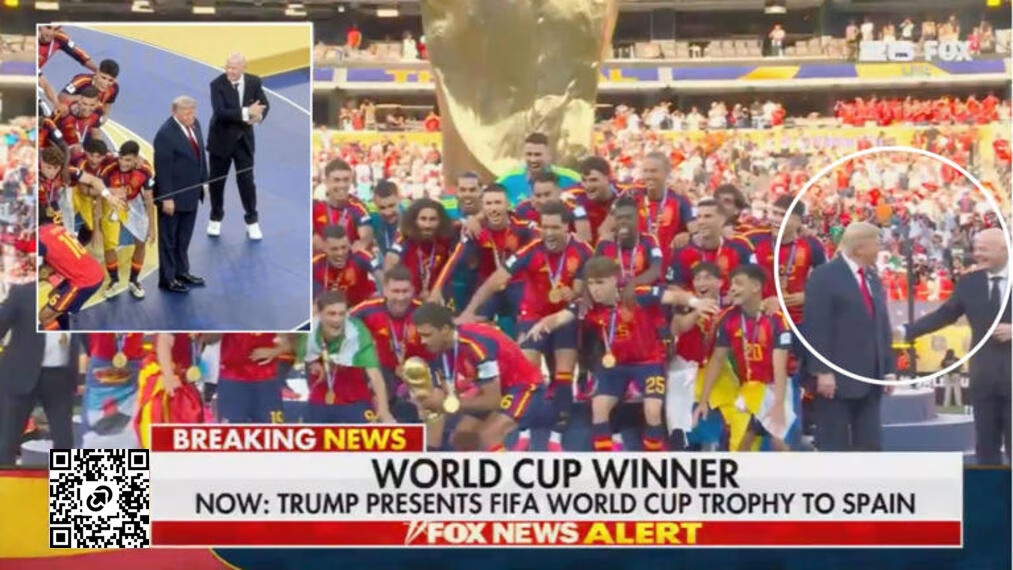
Just eleven days later, the same man who dismissed Spain as freeloaders and “bad people” appeared on the World Cup stage in front of the very nation he had demeaned. Spain had just won the biggest prize in global sports. It was their moment—earned, deserved, historic. Yet there was Trump, stepping into the spotlight, shaking hands, posing, refusing to leave the stage. It took FIFA president Gianni Infantino physically nudging him off to give Spain back the celebration that belonged to them.
The crowd’s reaction told its own story. According to reporters traveling with the White House, the boos reached 84 decibels—loud enough to drown out the stadium’s ambient noise. It wasn’t polite disapproval. It was a roar.
And it wasn’t just about the World Cup. It was about the pattern.
Trump had already inserted himself into FIFA business weeks earlier, calling Infantino after U.S. player Folarin Balogun received a red card and suspension. Trump insisted he didn’t pressure FIFA, but the suspension was later rescinded. Spain’s goalkeeper, Álvaro Morata Malagón, admitted the “outside noise” made the next match “difficult.” Trump’s interference never lands quietly. It spreads, it distorts, and it drags everyone around him into turbulence he insists on calling “concern.” This moment was no different. His involvement didn’t steady anything—it warped the atmosphere, pulled politics into a match that didn’t need it, and left players dealing with noise that had nothing to do with the game they were trying to play.
Then he pushed even further, crossing a line democratic leaders simply don’t cross. He publicly predicted the winner of the Spain‑Argentina match, handing the victory to Argentina because of his personal closeness to its president. It wasn’t analysis. It wasn’t diplomacy. It was Trump turning a global sporting event into another extension of his political orbit, injecting favoritism where neutrality is expected, and making the match about himself instead of the athletes on the field.
Infantino, for his part, has spent years accommodating Trump. FIFA rented space in Trump Tower. Infantino appeared with him repeatedly. The World Cup draw was moved to Washington at Trump’s urging. Infantino even handed Trump FIFA’s inaugural “peace prize,” a decision widely mocked by human rights advocates. It was a relationship built on flattery, proximity, and political convenience.
And what did Infantino get in return? A public spectacle. A stage‑hogging moment that forced him to physically push the President of the United States aside so Spain could celebrate its victory.
The symbolism couldn’t be clearer. Those who bend to Trump often end up cleaning up after him.
But the deeper concern isn’t the awkward shove or the boos echoing through the stadium. It’s the contradiction at the heart of Trump’s behavior. One moment he’s calling Spain “terrible partners,” accusing them of not paying their share, branding an entire nation “bad people.” The next, he’s trying to bask in their triumph, inserting himself into their celebration as if nothing happened.
For Spain, the insult was personal. For NATO, it was destabilizing. For the United States, it was embarrassing.
America’s president stood on the world stage—literally—at an event meant to honor athletic excellence and international unity. Instead, he became the story. Not for diplomacy. Not for leadership. But for being pushed off a stage he wouldn’t leave.
Spain deserved better. The United States deserved better. And the world deserved a moment free from political spectacle.
The World Cup wasn’t just a sporting event. It was a reminder of how quickly a single leader can turn celebration into discomfort, partnership into insult, and global respect into global bewilderment.
SpaceX Plunges 36% From Its Post‑IPO High — And the Real Freefall May Still Be Ahead
The Supreme Court Helped Create a More Violent Nation: Now They Want Safety Money
As Trump’s Iran War Drags On, He Revives His Debunked 2020 Narratives in Primetime Address