
By Tony Bruce | Saturday June 20 2026 | 5 min read
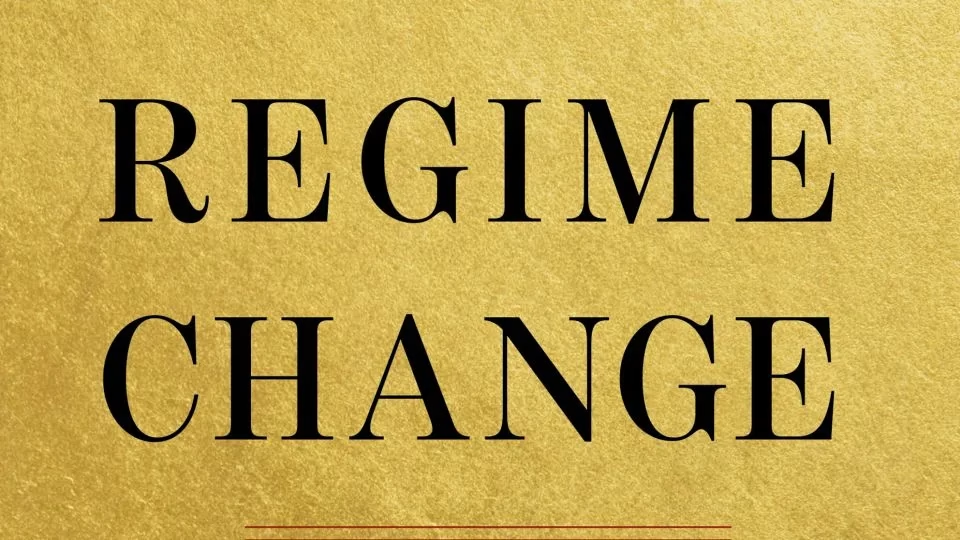
When Maggie Haberman and Jonathan Swan sat down with Donald Trump for their new book Regime Change, they may have unintentionally reinforced a theme that critics have been raising for years: Trump’s fascination with power itself.
One of the most striking anecdotes in the book centers on a document Trump proudly shared with the authors. According to Haberman and Swan, Trump was discussing his place in history when he produced a two-page paper that compared his power as president to some of history’s most infamous rulers, including Attila the Hun, Genghis Khan, Napoleon Bonaparte, Joseph Stalin, Mao Zedong, and Adolf Hitler.
The document argued that while those leaders inspired fear and exercised immense authority, their power was geographically limited. Trump’s power as President of the United States, the paper claimed, extended across the globe.
Trump reportedly recited the names himself and appeared pleased by the comparison.
For many readers, that moment alone may be among the most revealing passages in the book.
The irony is that Haberman and Swan later discovered the author of the document was not a respected historian, as Trump claimed publicly, but rather the longtime caddy and confidant of golf legend Gary Player. Yet the identity of the author may ultimately be less important than Trump’s apparent enthusiasm for the comparison itself.
The story arrives at a time when questions about Trump’s relationship with strongman leadership styles continue to dominate political debate.
Years before Regime Change was published, author Ben Emos explored similar concerns in his controversial book Mein Kampf & Trump: A Dangerous Resemblance. Drawing on reports that Trump’s former wife, Ivana Trump, once described her husband as keeping a copy of Adolf Hitler’s speeches near his bedside, Emos argued that certain aspects of Trump’s political rhetoric, personal grievances, and leadership style warranted closer examination.
At the time, critics dismissed such comparisons as exaggerated or politically motivated.
Now, however, Haberman and Swan’s reporting presents something different: Trump’s own willingness to discuss himself alongside some of history’s most feared rulers.
For Jewish communities in Israel and around the world, that revelation may be especially unsettling.
No serious observer is suggesting Trump is identical to Hitler, Stalin, or Mao. History is too complex, and such comparisons often generate more heat than light. Yet many people may reasonably ask why any American president would take pride in being measured against leaders whose names are synonymous with dictatorship, mass suffering, and authoritarian rule.
That question becomes even more significant when viewed through the broader portrait painted by Regime Change.
Throughout the book, Haberman and Swan describe a presidency increasingly unbound by traditional constraints. Based on more than 1,000 interviews conducted over three years, the authors depict a White House driven heavily by personal grievances, loyalty tests, and impulsive decision-making.
The examples are numerous.
Trump reportedly referred to Israeli Prime Minister Benjamin Netanyahu as a “con man,” one of the harshest insults in his personal vocabulary, before eventually supporting military action against Iran. He allegedly described his public confrontation with Ukrainian President Volodymyr Zelensky as “better than The Apprentice,” viewing a tense diplomatic clash through the lens of entertainment.
The book also recounts Trump berating Commerce Secretary Howard Lutnick with vulgar insults, discussing ways to “bust” Federal Reserve Chairman Jerome Powell, and directing aides to investigate perceived political enemies after struggling to remember their names.
Taken individually, these episodes may appear anecdotal. Taken together, they paint a picture of a leader who often treats immense governmental power as a deeply personal instrument.
Even seemingly trivial moments contribute to that image. Haberman and Swan describe Trump personally applying gold decorations to the Oval Office with a tube of superglue, reflecting a hands-on obsession with appearance and symbolism that mirrors his broader approach to politics.
The cumulative effect is striking.
Regime Change is not simply a book about policy decisions. It is a study of how Trump sees himself, his office, and his place in history.
That is why the document comparing him to Attila the Hun, Stalin, Mao, and Hitler matters.
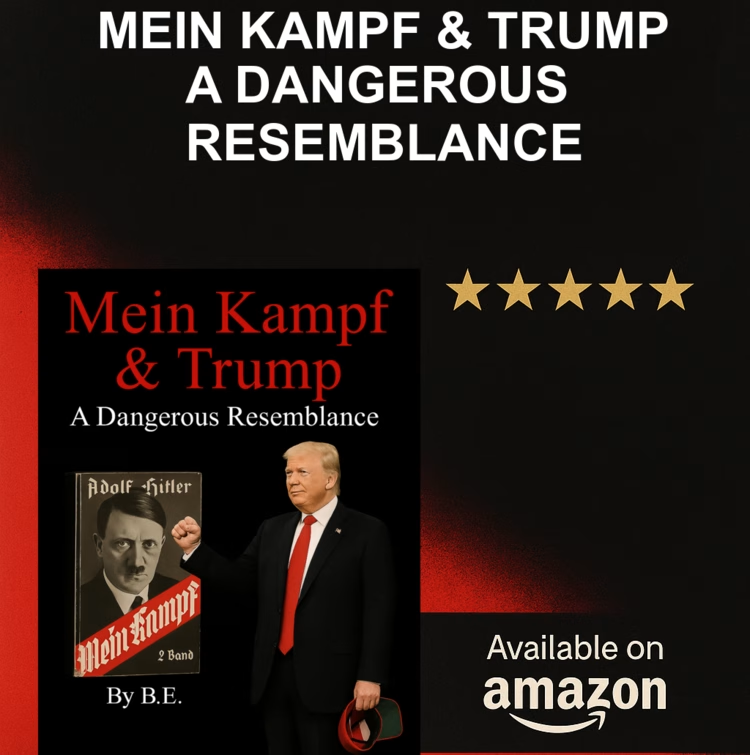
Mein Kampf & Trump — Available on Amazon
Whether readers view the comparison as harmless ego, historical ignorance, or something more troubling, the fact remains that Trump reportedly embraced it. He displayed it proudly. He repeated its arguments. And according to Haberman and Swan, he seemed genuinely persuaded by its central premise.
For critics such as Ben Emos, whose earlier work warned about dangerous parallels between Trump’s leadership style and authoritarian movements of the past, the revelations contained in Regime Change may feel less like a surprise and more like confirmation.
The debate over Trump has always extended beyond politics. It has often centered on power itself—how it is acquired, how it is exercised, and how leaders perceive their own place in history.
Haberman and Swan may not have set out to validate that argument. Yet their reporting offers a revealing glimpse into a president who appears increasingly comfortable measuring himself against some of history’s most notorious rulers—and finding the comparison flattering.
Trump’s Iran Deal Faces Criticism as Questions Mount Over the Outcome of the Conflict
Trump and Netanyahu Are Discovering They’ve Become Political Liabilities to Each Other
FIFA Boss Gianni Infantino Stood With Trump While the 2026 World Cup Shut Out the World
FIFA Boss Gianni Infantino Stood With Trump While the 2026 World Cup Shut Out the World
The Kennedy Center Just Dropped Trump’s Name — And the Message Is Unmistakable