
By Ben Emos | Friday May 22 2026 | 6 min read
For years, Elon Musk has sold a vision that felt just within reach: cars that drive themselves, a future already unfolding, a technological edge no rival could match. It was a powerful story—one that helped send Tesla soaring in value and turned Musk into something close to untouchable in the eyes of investors.
Along the way, the narrative only grew bigger. Musk leaned into the mythology—at times framing himself as a figure on the edge of becoming a self-made trillionaire. Much of the press went along with it, amplifying the ambition without always pressing on the details. The story was simply too good: a man building the future in real time.
But outside the stage lights, that story has been meeting resistance.
Regulators in Europe and China—markets not known for taking risks on unproven claims—have drawn a clearer line. What they’ve approved is not “self-driving” in the way the public understands it. It’s driver assistance. The driver must remain engaged, alert, and fully responsible. The car does not take over.
That distinction isn’t technical—it’s fundamental. And for years, it’s been blurred.
The gap between promise and reality is no longer abstract. It’s showing up in policy decisions, regulatory language, and increasingly, real-world behavior. At some point, the question stops being about innovation and starts becoming about representation: when does selling the future cross into overselling it?
Consider what happened recently in Texas.
A man drove his Tesla Cybertruck straight into a lake. Not by accident—he said he wanted to test “Wade Mode,” a feature described as allowing the vehicle to enter and move through bodies of water. By the time authorities arrived, the truck was already taking on water. It had to be pulled out by a rescue team. The driver now faces charges.
On paper, Tesla is covered. The manual clearly limits water depth and includes warnings. But that’s not what most people internalize. What sticks is the image—the suggestion of capability, the implication of confidence. In practice, perception often outruns fine print.
And that’s where the risk begins.
Consumers don’t read manuals the way they watch product launches. They don’t dissect disclaimers the way they remember bold claims. When a product is marketed as revolutionary, bulletproofed—almost limitless in its capabilities—people begin to treat it that way. They trust it further than they should.
This isn’t an isolated incident. It’s part of a pattern: bold claims first, clarifications later.
We’ve seen it with “Full Self-Driving,” a term that suggests autonomy but delivers supervised assistance. We’ve seen it in features that require constant human oversight but are framed in ways that hint at independence. The language leaves room for interpretation—and often, overconfidence fills the gap.
Even comparisons muddy the waters. Vehicles like the BYD YangWang U8 have demonstrated controlled flotation under specific conditions. The Cybertruck is not built for that. But in the minds of some consumers, those distinctions blur—and when they do, the consequences aren’t theoretical.
They’re real.
The harder question isn’t why one driver made a reckless choice. It’s why that choice felt reasonable in the first place. That kind of assumption doesn’t come out of nowhere. It’s shaped over time—by messaging, by repetition, by the steady build of belief.
And that belief has financial consequences too.
Tesla has never been valued purely on what it is today. Its worth has always leaned heavily on what it claims it will become. But when those promises keep shifting—reframed, delayed, or quietly corrected by regulators—the gap stops being technical and starts looking structural. Investors aren’t just buying into a product; they’re buying into a story.
And lately, that story is getting harder to reconcile with reality. Sales of Tesla cars have shown signs of strain globally, even with high-profile endorsements from figures like Donald Trump. Yet at the same time, a new narrative is being pushed forward: humanoid robots, branded as Optimus workers, positioned as the next trillion-dollar frontier.
In my book, Tesla Optimus Gen 2: Elon Musk’s $1 Trillion Army of Programmable Workers, I tried to step back from the hype and look at what this actually means. The focus wasn’t just on the technology, but on the pattern behind it. Elon Musk has consistently pushed toward autonomy—cars that drive themselves, rockets that land themselves, and now machines that could, in theory, replace human labor.
What’s striking isn’t just the ambition—it’s how quickly the conversation moves past the implications. When innovation accelerates faster than the guardrails around it, the line between progress and control starts to blur. What begins as a technological leap can quietly evolve into influence over the systems people rely on every day.
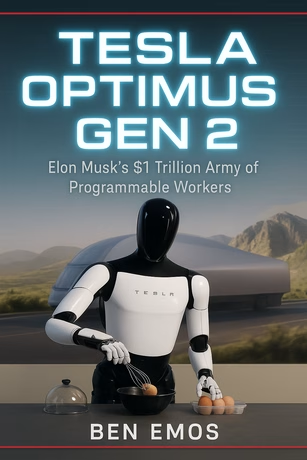
Optimus Gen 2 Tesla Army of Workers
That’s the part that doesn’t get enough attention.
Because the real question isn’t just whether these technologies will work. It’s who controls them—and how much trust we’re willing to place in that control.
At some point, the conversation has to move beyond possibility and into accountability. And when it does, a more uncomfortable question starts to take shape:
Would you trust Elon Musk—or anyone—with that kind of reach over the tools that could define how people live and work?
At some point, that narrative has to align with reality.
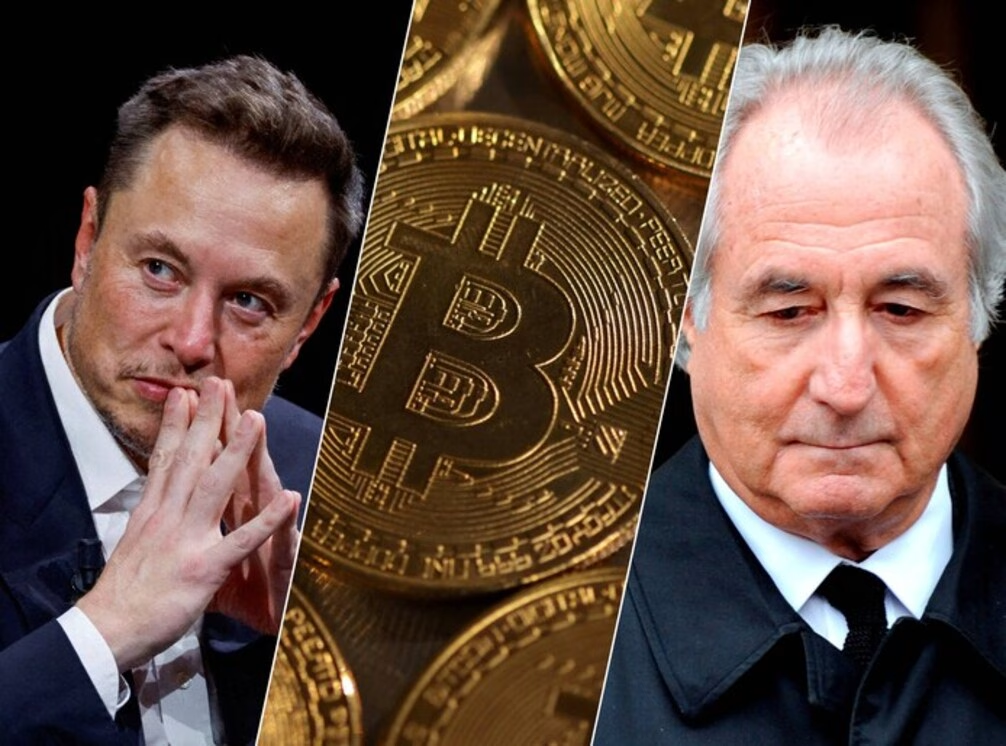
Because when it doesn’t, the fallout isn’t limited to branding. It becomes a question of safety, of trust, and potentially of accountability. The comparison to Bernie Madoff may sound extreme—but it reflects a growing unease: what happens when belief is sustained longer than the underlying reality can support?
The Texas incident may seem like an outlier. It isn’t. It’s a signal.
A signal that the distance between what’s promised and what exists is being tested—not in boardrooms or regulatory filings, but in the real world, by real people making real decisions.
And when that gap becomes too wide, belief alone isn’t enough to hold it together.
Trump’s $1.8 Billion DOJ Fund Looks Less Like Justice—and More Like Appeasement
Trading the Presidency: Did Trump’s Stock Buys Suspiciously Track His Presidential Actions?
Tesla Spins FSD Setback: Drops Autopilot in Netherlands, Cancels Denmark Purchase
How Democrats Could Win Despite GOP Gerrymandering and Trump’s Unpopularity