
By Don Terry | Friday May 22 2026 | 4 min read
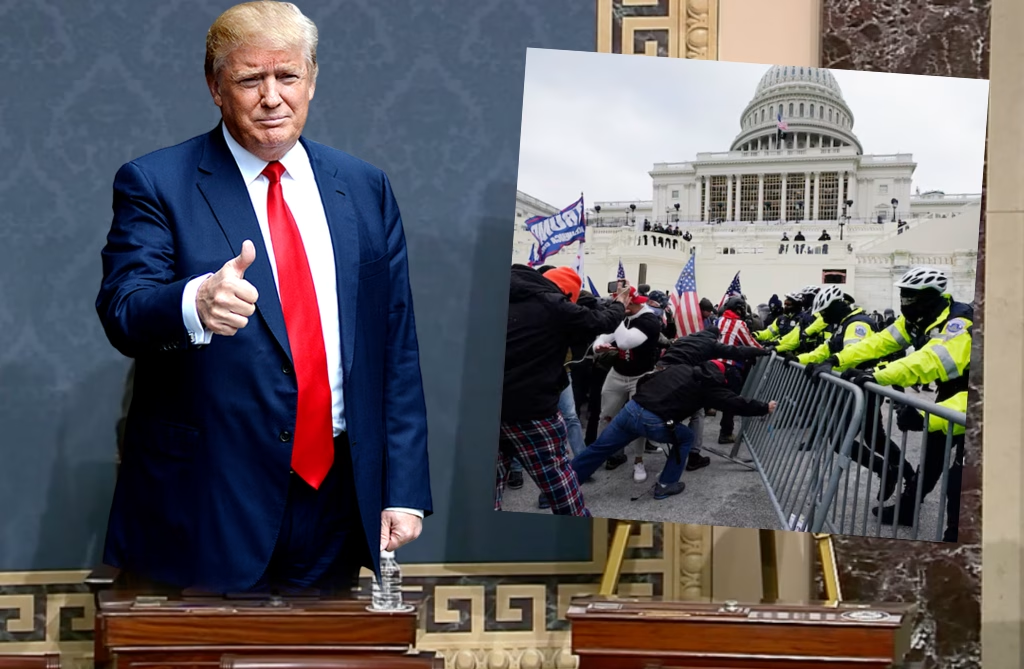
For years, the political instinct in Washington was to move on. After the chaos of the January 6 attack, many Republicans chose silence over confrontation, calculation over clarity. Even when Donald Trump issued pardons tied to that day, there was little appetite within his party to challenge him directly. The message was simple: don’t reopen old wounds.
But the creation of a $1.8 billion Justice Department fund has forced those questions back into the open—and this time, they’re harder to ignore.
At its core, the fund is being framed as a vehicle for fairness. A way to compensate those who say they were wronged by past investigations or prosecutions. That’s the official line. But outside the language of policy, critics see something else entirely: a mechanism that risks rewarding people connected to one of the most violent moments in modern American politics.
That’s where the controversy begins.
Because January 6 wasn’t abstract. It wasn’t a debate on cable news or a talking point on social media. It was a day when police officers were beaten, overrun, and left to defend the Capitol against a mob. Some were seriously injured. Others carried the physical and emotional toll long after the headlines faded.
And yet, as this fund takes shape, those officers are largely absent from the conversation.
That absence is becoming harder to defend—even among Republicans who once stood firmly behind Trump. Quietly, and sometimes reluctantly, some are beginning to shift their tone. Where there was once silence, there are now careful statements about the need to support law enforcement, about the sacrifices officers made that day, about the line between protest and violence.
It’s a notable change. Not a full break, but a recognition that the ground has shifted.
The Justice Department insists the fund is about fairness. But fairness without clear rules is difficult to measure—and even harder to trust. Who qualifies? On what basis? Who decides? Those questions remain unanswered.

Mein Kampf & Trump — Available on Amazon
And fairness that overlooks the officers who were injured—or worse—starts to feel less like justice and more like selective memory.
That’s where the argument breaks down. Because the moment you fully recognize and compensate those officers, you’re also forced to confront what January 6 actually was—something many are still reluctant to acknowledge plainly.
For some, that’s a reality still being resisted.
This is what makes the fund so politically charged. It doesn’t just raise questions about money. It forces a confrontation with the past—one that many in Washington had hoped to avoid. You can’t separate the two. Not anymore.
Trying to hold both positions at once is becoming increasingly difficult.
In the end, this isn’t just about a number—$1.8 billion. It’s about what that money represents, and what it says about accountability. If the goal is truly fairness, then it has to apply across the board. It has to include those who were harmed, not just those who claim they were wronged.
Until that happens—until the rules are clear, the oversight is visible, and the priorities are balanced—the fund will carry a credibility problem it won’t easily shake.
Because right now, it doesn’t read like justice—it reads like something else entirely: a slush fund.
Trump’s $1.8 Billion DOJ Fund Looks Less Like Justice—and More Like Appeasement
Trading the Presidency: Did Trump’s Stock Buys Suspiciously Track His Presidential Actions?
Tesla Spins FSD Setback: Drops Autopilot in Netherlands, Cancels Denmark Purchase
How Democrats Could Win Despite GOP Gerrymandering and Trump’s Unpopularity