

By Don Terry | Thursday March 12 2026 | 6 min read
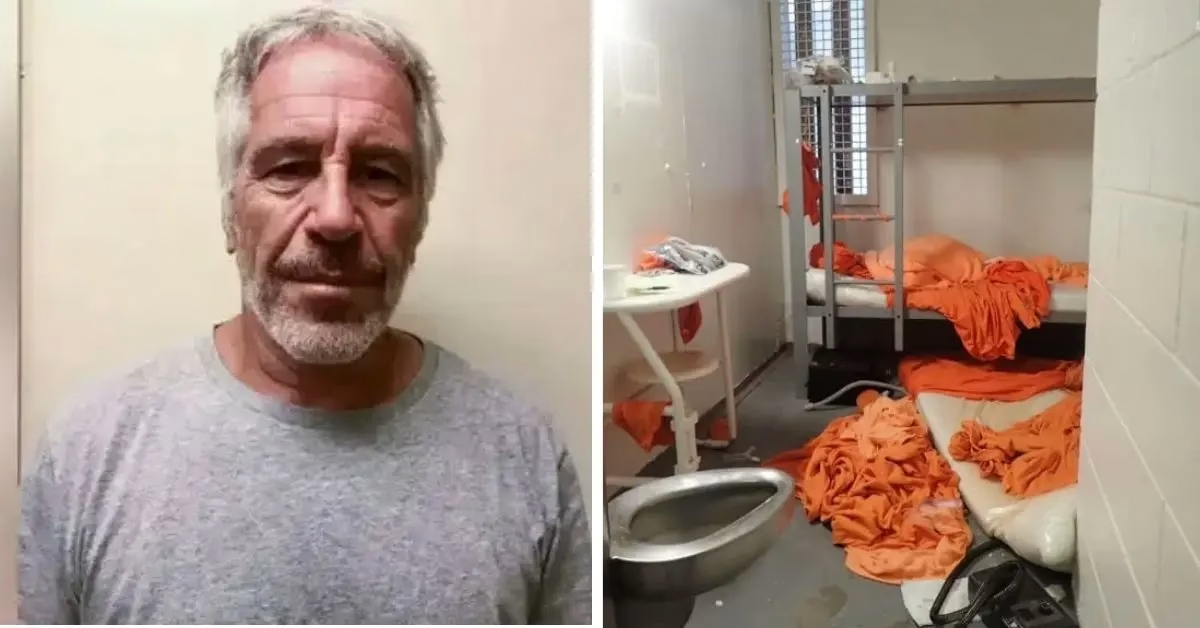
Newly released files and surveillance footage connected to Jeffrey Epstein’s death are raising fresh questions about the government’s investigation. Documents reveal discrepancies in how prison video evidence was described, including a “flash of orange” seen near Epstein’s cell. While officials ruled his death a suicide, the new details highlight prison security failures and continue to fuel debate about what happened the night he died.
For years, most public discussion around the Epstein case has focused on his crimes and the powerful figures connected to him. But the new disclosures shift attention back to the circumstances of his death while in federal custody—an event that has long fueled speculation, confusion, and distrust.
Epstein was first arrested in July 2019 and placed in a federal detention facility in New York. Early in his time there, he reported that a cellmate had tried to kill him. Prison staff even found him with what appeared to be a makeshift noose fashioned from prison clothing around his neck. The incident raised alarms and led to Epstein being placed on suicide watch.
Yet the situation quickly became complicated. The cellmate denied any attack, and Epstein later appeared to change parts of his story. Despite the uncertainty, the incident was serious enough that officials kept him under observation—at least for a time. Days before his death, however, Epstein was taken off suicide watch.
Around that same period, Epstein signed a new will. Because meetings with attorneys are confidential, prison officials did not learn about the document until afterward. While legal experts often consider such decisions when examining a person’s state of mind, a will alone does not determine whether a death was suicide or something else. In what investigators call a “psychological autopsy,” actions like these are just one piece of a much larger puzzle.
On August 10, 2019, Epstein was found dead in his cell. Authorities ruled the death a suicide. But problems with the prison’s procedures quickly came to light. Guards reportedly failed to perform regular inmate checks, and required head counts were missed. Two correctional officers were eventually charged with falsifying records, though those charges were later dropped.
At the time, then–Attorney General Bill Barr described the circumstances as a “perfect storm” of failures inside the jail. Barr also said he had personally reviewed available surveillance footage and believed no one had entered Epstein’s cell.
If that conclusion were backed by clear video evidence, the case would be straightforward. But one of the most troubling issues surrounding the investigation was the failure of several security cameras. Some recordings that might have shown activity near Epstein’s cell simply did not exist due to technical problems.
Did the Epstein Jail Video Capture an Inmate Instead of an Officer?
Years later, further scrutiny came through reports issued during the tenure of Merrick Garland. A Justice Department watchdog reviewed the case and maintained the official finding of suicide. The report stated that a blurred image appearing on an exterior camera seemed to show a corrections officer passing through the area.
However, newly released documents suggest the initial interpretation may not have been so clear. Early notes from the Federal Bureau of Investigation reportedly described the image differently—as a brief “flash of orange.” In federal prisons, inmates typically wear orange clothing, while correctional officers do not.
That distinction has become one of the most debated details in the newly released files. If the image captured someone wearing orange, it could suggest an inmate was present in the area—despite lockdown procedures that should have kept prisoners confined to their cells.
Independent analysts who reviewed the footage have also said the figure appears more consistent with an inmate uniform than a staff member’s attire. Even so, that observation alone does not establish foul play. At most, it raises questions about whether prison rules were being followed that night.
The broader picture remains murky. Only one camera covering a nearby common area was functioning, and there was no footage from a camera positioned directly down the hallway leading to Epstein’s cell. Moments after he was discovered, video shows staff rushing around the tier in what appears to be a chaotic response to an unexpected emergency.
Another troubling detail is timing. Federal investigators did not arrive at the facility until several hours later. By then, Epstein’s body had been removed and the scene inside the cell had already been disturbed.
Supporters of the official conclusion argue that the evidence still points to suicide. Critics say the chain of mistakes, missing recordings, and shifting descriptions in official reports warrant deeper investigation.
The newly released records still stop short of providing a clear answer about what truly happened that night. Instead, they paint a picture of missed procedures, conflicting details, and lingering gaps in the story—issues that continue to cast doubt over the official account.
What new evidence was revealed in the Epstein jail video?
Documents made public more recently reference a brief “flash of orange” appearing in surveillance footage near Epstein’s cell. Because inmates in federal facilities typically wear orange uniforms, the image has raised questions about whether the figure seen on camera may have been a prisoner rather than a corrections officer.
Was Jeffrey Epstein’s death officially ruled a suicide?
Yes. Federal investigators concluded that Epstein died by suicide while in custody. Even so, the unusual circumstances surrounding his death have kept the case in the spotlight and continue to spark debate about whether the investigation answered every question.
Why is the Epstein jail footage controversial?
Part of the controversy stems from how the video was described in official reports. Early FBI notes reportedly referenced the “flash of orange,” while later summaries suggested the figure was likely a corrections officer. That difference in wording has led some observers to question how the footage was interpreted.
Why were some prison cameras not working?
Investigators later discovered that several surveillance cameras near Epstein’s housing area had malfunctioned or failed to record. As a result, key angles that might have provided clearer evidence were never captured, leaving investigators with an incomplete record of what happened.

Mein Kampf & Trump — Available on Amazon
Epstein’s life was marked by secrecy, influence, and criminal wrongdoing. In death, the uncertainty surrounding his final hours has only added to the intrigue. For many observers, the unresolved questions point to the need for a deeper, fully independent investigation—one with the authority and access necessary to examine every remaining piece of evidence.