

By Don Terry | Wednesday March 25 2026 | 4 min read
There’s a familiar tension running through today’s Republican Party—one that feels almost like a scene from a fairy tale shaped in large part by Donald Trump. Everyone can see what’s happening, but few are willing to say it out loud. The story of the emperor with no clothes comes to mind, except in this version, no one in power seems ready to speak up.
At the center of it all is Donald Trump, still clinging to a political message rooted in the idea that the 2020 election was stolen. Years later, that claim continues to shape the party’s direction. The problem isn’t just that the claim has been widely rejected by courts, officials, and even members of his own administration—it’s that it has become a kind of litmus test within the party itself.
Imagine being a Republican member of Congress today. Would you publicly state that Joe Biden won the 2020 election fairly? For many, the answer appears to be no—not because they don’t know the truth, but because the political cost of saying it out loud is simply too high.
Has Trump Ever Used Mail-In Voting?
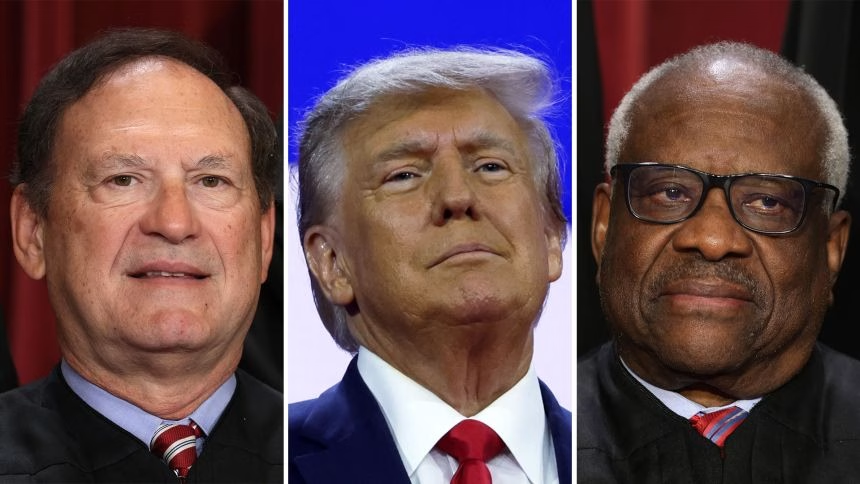
Instead, the task of facing that reality seems to be slipping away from Republican lawmakers and landing elsewhere—most visibly in the courts. The Supreme Court of the United States has become a place where familiar arguments about voting and election integrity keep resurfacing. In a recent case centered on mail-in ballots, some of the questions from the justices echoed concerns long promoted by Donald Trump and his allies—even though Trump himself has made use of mail voting, including in more recent elections tied to his home base in Florida. Whether deliberate or not, it had the effect of giving fresh momentum to claims that many in the party still seem reluctant to challenge directly.
Meanwhile, Republican lawmakers are making choices that reflect this pressure. John Cornyn, for instance, has shifted positions in ways that suggest alignment with Trump’s priorities—even when it means abandoning previously held views. It’s a pattern that speaks less to ideological evolution and more to political survival.
But here’s where things get complicated. The policies emerging from this dynamic—particularly around voting—may end up hurting the very voters Republicans have traditionally relied on. Restrictions on mail-in ballots, for example, could disproportionately affect older voters, rural communities, and others who have historically leaned Republican. It’s a paradox: in trying to reshape the system, the party may be narrowing its own path to victory.
At the same time, broader strategies meant to secure long-term advantage—like aggressive redistricting—are triggering backlash. When Republican-led states redraw maps to favor their candidates, Democratic-led states respond in kind. The result isn’t dominance, but escalation. In places like California and Virginia, those countermeasures could shift the balance in ways that ultimately benefit Democrats.
There’s also the question of tone and messaging. Trump’s rhetoric has grown more combative, more focused on grievances than forward-looking ideas. While that may energize his base, it risks alienating independent voters—the very group that often decides national elections. Polls have shown growing unease among these voters, particularly when it comes to prolonged conflicts and a sense of political instability.
All of this adds up to something political strategists sometimes call “boomerang politics.” Actions taken to secure an advantage in the short term end up circling back with unintended consequences. We’ve seen it before. In Georgia, Trump’s attacks on the election system contributed to lower turnout among his own supporters in key Senate races—costing Republicans control of the chamber.

Mein Kampf & Trump — Available on Amazon
Now, similar dynamics may be unfolding on a larger scale.
If things keep moving in this direction, it’s not a stretch to see Democrats taking back both chambers of Congress. Leaders like Hakeem Jeffries and Chuck Schumer could soon have the numbers to push forward a far-reaching agenda. Ideas that once felt politically out of reach—on healthcare, wages, Supreme Court reform, and taxes—might suddenly move from talking points to actual legislation.
And if that happens, the irony will be hard to miss.
Because the path to that outcome may not run through Democratic strategy alone. It may run through a Republican Party unwilling to challenge its most dominant voice, and a political environment shaped in part by legal battles that keep old grievances alive.
In the end, the emperor may still be walking—but the consequences of staying silent are becoming harder to ignore.
#Trump, #DonaldTrump, #SupremeCourt, #USPolitics, #ElectionIntegrity, #MailInVoting, #Congress, #Democrats, #Republicans, #PoliticalAnalysis
Yah