

By Ben Emos | Friday, March 27, 2025 | 5 min read
There’s an old rule in geopolitics: never give your adversary leverage you don’t fully understand. And yet, in the middle of a volatile conflict, that may be exactly what Donald Trump has done—only not through military strategy, but through messaging.
In recent days, a pattern has begun to emerge, one that traders, analysts, and foreign governments alike are starting to notice. When Trump publicly suggests that Iran is close to surrendering or eager to negotiate, markets respond almost instantly. Stocks rally. Oil stabilizes. There’s a sense, however brief, that the crisis might be nearing some kind of resolution.
Then comes the response from Tehran.
Iranian officials quickly push back, denying any such talks or desperation. The tone shifts. Markets fall again. Oil prices spike. Uncertainty returns.
It’s a cycle that has repeated enough times to raise an uncomfortable question: has the U.S. president, perhaps unintentionally, created a feedback loop that allows Iran to influence market behavior simply by responding to his words?
That possibility would have been unthinkable in previous administrations. Messaging during wartime has always been tightly controlled, carefully calibrated to avoid giving away signals—intentional or otherwise. But this moment feels different. Less controlled. More reactive.
And more revealing.
At one point, with a war underway, Trump was asked about his approach to the conflict. His answer was striking in its bluntness: “I don’t care.” Whether taken literally or not, it reinforced a broader perception that the administration’s strategy is being shaped on the fly, rather than guided by a clear, consistent plan.
The markets seem to sense that.
According to recent reporting, the S&P 500 has slipped into a sustained downturn, posting consecutive weeks of losses. At the same time, global oil prices—particularly Brent crude—have surged, reflecting fears of prolonged instability in the region. These are not abstract indicators. They translate directly into higher fuel costs, rising prices for goods, and growing anxiety for consumers.
What’s driving those movements isn’t just the war itself. It’s the uncertainty surrounding it.
Military analysts have pointed out that troop deployments so far remain limited—far below what would be required for any decisive outcome in a country as large and complex as Iran. That suggests a conflict that is neither fully escalated nor clearly winding down. A kind of strategic limbo.
In that vacuum, words matter more.
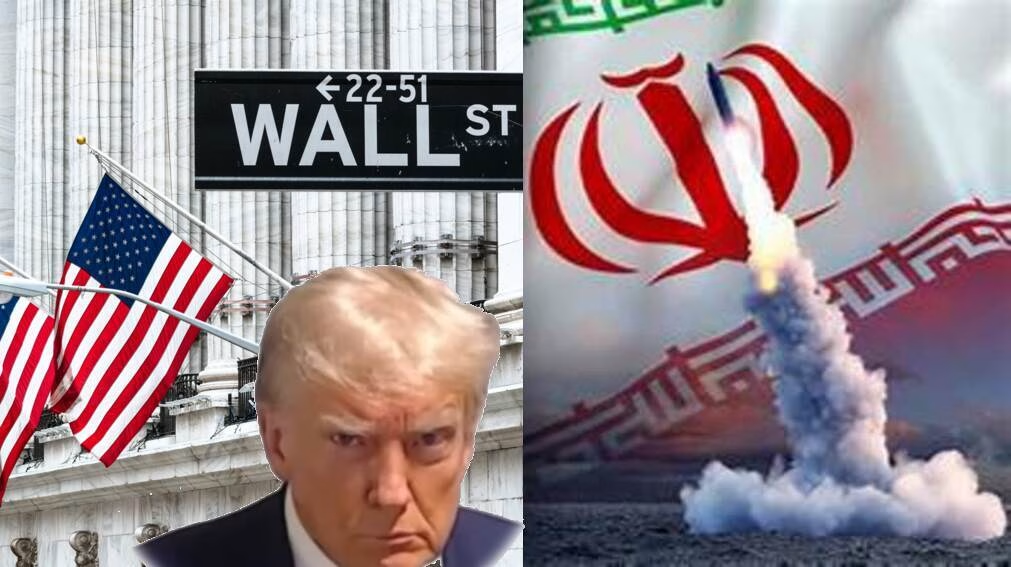
Has Trump Handed Iran Control of the Stock Market?
Every statement from Washington is parsed not just for meaning, but for signals. Is there a deal coming? Is escalation imminent? Or is this simply another shift in tone? Markets react to those signals in real time, often within minutes.
And now, so does Iran.
By responding quickly and publicly to Trump’s claims, Iranian officials are effectively shaping the narrative—and, by extension, the market reaction. It’s not that they control the market outright. But they’ve learned how to influence the emotional rhythm of it, pushing back at precisely the moments when optimism begins to take hold.
That’s a form of leverage. And it’s one that doesn’t require troops or missiles—just timing.
Back home, the political fallout is beginning to build. Polls show growing skepticism among Americans about how the conflict is being handled. Rising gas prices are making the situation tangible in everyday life, while economic volatility adds another layer of concern.
Even within Washington, there are signs of strain. Policy disputes, funding battles, and shifting priorities all contribute to a sense that the administration is juggling multiple crises at once—without a clear hierarchy or roadmap.
For foreign observers, including Iran, that uncertainty is telling.
They are watching not just what the United States does, but how it reacts under pressure. How quickly it changes course. How strongly it sticks to its own messaging. And what they’re seeing, critics argue, is a pattern of bold statements followed by recalibration.
That pattern creates openings.
It allows adversaries to anticipate reactions, to test boundaries, and—perhaps most importantly—to insert themselves into the cycle of cause and effect. In this case, even into the behavior of global markets.
Mein Kampf & Trump — Available on Amazon
None of this means that Iran has suddenly gained the upper hand in a traditional sense. But influence doesn’t always come from strength alone. Sometimes, it comes from understanding your opponent better than they understand themselves.
And right now, the question isn’t just what the next move in this conflict will be.
So the question is no longer just about who is shaping the narrative—but who is gaining leverage from it. Iran already sits astride the Strait of Hormuz, a chokepoint through which roughly 20% of the world’s oil flows , giving it enormous influence over global energy markets. Now, by simply countering Trump’s shifting claims in real time, it appears to be finding a new kind of leverage—one that ripples through markets far beyond the battlefield.
#StockMarket, #MarketVolatility, #WallStreet, #OilPrices, #Geopolitics, #EconomicCrisis, #GlobalMarkets, #USIran
Y